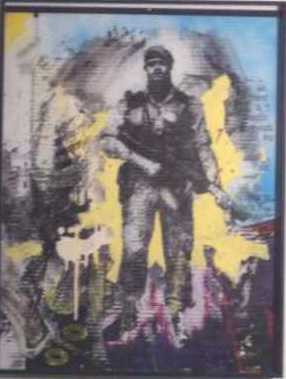
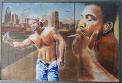
It is difficult to pinpoint why the Quebecois Gay artist Yvon Goulet (born 1956) is virtually unknown in the U.S. Perhaps it is his distinctly intellectual approach to his subject matter or his decidedly Canadian slant on Gay themes--intertwining language, image, and medium; as well as frequent allusions to people, events, and situations specific to Montreal and Quebec. One thing is certain, it is not due to a lack of quality. To my mind, his work is definitely cutting edge, and not only among Gay artists. Each time I visit his studio, or galleries where he exhibits (all too rarely) his work, I'm amazed by his imagination, and skill. Yvon Goulet's favorite medium is recycled corrugated advertising board, on which he superimposes images derived from photographs, frequently assembled in a collage like manner. Once the basic theme has been established, it is manipulated or enhanced through a variety of techniques, including wood cuts, lithography, etching, silk skreen technology, or the more or less focused superimposition of paint to underscore the mood of the piece. Media into which he has delved more recently include plexiglass, which constitues yet another variant of the multidimensionalism typical of his work, as the medium opens up the painting to reveal the world behind his world. While clearly influenced by Andy Wharhol, his art has an edginess all of its own, that pushes beyond Warhol's criticism of modern commercialism and the effects of mass production, to explore the stereotypes, psychology, iconography, and anthropological roots of Gay existence in our society. It is no surprise that a recent self-portrait echoes images of Che Guevara. His themes predominantly intertwine the local geography of Montreal with subject matter of a more or less explicitly erotic nature, particularly focusing on the Gay scene of that city. At the same time, Yvon's paintings explore the possibilities and limitations of the medium of his choice. In fact, the material itself regularly becomes part of the theme, or is used as a springboard to add an additional dimension to the image, such as when the text on recycled posters is allowed to come through as if revealing a hidden message. The multi-dimensionality of the image is frequently increased through the xerographic imposition of text fragments, the relevance of which is left to the viewer more fully to explore. An excellent example of Yvon's multi-layered technique is the picture of a soldier, depicted as if standing in mid-air, an effect that is enhanced by the surrounding splashes of color. However, upon closer inspection, the figure seems to be positioned in the middle of the Rue Ste. Catherine, the heart of Montreal's 'Gay ghetto', identified by the vaguely visible photographic images of several of the architecturally unique buildings located along that street, notably a high rise and a bank. That it should be a bank that is depicted seems to suggest an underlying economic theme to the painting, a possibility that is enhanced through the percent sign visible at the bottom of the picture, and the barely legible snippets of text. The image of the soldier itself combines elements of the erotic (suggested by the clear outline of his penis) and violent (the submachine gun apparently held at the ready), leaving it open to the viewer to interpret whether the source of the emotions raised is a paramilitary fantasy or the result of the picture's reference to the political tension inherent in the relationship between the Gay community and society at large, whereby the soldier is there to guard the economic lynchpin that is critical to society's tolerance of the inherently subversive Gay lifestyle. Erotic tension of a very different kind is conveyed through a painting I refer to as the "Hitchhiker", which however has the more enigmatic title of "Memory of a certain 4th of April, always raising the miserable problem of living over the border." (Click on the thumbnail for a larger image of the painting, which measures 6'x4' in the original.) The first version of this painting I saw posed the hitchhiker alone against a blue background, focusing solely on the erotic beauty of the young man, in his invitingly unzipped jeans. However, the hitchhiker is given a totally different meaning in this second painting, in which one sees the young man against the backdrop of Montreal, specifically on a bridge leading into the city. The story told by the picture gains additional complexity through the profile of the smoking male introduced at the right. That this figure is given a superhuman dimension gives the impression that he is imaginary rather than being an observer of the scene. Could he be the young man's reason for wanting to head for the city? Such an interpretation seems to be made all the more plausible by the man's pose -- smoking a cigarette, as if to pass away the time waiting in expectation of a "scene" -- and by the fact that he appears to be at least partially nude. At the same time Yvon has integrated this male with the city itself, by continuing to trace the outlines of the buildings of the cityscape across his body. I suggest that this integration of city and figure opens the possibility that rather than depicting a specific person such as the hitchhiker's lover, this figure might be just an anonymous representative of the city's Gay population, a trick or an anonymous hustler? Again, Yvon has chosen to paint over the side of the cardboard that has been previously used, simply taping over the holes with which it was affixed to a wall and subtly leaving a few fragments of words exposed that appear to refer to one of the Quebequois political parties. A 'humorous' extension of this integration of different layers of reality is caused by the fact that once framed and hung in my home, the picture now reflects the closed louver doors of my bedroom closet, thereby integrating the painting into the world in which I myself live. This integration of the depicted subject matter and the underlying message of his material is even more explicit in some of Yvon's other paintings, such as those available for viewing on his site. As he explained to me, Yvon occasionally takes particular pleasure in turning the original message on its head, such as when he uses the poster of a right wing politician as the material on which to create a particularly explicit statement about Gay sex or homosexuality in general. In other works, such manipulations are the very subject matter of the work itself, for instance in his series of Madonnas, in which he uses photographic images of famous paintings as the basis of messages about Gay life. The resultant surrealism is even more obvious in his paintings of drag queens, typically depicted as ostriches, an animal whose use is clearly ambiguous, when one considers its fundamental ugliness and then keeps in mind that the use of ostrich feathers is an extremely popular component of drag outfits. Though he appears little known in the United States, Yvon's work has been on display internationally, both in solo exhibitions and in group show in places as far away as Tokyo, Paris, Korea and Austria, and even the United Arab Emirates. It is owned in the collections of the National Gallery of Canada, banks, universities, and museums both in Canada and abroad. |
 |

|
 |
| The Art of Yvon Goulet |
| Souvenir d'un certain 4 avril, 2002 |
| Soldat, 2001 |
 |