| The Art of Sheila Crider |
 |
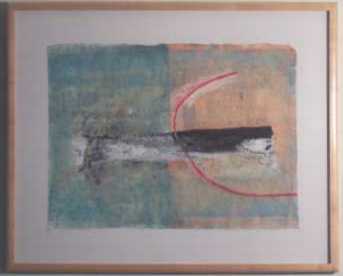 |
| I first encountered Sheila's work back in the summer of 2001 at Eastern Market, the weekly Capitol Hill open air Arts and Crafts fair that gives many artists an inexpensive alternative to exhibiting their work and allows them directly to interact with the public, an option that in the case of more formal art shows is generally limited to openings or special events. While the work of the artists who choose to show at Eastern Market obviously varies considerably in quality and consistency, I think Sheila's work is arguably among the best that is to be found there, as is amply attested by the grants and international recognition shehas received. For example, she was Artist-in- Residence at the Cite Internatinoale des Arts in Paris as early as 1989 and again in 1997. She has also received several grants from the DC Commission on the Arts and Humanities. The first piece of Sheila's I acquired is a product of her extended residence in Japan, where she learned to make the rice paper used for the work. The piece is an example of the cross-fertilization between the theories of Zen and African art, a hybridization at times termed 'Blackstraction'. Other representatives of the genre are Sam Gilliam, Nancy Crow and Grace Knowlton. As such, the roots of Blackstraction are drawn from a whole gamut of influences, ranging from the primitive work of the earliest Negro slaves and other immigrant artisans to European responses to Art Negre and the Craft as Fine Art movement of the 80's and 90's, as evidenced its multi-media approach and -- frequently -- in its three dimensional presentation, employing a variety of craft techniques. |
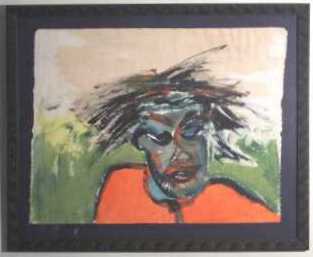 |
| The reductionism that attracted me to that first example of Sheila's work I bought is also a quality I found in the stylistically very different self portrait on unstreched canvas that she created while on an NEA fellowship at the Vermont Studio Center. With a few strokes, Sheila manages to create a face that is both introspective and observant. Yet at the same time it appears to be in a dialog with the viewer, as the mouth, opened as if to express a thought, seems to suggest. An additional element of interest for the observant viewer is the interaction between the orange of the blouse and the green sunlit background of a Vermont landscape that is suggested though not made explicit, and the blue-black skin tone of the Afro-American face. |
| Untitled, 2001 |
| Self Portrait, 2001 |
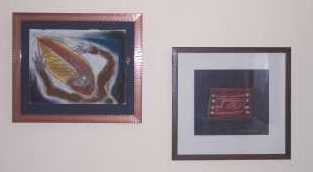
| One of my later acquisitions by Sheila actually entails a rather instructive tale. I had stopped by Sheila's stall in the Summer of 2002 and looked at a variety of quite different pieces, including some multi-media compositions made of interwoven pieces of rice paper with stylized script. However, as I laid the various pieces next to one another, something within me made me choose a very simple representation of a fireplace, executed in a couple of strokes that outlined the fireplace, a few logs, and flames. Upon having it framed and hung in my dining room, I became increasingly distrubed. Had I made a mistake? Something just did not work. The more I looked at the piece, the unhappier I became, until I s eriously began to doubt my sense of judgement. As it happened, not long after, Sheila was among the guests at a dinner party I was giving prior to her scheduled departure for Korea. As Sheila later admitted to me, she too thought that the piece simply did not work -- at leastnot where it was. However, neither Sheila nor I spoke about the matter. Then early in August I went on a previously scheduled trip to Montreal, where I had planned to visit the studio of the German-born artist Peter Flinsch, whose work I had encountered through a book on male nudes and further researched through the internet. One of the pieces that Peter had included among the items for sale through the internet was a rather large oil painting of an African Fire Dancer, painted in the early nineties on a trip to South Africa. Since the painting was quite out of my range, I never gave the matter any further thought. However, when I visited Peter's studio and was rummaging through his sketches and drawings, I came across a small sketch of that very same fire dancer, clearly a study for the painting I had seen on the Web. Immediately it became obvious to me that this was the piece that was missing as the partner to Sheila's work. I could already see in my mind's eye that the two pieces together formed a dialog that now placed the Fireplace into a totally new context. Once I put them together, it was as if the Fire Dancer was invoking the Fire, and my original opinion of the inherent quality that very abstract painting was affirmed. The Fire Dancer is one of the few times in my life when I have bought a piece not only because of the intrinsic attraction it held for me but because I had a specific context into which to place it. Conversely, I believe that this sequence of events shows that if you like a particular work there are times when you must work with it to bring it to its full effect. In 2003 Sheila produced the first of what is promising to become a series of loose leaf catalogs aRtiSt' uP-dAate/cAtalog: Texture/Pattern/Line, produced with the DC Commission on the Arts and Humanities and providing an overview of her work. Most recently she has been working on a series Deep in the Earth's Plenum, I grow from the Facula, including the wonderful piece Reads like Reeds that I acquired earlier this year. |
| Peter Flinsch, Firedancer 1992 |
| Sheila Crider, Fireplace 2000 |
 |

|