| The Art of Morgan Monceaux |
 |
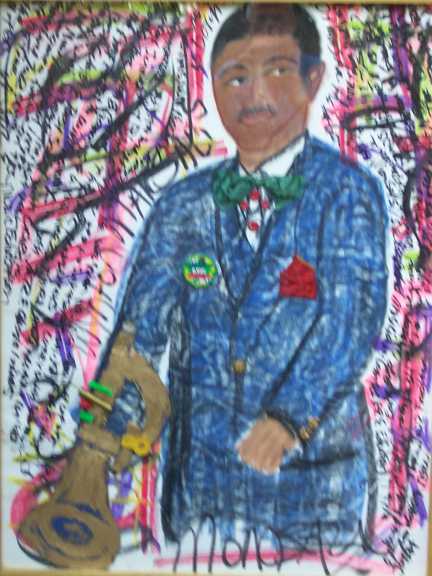 |
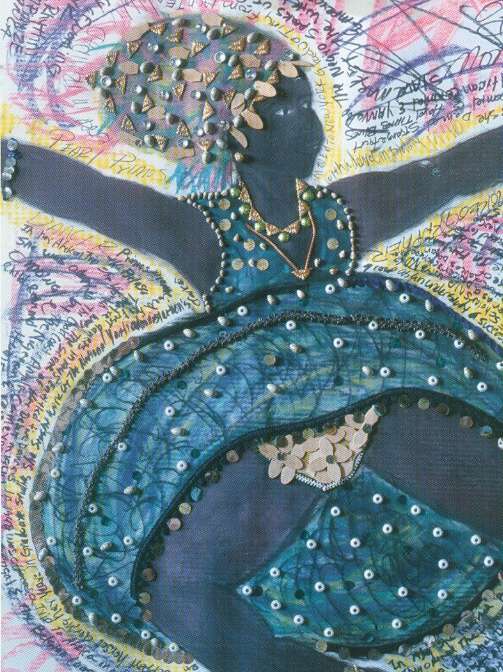
| If I remember correctly, when I once asked Morgan Monceaux how one could best classify his art, he told me that the term that seemed best to describe it was Urban Primitive. While much of his material has focused on Afro-American history and culture, he has always resisted having his work classified as Afro-American. At times he has gone so far as to state that "there is no such thing as Black Artists -- only American Artists," an assessment which I think is an intentionally provocative overstatement in the interest of making a point. Certainly, when one looks across the breadth of Morgan's work, it shows evidence from most diverse traditions that he has assimilated over the years, such as the technique of urban graffiti artists that is almost a signature feature of many of his paintings, in which graffiti-like text with biographical notes on the subject of the painting is an integral component of the work, such as in the portraitof Wynton Marsalis (1991) on the right, or in the portrait of the Dancer Janet Collins, below, which is part of his 1993 series "Shall We Dance" that is currently touring the US (photo taken from the brochure for the show). Another feature common to many of these works is the use of pieces of fabric, feathers, beads, buttons, etc. creating three dimensional, multi-media collages that literally transform the pieces into tactile renderings of the subject matter and frequently lend a very personal quality to the painting. |
 |
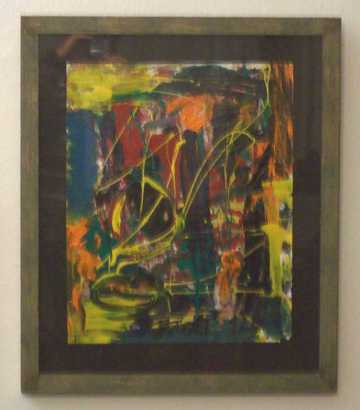
| Complementing the figurative nature of the bulk of Morgan's art, are pieces that are much more conceptual in nature. Most notable among these are works belonging to his "Jazz Notes" series, some of which incorporate text and other elements in the tradition of the Surrealists and the adherents of DaDa. Other pieces in the same series, such as the painting below, remind one of the technique of Abstract Expressionists like Jackson Pollock. |
 |
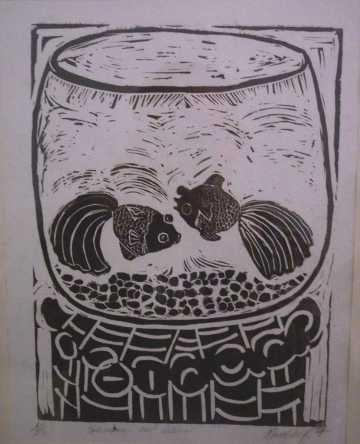
| Given the accessible, exuberant style of these paintings, it is hardly surprising that a significant number of them have been assembled into two children's books: Jazz, My Music, My People (1994), with a foreword by Wynton Marsalis, and My Heroes, My People: African, Americans, and Native Americans in the West (1999). A total contrast to the technical complexity of Morgan's paintings, many of which are of considerable size (60"x40"), are his primitive linocuts, typically no larger than 9"x12". While a good number of these were also conceived as thematic series devoted to Afro-American history and culture, notably his "Black Divas", others stand alone in terms of subject matter and are occasionally quite whimsical in nature, such as his humorous depiction of "Tea with Auntie Roger" or the one of his two favorite Black Moor goldfish, Sampson and Delila, below. |
 |
| More recently, Morgan'a work has shifted in the direction of what is frequently described as Sexual Outsider Art, evidencing his increasing involvement in the Leather Community and the culture of S&M. In that genre, he has recently completed a series entitled: "A Leatherman's Journal", including some very graphic depictions of Leather sex. While examples of this new subject matter can already be discovered in some of his earlier work, such as his linocut "Black Men in Leather", this change in subject matter, has brought with it a change in preferred medium and style. In contrast to the use of pastels, commercial markers, and miscellaneous objects to enhance his paintings, his primary medium for the Leatherman's Journal series is acrylic a technique that was more sporadic in his earlier work. In addition Morgan relies largely on the power of the image itself, rather than using text to convey his message; and |
| Wynton Marsalis, 1991 |
| Janet Collins, 1993 |
| Jazz Note, 1993 |
| Sampson and Delia 1993 |

|
| his subjects are generally no longer biographically identifiable to the viewer but generic participants in anonymous sexual acts. Besides the ongoing tour of the "Shall we Dance" series, the most exciting news is Morgan's inclusion in the exhibit of Race, Class Gender, does it not equal Character, which opened at the Baltimore American Museum of Visionary Art. A truly top class exhibit, in which a selection of Morgan's "Royals" and his series "American First Ladies" are prominently figured. |