Color
and
Pigments:
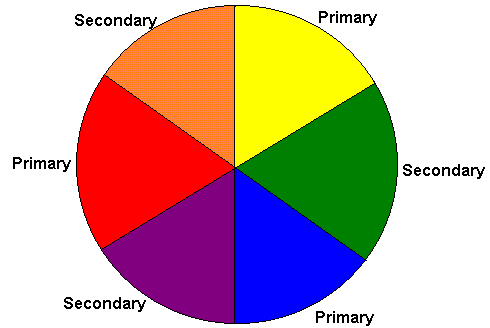
Pigments are the substances added to a liquid carrier or
binder to give it color. A basic knowledge of how colors are mixed
is required in order to fully understand how to make pigments for paints
and varnishes. A color wheel is useful in demonstrating how pigments
are combined to form new pigments.
Looking
at the color wheel you'll notice it is made up of Primary and Secondary
colors. Additionally, the Tertiary colors are not shown on our color
wheel here, but nonetheless deserve attention.
-
The Primary Colors: Red, blue and yellow are the pure hues that
all other colors are derived from. These are the colors that are
not mixed from any other colors. Red and Yellow are the primary pigments
most used in creating stains. All three primaries are used when formulating
paints.
-
The Secondary Colors: These are the colors you get from mixing equal
parts of two primary colors. For example: Red + Yellow = Orange,
Yellow + Blue = Green or Red + Blue = Violet.
-
The Tertiary Colors: These colors result when a primary color is
combined with the secondary color nearest on the color wheel. Examples
are blue-green, yellow-green, yellow-orange, red-orange, red-purple, blue-purple
and so on.
-
The Neutral Colors: These are typically black and white. These
neutral hues can be added to any of the colors to change the tone.
Tone
defines the lightness or darkness of a color. When white is added
to a color, it lightens the tone of that color. This is referred
to as a tint. For example, when white is added to red it creates pink.
Shades are made by adding black to a color. This darkens the original
color. For example, midnight blue is created when you add black to
blue.
Sources for this information: http://www.fortunecity.com/westwood/cerruti/236/color.html
and Coloring, Finishing, and Painting Wood, by Adnah Clifton Newell
(1972).
Likely Pernese Pigment
Sources:
This is to provide
some ooc knowledge about pigment sources for use in the RP of stain making
and mixing paints. Admittedly, some of these items may be up for
debate. However, a lot of research was obtained from books on pre-20th
century, renaissance and medieval pigments used in stains and paint.
It could perhaps be assumed that if Medieval and Renaissance woodworkers
and painters had knowledge and technology to make these paints that the
Pernese do as well.
Pigments:
Pigments are
derived from plant, animal or mineral sources. These natural pigments
can be added to a base to make stains or paint. Artificial pigments
are obtained by performing simple chemical reactions to any of the plant,
animal or mineral sources. It should be noted that not all pigments
are suitable for paints, nor are they all suitable for stain. As
a general rule of thumb, it can be assumed the vegetable pigments make
better stains than paints and that powdered rock can only be used in paints.
Additionally it should be noted that paints obtained from metallic constituents
would be used sparingly and only for very fine, expensive works.
-
Minerals are typically ground into a
powder and washed by a process called levigation. The powder is mixed into
water and is allowed to settle. If it is a mineral such as a clay, the
color left in suspension is drained off, kept and dried. If it is a stone,
the different sizes of particles are allowed to settle out. Heaviest would
sink first, finest would sink last. This is important because the size
of particles can determine the color of the pigment. The levigated powders
are then added to the base.
-
Animal derivatives are typically dried
and ground into a powder before adding to the base.
-
Plant pigments are usually extracted
from the plant as liquid, dried and ground into powder before adding to
a base. Some plant pigments come directly from drying plant parts
(such as leaves, pollen or petals) and ground into a powder before adding
to a base
-
Artificially created pigments are typically
found by accident or trial and error. They involve simple chemical reactions
that are usually time consuming. However, the materials used were
normally common substances obtained from natural sources.
Black:
Lampblack:
This is a deep black made from burning vegetable oils. A cool metal or
porcelain object is stuck into the flame and the soot is collected
off the object. It is a bit greasy and is not used so often in paints as
it is for inks.
Charcoal Black:
This blue black pigment is typically made by bundling grape vines or willow
twigs together in a tight roll. The bundles are then placed in casseroles,
covered and sealed and backed to charcoal in an oven. This can also be
done with fruit stones (cherry, apricot or peach pits) to produce different
tones of black. It is then powdered before adding to a base.
Ivory Black:
This
is thought to be the deepest of the blacks obtainable from organic sources.
This is produced in much the same fashion as Charcoal black, but hard bone
chips are charred in this case.
White:
White Lead: This process creates a very opaque basic white. White lead
is the product of a chemical reaction involving lead metal, vinegar and
dung. Coils of lead are placed above (but not submerged) a pot of vinegar
where the fumes from vinegar cause a white crust to form on the coils.
The pots are then placed into the dung to be heated. Fermentation
of the dung produces heat enough to induce the reaction. the white crust
is then collected and powdered. White lead is poisonous to inhale or consume,
so care must be used while preparing it so as not to suffer irreversible
lead poisoning! Wear glass goggles and cloth masks to prevent this
mishap! Apprentices most likely would not handle the raw powder due to
its toxicity. It is also recommended that white lead not be used where
babies can suck or teeth on it.
Bone
White: This astonishingly bright white is made from sticking bones
into a hot flame until ashes are formed. The ashes are collected ground
before mixing into a base.
Lime
Whites: For painting large areas such as walls. These whites are obtained
ground lime and added to a base. It is not as opaque as Lead White.
Zinc
White: This pigment is obtained from burning Zinc ore. White powder
coats the inside of the furnace where it is burned, collected and powdered.
It is opaque like White Lead but not harmful as lead is. It may be harder
to obtain on Pern though, so this is probably used only on expensive items.
Blue:
Ultramarine and Azurite Blues: Both pigments are made from finely
powdered naturally occurring minerals. Ultramarine is highly expensive
and should only be used sparingly. Azurite is a far less expensive version
and is usually left more coarse before adding to a base.
Copper
Blue: This is produced by adding sal ammonia to a brass container.
The ammonia sprits react with the copper in the brass forming a blue precipitate.
Mixed with a little lime, this yields an inexpensive deep blue. Through
time, as the ammonia leaches out, the pigment will revert to a soft green
again.
Indigo
Blue: Although this plant was typically used as a dye, it did work
well when mixed with linseed oil to produce a paint. The paint fades easily,
and must be upkept if left unprotected. However, a coat of varnish improves
the life of the pigment considerably.
Purple:
Most purples
are either mixed from blue and red or are a color deviant from a blue pigment.
Reds
and Oranges:
Clay Reds: Reds from mineral rich clay
are usually deep, red orches. Due to variations in mineral content, these
reds can very greatly. There's even some pink pigments to be known from
these clay reds! The clay is dried, powdered and added to a base for use.
Minium-Orange Lead: This vibrant, orange
red is made the same way as white lead, but roasted in open air until the
white powder results in this pigment. This color is highly admired
for its flame like appearance. It was not used to cover very large areas
as it is so time consuming and poisonous to make.
The Red Lakes: Several different pigments
of red, excellent for use in stains and in paints are obtained from insects!
In hot and humid tropical climates, certain types of insects lay their
eggs upon a host tree. They then coat the eggs in a reddish to brownish
goo to protect the eggs until they hatch. This secretion is collected,
emersed in hot water and then evaporated to collect the pigment. The Lakes
vary depending on where they are collected and are more of a transparent
kind of red than the others.
Cinnabar and Vermilion: When powdered, Cinnabar
creates a liver-red or scarlet pigment that coats nicely opaque in a base.
Vermilion is just a product of cinnabar mixed with powdered sulfur and
heated until turning a vibrant red.
Other Reds: Many other viable reds
comes from twigs, leaves, berries, flower petals or even pollen of plants.
The pigments are extracted from the plant and added to a base. These colors,
however, usually fade with time and exposure and usually require use with
coats of varnish.
Yellow:
Yellow Ochre: Yellow
Ochres are derived from mineral rich clays. they are prepared in the same
fashion as Red Ochres and have many of the same characteristics.
Saffron: This deep
yellow comes from the dried stigmas of a crocus. The dried stigmas are
added to a base and applied. Because of it's transparency, Saffron works
best as a pigment in stains.
Orpiment: This naturally
occurring mineral is a sulfide of arsenic. It is powdered several times
until fine and added to a base. It paints on opaque bright yellow.
Green:
Clay Greens: Similar to yellow and red ochre.
These are found naturally in the ground, dried and powdered before adding
to a base. They are know for their opaqueness.
Malachite Green and other green minerals:
Malachite and other greenish minerals are powdered until fine and added
to a binder base.
Iris Green: Iris blooms of very dark blue
hue make an excellent green! This pigment is derived by squeezing the iris
petals to obtain the purplish plant juices. This iris extract is then mixed
with powdered alum which reacts with the purple to turn the juice a clear
and beautiful green. This green is then soaked up into pieces of gauzy
cloth and dried. The pigment is used by dipping the clothes into the medium
and allowing the color to be soaked in and brushed on.
Other greens: Many greens can be mixed from
yellow and blue pigments. Additionally, greens can be obtained from berries,
leaves and tree sap much in the same fashion as Iris Green.
Brown: Note:
The brown pigments are most useful for staining, but are used in paint
too.
Brown Ochres: These are obtained from clays
and come in many variations from light to deep brown, depending upon where
they are obtained from. they are dried and powdered and added to a medium
to be used.
Burnt Umber: Umber is very similar to ochres,
but in addition to having a high iron content, umber also has a high manganese
content, which gives it slightly different characteristics. The raw umber
is roasted until it reddens. the pigment can then be powdered and added
to a medium. This pigment dries very quickly due to its manganese content.
Vandyke Brown: This color is a rich, blackish
red that is considered brown. It is derived from deposits of lignite and
peat and powdered with linseed oil and allowed to drain before adding to
a medium.
Asphaltum: This mineral is found in natural
deposits. It is organic in nature, formed from compression of peats. It
is not soluble in water, and therefore makes for a good paint for ships
or other outdoor products. It is made by simmering linseed oil and added
pulverized Asphaltum and a small amount of turpentine (distilled from coniferous
oils). The color formed is a very deep black-red, or very dark brown.
Bistre: This pigment only used in water color
or in water applied stains. It's derived from the soot of wood, the best
pigments from beechwood. Once the pigments obtained, it's boiled in water
and allowed to settle off heat. While still hot, the clear liquid is poured
off, producing this warm, deep transparent brown water stain.
Sepia: This transparent, dark brown pigment
is obtained from the ink glands of fish. Very soon after the fish is caught,
the ink sacs are removed and the dye allowed to dry. It is then ground
into a fine powder, then again ground with a natural alkali (like lye)
and finally treated with an acid (like vinegar). A brown precipitate is
formed and washed, the resulting pigment being of very fine grain. It works
best as a water stain or water color due to its transparent nature and
solubility in water.
Sources: 1) Thompson, Daniel V. (1956). The Materials and Techniques
of Medieval Painting.
Dover Publications, Inc: New York.
2) Harley, R. D. (1970). Artists' Pigments c. 1600-1835. Butterworth
& Co.: London.