| There's a huge variety of scopes on today's market, and for good reason. A single scope simply won't function everywhere. A 12-33X scope will be no good in Southern swamp country, and a 3.5-12X scope won't work too well when you're trying to center up a crow at 300 or 400 yards. The following page should help you to pick what scope you need, and sight it in. |
| Do You Need a Scope? |
| You don't need a scope on every gun. Shotguns, unless primarily used with slugs or as turkey guns, aren't going to need one. Unless you've invested in a good one, and you're willing to invest in a good scope to withstand the shock associated with one (yes, pumping hurts scopes worse than alot of recoil), neither does an air rifle. For that matter, if you're going to be using your rifle (rimfire, air, or centerfire) for primarily short range hunting purposes, or informative plinking, it won't need a scope. Too, if you are going to be using your rifle against primarily running targets, say you hunt deer with dogs, you may do better without a scope. Now, don't think you don't need a scope just because your gun fits one of those descriptions. If a scope would simply be a burden as a result of one of the past conditions, say there's a chance you could have to shoot a running target, go with a scope, but with see-thru mounts. This will allow you to revert to iron sights if you can't get a target in the scope's field of view. The most important aspect in this decision is common sense. If you're going to be hunting, especially big game, under normal circumstances, you'll want a scope. With practice, it's really not so hard to find moving target in a scope zoomed down to, say, 3 or 3.5X, just as long as the target's not absolutely flying when it comes by. A scope pays off big time in low light conditions, when it can give you an extra 30 minutes of effective shooting light. Obviously, if you're a varmint hunter, you're going to like the accuracy it can add to your hundred yard plus shooting. Paired with a heavy barreled rifle and a good fast cartridge, a scope can make you effective past 300 yards. Anyone that has ever deer hunted probably knows how easy it is to lose a deer behind a bush, or a small group of trees. A scope can help you see just enough to get a shot off. Finally, probably the best benefit to having a scope is the ease with which you, or practically anyone else, will be able to shoot accurately. And remember, it is better to have it and not need it than to need it and not have it! |
| What Kind of Scope do you Need? |
| You'll need to contemplate several things before purchasing a scope. Probably the first is the range at which you'll be shooting. |
| If You're Shooting at: |
| Short Range: 100 Yards or Less |
| If your shots are going to be limited to mostly under 100 yards, you'll have to have a scope with a low power setting, as a good number of your shots will probably take place under the fifty-yard mark. A scope with a minimum setting of 2.5X to 3.5X will work great here, as will a scope with a minimum setting or fixed setting of 4X. Although you likely won't need it, it doesn't hurt to have a scope that will zoom out to 9X or greater. This can help immensely on offhand 100 yard shots at non-moving targets. |
| Medium Range: Short Range to 200 Yards |
| In this scenario, you'll still probably have a good number of shots at under 100 yards, so you'll want a scope with a good low minimum power, say 2.5-4X. Because a 200 yard shot is actually a fairly long one, you'll want a higher maximum power, at least 12X, though a 15X may work even better. Don't let the 200 yard mark overwhelm you whatever you do....as long as you are shooting a capable cartridge, this shot should be, with a good scope and practice, a very good possibility. If it is called for, a scope with a very high maximum zoom, say 25X or greater, can be used here, although it will be difficult to find one that will permit easy use at short range, and see-thru mounts will likely not be the best combination with this scope. To, it can be quite difficult to find a target in such a scope. |
| Long Range: Over 200 Yards |
| Shots beyond 200 yards will almost require a scope with a good level of zoom. Folks that shoot in such situations will probably not have too many chances at shots inside of 100 yards, so don't worry if you can't find a high-zoom scope with a minimum zoom of under 10X or 12X. Go pretty high with the maximum zoom, from 25X to 33X, and if you're going to be going for really long shots, say past 500 yards, opt for something that will zoom up to 50X. Remember: Shots at game beyond 300 yards are, with the exception being varmints, a largely-chance deal. Non-magnum bullets will often struggle at this range, and light magnums will have trouble on game larger than deer. There's no reason to shoot beyond 500 yards unless you're a professional at such shots. If you find yourself about to take such a shot, stalk closer! |
| Now that you know what kind of zoom you'll be wanting to go with, you can think about other factors. Get an idea of exactly what you want, then look through the catalogs and sporting goods departments for one that matches, or very nearly matches, everything you need. I'll make a list of more considerations for you to think about before you purchase a scope. |
| If You're Shooting at: |
| Small Game |
| Don't go overboard, but get something that will allow you to make precise shots on small game. A fixed 4X, 1" scope will do nicely inside of 25 yards, and maybe a little further with a good shooter. Generally, I've found that these scopes have bad focus beyond this range. There are a few 3.5X-9X scopes available made exclusively for .22 rifles, and these would serve even greater for extended ranges. If you're using a .22 Mag, go with one of these. They'll help you make the most of this great little cartridge. Finally, there are also quite a few "deluxe" 4X scopes on the market, with larger fields of view and bigger objectives. These are a good step up from the bottom-line 1" scopes, and are much easier to sight in and keep sighted in. They make 50 yard shots easy, and might extend your range a little further. Also, for small game, try to get see-thru mounts. They're hard to find for 1" scopes, but if you can find them, get em! |
| Big Game |
| Invest more money in a big game scope, but again, don't go overboard. The majority of 3-9X or 10X scopes available on the market are good for most deer hunting in the South, and elsewhere for that matter. Make sure you keep it sighted in, and you'll be just fine. Generally, in the world of optics, you get what you pay for. Don't buy a $50 scope thinking you're going to have it for a lifetime. These scopes may last you a good 5, even 10 years, but when they get to the point where they fail to stay zeroed for over 3 shots, its time for something new. For longer shots, don't buy a cheap scope. In big game hunting, shot placement is vital, and a cheap scope won't help you much past 150 yards. If you buy a good scope, the difference in the view at extended ranges will be obvious from that of a cheaper scope. |
| Running Game |
| Alot of hunters, particularly those that use deer drives and/or dogs, will be taking alot of shots at running deer. Alot of people opt to use rifles in such situations, and in such a case, finding the target in the scope becomes a major issue. A scope with a good field of view is important, as is a low-zoom feature. Even no zoom will work. You can use as big a scope as you want in such a situation, if you use see-thru mounts. Although many people dislike these mounts, becuase they don't seem as solid, I assure you that they work just fine. I've seen scopes go three+ seasons without getting knocked off using see-thru mounts. If you shoot your rifle like you should, it shouldn't have to stay on more than about a month. You'll appreciate the see thru mounts the first time a deer rushes by too quickly to spot in the scope! |
| Dangerous Game |
| Get see-thru mounts, or a no zoom scope, if you're going to be shooting at anything close. Any type of dangerous game will usually be fast, so you won't have time to, in the face of a charge, mess around trying to find a running, snarling, angry, and deadly piece of furr and teeth rushing towards you. If you think you're going to be shooting at long range, get a variable-power scope with see-thru mounts. Whatever you get, make sure that it won't impair you in close range snapshots. |
 |
|
| Other Considerations |
|
| Varmints |
| If you're hunting varmints, like prairie dogs and crows, get a scope on your rifle. If you'll have alot of distant shots, get a big scope, with alot of zoom, say 25X to 33X. Now, if you're hunting predators and other varmints that will offer mostly shots inside of 200 yards (and alot inside of 100), get a 3.5 to 9X or 12X, maybe even something that zooms up to 15X. Try to get a minimum zoom of 4X or less. Those hunting coyotes and foxes will want see-thru mounts, because running shots on such animals are quite common. |
| Getting Ready to Hunt |
|
| Mounting the Scope |
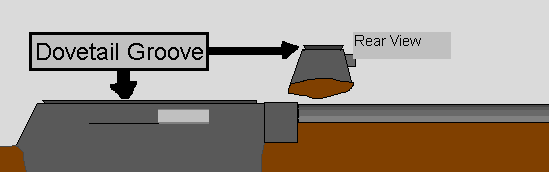
| Get some rings that will fit on your gun; if you've got a dovetailed reciever (the top of the reciever has two little ridges running in from the side....this is common on rimfires, and it will make a little 'plateau' on the top of the reciever), get dovetail mounts. Other mounts will say what kind of gun they fit. If you have a gun with no provisions for scope mounts, you'll have to get it drilled and tapped. I'd reccomend getting a good gunsmith to do it. Follow the instructions that come with the scope mounts, and make sure that everything is done right before you try to sight in your scope. |
| Sighting it In |
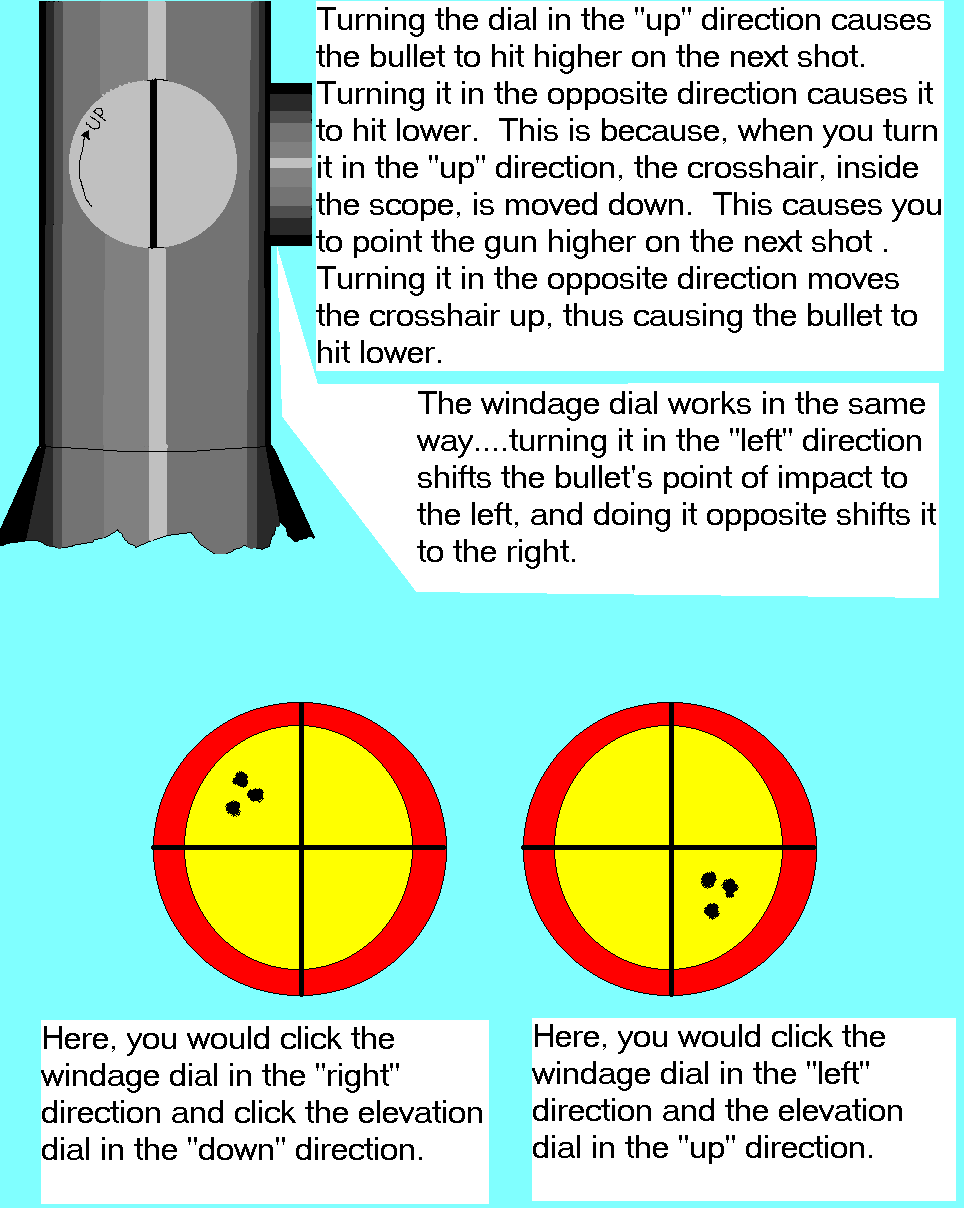
| For some shooters, this is the most confusing step, and/or just the hardest, with regards to optics. If you're gun is boresighted, and you've got a good rest, it doesn't have to take more than about four to five shots, three if you're lucky. Once the scope is mounted, either boresight it yourself, or get a gunsmith to do it. Next, take it out to the range, and get a good rest. Place a target at the distance at which you want your gun sighted in, and, with steady aim, and from a good rest, fire a three shot group. The shots should be pretty close togethor. Now, this is where a good rest or clamp really comes in handy. The fastest way to do this is by holding the gun completely still,with the scope zeroed on the bullseye. While you look through the scope, have a friend turn the appropriate dial, until the crosshair is centered in the middle of the three-shot group. Now, your scope is aiming where you are hitting, and thus, you will be hitting where you are aiming! |
 |
| Final Tips |
| When hunting, rain on your scope's lens can be your worst enemy. There is a liquid made for sun glasses (I forget what its called) that causes moisture to slide off of the lenses. This works well on a scope, as long as the rain isn't too hard. If you think it'll be raining hard during the hunt, take a smooth, soft cloth, that won't scratch up the lens, and occasionally wipe the rain/fog off the lens. |
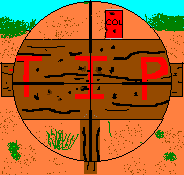 |
| Alot of people have trouble seeing through the scope. Make sure that you adjust the objective so that as soon as you raise the gun up, you can see clearly through the scope. Also, to allow easier location of the target, rather than looking at the scope, look through it. With practice, instant target location in the scope will come naturally as raising your gun. |
|
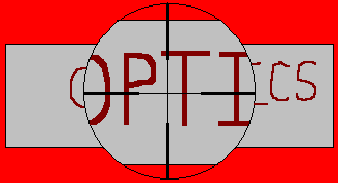
| If for some reason you find yourself having lots of trouble locating targets in the scope, see-thru mounts can help. If you have them, aim at the target with iron sights. Look in the scope. Magically, there, resting right in the crosshairs, will be your target! This is especially helpful when you're hunting small game, or a target hidden in a bush. |
|

|
|
 |
 |
