 |
| Freedom Village |
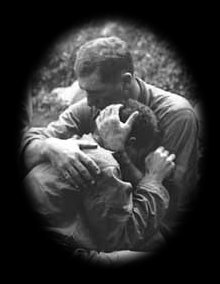
| My most vivid memory associated with the American flag flashes back to Korea and a gray, clammy day in early August 1953. The Korean War had come to an end a week earlier, on July 27 at precisely 10p.m. I remember lying in a rice paddy and suddenly experiencing the thunderous, deafening silence of peace. The Chinese and North Koreans, surely as joyful as I, were singing and raising their flags less than two hundred yards away from where my platoon sergeant and I sat smoking celebratory cigars. A military spotlight, affectionately referred to as "Moonbeam Charlie," played along the valley floor and crept up the scarred hills, catching the Chinese and North Koreans in spirited dancing around their outpost flag- pole. Their flags seemed to mean something to them, and at that time, I wasn't sure what my flag meant to me. But that changed dramatically a week later, when I was a part of a contingent sent to represent my regiment at "Freedom Village." "Operation Big Switch" was on. Our prisoners of war were to be returned to American hands, as the Chinese and North Koreans were to be returned to their people. Through the dim half-light of fading memory, I recollect that Freedom Village was in a scooped-out hollow with hills brooding over it from four sides. A few dwellings leaned into the village amid taut canvas hospital tents. We representatives of the United Nations stood at attention as ambulances and beat-up buses arrived from the north. The UN, American and Korean flags hung limply in the humid August air. Photographers, Army and civilians alike, scurried about for good vantage points. The Chinese and North Koreans were the first to cross over the "Freedom Bridge." They were surly, healthly looking and well fed. Some carried signs decrying capitalism. Members of a Republic of Korea regiment scowled, and one of them sent a spray of saliva in his former opponent's direction. The exchange had a tone of tense and bitter antagonism, and as young as I was, I wondered how long the newly inked truce would last. When the remaining Chinese and North Koreans had been herded off to their own vehicles, the UN prisoners were ushered from the trucks and buses and sent across the bridge to our side. The UN Honor Guard, combat veterans and observers gasped when they saw the condition of their returning comrades, who struggled, hobbled and staggered, gaunt and emaciated, toward friendly faces. One after another they came. The next one was in worse condition than the one before. Long lines of dull-eyed soldiers of the "Forgotten War" inched their way to freedom, and out of their number a gray-faced stick figure of a boy-turned-old-man dragged himself along the bridge. His bony arms were held out like a sleepwalker. He staggered and swayed, and one time fell into the wooden railing. Every eye in that village was suddenly trained on the one figure. Even those on the northern side watched the gallant physical effort of the wasted soldier. Each tried, inwardly, to help, to urge him on, until finally, when he lurched forward, an MP major, a giant of a man, came up to help. The soldier waved him off with his skeleton hands and arms. Looking around at the grim faces, he caught sight of the three color bearers and shuffled toward them. When he reached the American flag bearer, he knelt on trembling knees before the flag as though it were an alter. He reached up and tugged at the flag. The color bearer, either by instinct or by some infinite wisdom, lowered the flag, and the soldier covered his face with it, sobbing and shaking uncontrollably. Other than the clicks of cameras, the village was cemetery-quiet. Tears streamed from all of us. Cotton replaced saliva in our throats. After several moments, the stillness was broken by the sound of the heavy boots of the MP major, who came crunching across the gravel, his cheeks moist and glistening. He bent down and tenderly scooped the soldier up in his muscular arms and carried him off to a waiting ambulance, much as a father would carry a baby. There wasn't a dry eye in the silent village, thousands of miles away from Main Street, USA. James F. Murphy Jr. |