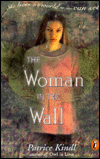
Anna is extremely shy and after experiencing a trauma, she goes into hiding within the walls of her family's huge twenty-three bedroom house. She lives there for seven years until her family has mostly forgotten her. A love letter shoved into a crack in the wall eventually lures her out of hiding.
The plot is extremely original. Anna, at the age of seven, has hidden herself inside the walls of her house by building a series of hidden rooms and passageways. The story is believable once you suspend your disbelief, but the fact that her mother and older sister practically forget Anna ever excited is a bit hard to believe. �Anna's mother's casual acceptance of her daughter's self-imposed isolation will be unsettling to many children� (School Library Journal 1997). The story has some suspenseful, fast paced moments, but overall moves at a more moderate pace. One such suspenseful moment occurs when Anna realizes that someone has discovered her secret and has entered one of her secret rooms (Kindl 98). The climax occurs during the Halloween party when Andrea gets upset and realizes that Anna is her forgotten younger sister and gets some boys from the party to try to chase Anna away (Kindl 165). The resolution follows quickly when Anna agrees to move to Chicago with her family and eventually attend school like normal children her age (Kindl 185).
The entire story is set within Anna's house in a town called Bitter Creek. The story has an old feel to it, like its set in the distant past, but its actually set in modern times as we can tell from the mention of computers and email. A lot of the story takes place in the secret rooms and passageways that Anna has created. The house is a unique setting because of its enormous size and because Anna is isolated from everyone in her secret rooms.
While Anna is strange, readers will still be able to identify with her. She's extremely shy and most likely has an extreme form of social anxiety disorder, though that is never mentioned. The thought of emerging from her house terrifies her. Although she has distanced herself from her family, she still loves them. . She fixes things for them and makes them clothing while she is in hiding. Like any other teenage girl, she is self conscious about her skin and wants the boy she likes to like her back. She is revealed through her thoughts and actions. Minor characters include Frances, her love interest and soon to be stepbrother, and her younger sister, Kristy. These two encourage Anna and help her to overcome her fear and leave the walls of her house. Anna shows major growth and character development. She's grown up, become a young woman, and while she's still shy, she's conquered her debilitating fear of social interaction and change.
The theme is growing up and the strength of family love. Part of Anna's change is due to the fact that she's simply gotten older. We see how she's changed when she interrupts Kristy, something she would never have done in the past (Kindl 115). But part of her change is also due to the love and support given to her by Frances and Kristy. Without them and their Halloween party plan, Anna might not have come out of her hiding place at all.
The story is told in first person point of view by Anna. It's hard to tell sometimes if the author is speaking figuratively or if she's being literal. For instance, at the beginning of the story, Anna's teacher doesn't see her and Anna ends up in her purse by accident (Kindl 28). Did this really happen or is this how Anna saw things from her seven year old imagination? The reviews in Horn Book Guide and Booklist describee the entire story as a metaphor for growing up, so perhaps Kindl is speaking figuratively (1997). The mood is one of loneliness and isolation. Anna has no friends and is cut off from her family. At first just seeing and hearing them is enough for her, but soon Anna sinks into a depression. Anna has a unique way of speaking. She speaks in very formal terms, even with her family members as if the story were set in the 1800's. This further paints the picture of Anna as someone who has been cut off from society for the past seven years.
�Anyone who has ever felt like fading into the woodwork will enjoy this story� (Booklist 1997).
Booklist. 1997. Booklist. In Books in Print [database online]. Available
from http://www.booksinprint.com/bip. Accessed 10 November 2004.
Horn Book Guide. 1997. Horn Book Guide. In Books in Print [database online]. Available
from http://www.booksinprint.com/bip. Accessed 10 November 2004.
School Library Journal. 1997. School Library Journal. In Books in Print [database online]. Available
from http://www.booksinprint.com/bip. Accessed 10 November 2004.