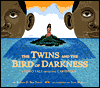
Widener. New York: Simon & Schuster Books for Young Readers. ISBN: 0689833431
When an evil seven headed bird threatens an island, the king's daughter agrees to be taken by the bird in order to save the island. Soliday and his lazy twin brother Salacota set off to rescue the princess, but Salacota betrays his brother.
Characters are revealed by the narrator and by their actions. We know Marie is selfless because she gives herself to the evil bird in order to save her kingdom. We know Soliday is good because the narrator says he is "good-hearted and brave" and we see how he saves Marie and forgives his brother. We know Salacota is a bad person because the narrator says he is "mean-spirited and cowardly" and we see him betray his brother. While both Marie and Soliday remain a good and king throughout the story, Salacota is the only character who changes. He finally feels regret over the things he has done and vows loyalty to Soliday.
This is an interesting story that I doubt many children will be familiar with. There's lots of action that will keep children interested. First the Bird of Darkness attacks, then Soliday sets off to rescue Marie, then Salacota betrays Soliday, then Soliday returns and the truth comes out. The illustrations really help move the plot along. When Soliday falls into the ravine, we see a picture of him falling, clutching tightly to his coat with the seven beaks inside, while Salacota stands there with his arms open as if to say "what do you want ME to do about it?" We also see illustrations of Soliday slaying the bird, of Soliday sailing home, and of Salacota trying to escape from the palace. The plot is well constructed and the climax comes when Soliday shows up at the palace with the beaks and Salacota is caught trying to escape.
The story is set in the Caribbean on two different islands. One is the home of Marie, Soliday, Salacota, etc. The other is where the Bird of Darkness lives. The illustrations really contribute to the setting. The illustrations depict the beauty of the island and how lush it is. WE also see how dark Marie's island becomes when the Bird of Darkness arrives. The tree where the bird lives is dark and ominous looking and surrounded by cliffs. The setting helps add to the characterization of Soliday. We see how far he must journey to rescue Marie and how he has to climb up the cliff o escape the island and make it back home. We wouldn't be as impressed with Soliday if he hadn't had to journey so far over such a dangerous terrain.
The theme of this story seems to that good always triumphs over evil. Some other themes that appear are the importance of forgiveness, loyalty and brotherly love. These themes emerge naturally and are important to impart to children. While in real life, good doesn't always triumph over evil, it's good for children to see instances where it does.
The story is told in third person point of view. The writing is very descriptive. For instance, when describing the evil bird's wings, the narrator says "its head blazed rainbow-bright against their fluttering darkness." The characters speak in very formal language, but this seems appropriate because the story is set in the distant past where people spoke differently than they do today. For instance, when Soliday greets the bird he says "Good morning to you, noble creature! I am Soliday who greets you." The mood is one of adventure, excitement and danger with a nice happily ever after feeling at the conclusion.
According to information within the book, the illustrations are "rendered in Gulden acrylics on Strathmore paper." I'm not sure what that means, but the illustrations are colorful and beautiful. Every page has an illustration on it. Some have one that only covers the bottom half of the page and the top half contains text. Even when this happens, there's no white space. The background color will be peach or green or blue, which really makes the pages attractive.
"Older readers may comprehend the complex ideas but the "rescue" scenario will appeal to younger children" (School Library Journal). This is an interesting story that will appeal to children of all ages.
School Library Journat. 2002. School Library Journal. In Books in Print [database online]. Available from
http://www.booksinprint.com/bip. Accessed 22 September 2004.