Books. ISBN: 061804597.
This is a collection of poems about camping and the various equipment and activities and feelings associated with camping. The poems in this collection vary in their style. Some are straightforward descriptions, while others are abstract descriptions of how camping can make you feel like the only person in the world.
Not all of the poems use figurative language, but some do. Iin �Sleeping Bag� the narrator says �I�m a caterpillar/in a cozy cloth cocoon/that zips� (George 10). Not only is she using a metaphor to describe herself, but also one to describe her sleeping bag. Personification is used in �eavesdropping� when �moon tries/to pretend/she isn�t/listening� (George 25).
The rhythm varies greatly from poem to poem. Some are rhyming (�Wild Mustard�) while others are free verse (�Eavesdropping�). The layout of the poems differs greatly from poem to poem as well. In �Tent� the concrete poem actually forms the shape of a tent (George 4). In �Two Voices in a Tent at Night,� the poem is a running dialogue between two people with the first person�s dialogue on the left side of the page and the second person�s dialogue over on the right side of the page (George 24). Onomatopoeia is used in �Mosquito Song� as the poem goes �It�s meeeeeeeeeeee/mosqueeeeeeeto� (George 21). Alliteration is used in �Breakfast� such as �furry flash� and �chubby cheeks� (George 11).
These poems contain a ton of sense imagery and descriptive language. For example, in �Old Truck� George describes the truck�s �fading green paint/peels in rusty scabs� (35). In �Owl� she says �the wind rush/of your wings/shouldered and spread/pleating the night/the satin flap/of your feathered cape� (George 41). We can almost feel the wind blowing on us as we read this description. "George's poems shine, the images clear and startling" (Publishers Weekly 2001).
This collection doesn�t have an index or a table of contents. The poems aren�t in any particular order except for the first poem where they are setting up their tent to begin the camping trip, and the last poem where they are back home from their trip.
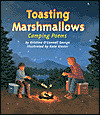
"Richly colored paintings enhance the verses" (Horn Book Guide 2001). They help the reader visualize the image. In �Wild Mustard� the text says �sweeps of wild mustard/swinging up the hillsides/as far as I can see� (George 30). In the picture, we see a young girl in a field of yellow with mountains in the distance. There really is yellow for as far as she can see. In this example, the illustration is on a two page spread with the text on the left side up in the sky area of the illustration. Throughout the collection, some of the poems are done like this, whereas others such as �The Doe� have the text in a white space off to the side of the illustration (George 6). The illustrations appear to be done in acrylic paints and are bright and colorful.
The author�s imagination and voice are evident in this collection. It�s easy to picture the author as a child on a camping trip feeling all the emotions and seeing all the sights that are described in this collection. Children will love this collection and will most likely want to go camping after reading it, I know I did.
Horn Book Guide. 2001. Horn Book Guide. In Books in Print [database online]. Available from
http://www.booksinprint.com/bip. Accessed 8 October 2004.
Publishers Weekly. 2001. Publishers Weekly. In Books in Print [database online]. Available from
http://www.booksinprint.com/bip. Accessed 8 September 2004.