Houghton Mifflin Co. ISBN: 0618077049.
This book looks at the tigers that live in the Mangrove forests of the Sundarbans, on the border of Bangladesh and India. They are the only tigers in the world that are man-eaters. The facts are current and accurate. The author does a good job of including actual empirical data, but also stressing that scientists do not know why these tigers are man-eaters. For instance, Montgomery lists some different theories about why the tigers might be like this, then makes a point of saying that these aren�t facts, but are called hypotheses (28). The author made four trips to the Sundarbans to research this book (Booklist). The author has written other acclaimed nonfiction books such as the Snake Scientist. There is a brief bibliography at the end and the thoughts of the locals are cited throughout the text.
The layout is logical. The author begins by introducing the reader to the question at hand � why do these tigers eat people? The author also gives background on the area itself and the people. Then she goes on to look at specific scientific theories, as well as the thoughts of the villagers and how their religion affects their beliefs about the tigers. The information definitely becomes more specific as the book goes on. Reference aids are included. Subheadings divide the different sections. There�s also an index, a list of other books available, a glossary of words in the Bangladesh language, and a list of organizations that deal with tigers.
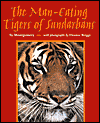
The design is definitely attractive and will appeal to children. The cover has a huge picture of a tiger�s face that will attract anyone. The font is large and every page has a photograph, which will help keep children�s attention. The photographs and maps are colorful and attractive. �Excellent color photographs and diagrams follow the multi-perspective theme, serving at times as evidence, other times as illustration of human activity in and around the reserve� (Horn Book Magazine). For example, there are pictures of statues representing different gods that the villagers think have influence over them and the tigers.
The writing is lively and interesting. The author darws the reader into the text by asking questions and saying things like �your study subject might be trying to eat you!� (Kirkus Reviews). The author�s enthusiasm for the subject is obvious not only by the writing, but by the fact that Montgomery visited the area so many times. The author encourages readers to read more about tigers through the book list at the end of the text. The book is full of interesting facts, such as the fact that the mangrove forests change so often that the maps of the region must be redrawn every three years (Montgomery 13).
Booklist. 2001. Booklist. In Books in Print [database online]. Available from
http://www.booksinprint.com/bip. Accessed 18 October 2004
Horn Book Magazine. 2001. Horn Book Magazine. In Books in Print [database online]. Available
from http://www.booksinprint.com/bip. Accessed 18 October 2004
Kirkus Reviews. 2001. Kirkus Reviews. In Books in Print [database online]. Available from
http://www.booksinprint.com/bip. Accessed 18 October 2004