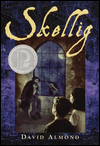
Michael and his family have just moved into a new house, when Michael�s mother goes into labor early. Michael finds a strange creature in the garage that he believes has the power to save his newborn baby sister.
The plot is extremely unique. There are two main conflicts occurring in this story. One conflict is the stress Michael and his family are going through because of the sick baby. The other conflict is over what the creature, Skellig, in the garage really is and what will happen to him if he stays there. There are smaller conflicts going on as well. Michael doesn�t feel like he fits in with his friends anymore and there is tension between them. Michael is also being blown off by his mother because she�s preoccupied with the baby. The premise is very unique. Michael discovers this creature in the decrepit garage, which could collapse at any time. After feeling something strange on Skellig�s back, Michael begins to think that Skellig might be an angel. The plot has some slow moments, but has suspenseful moments too. One such moment is when Michael can no longer feel his sister�s heartbeat and is certain that she has died (Almond 149). Another key moment is when Michael�s mother tells him of the dream she had where Skellig was holding the baby, though she knew nothing of Skellig. The resolution occurs when the baby and Michael�s mother come home from the hospital and when Skellig says goodbye to Michael and Mina (Almond 168). The two plot threads of the sick baby and Skellig are �adroitly intertwined in a web that connects Skellig and the baby, not just thematically but in visual terms as well� (Horn Book Magazine 1999).
The setting is not entirely necessary or unique. The story is set in an average British suburb in modern times. What is unique is the garage where Skellig is found and the house where Mina and Michael hide Skellig. Children typically don�t have places like these where no adults go. But Almond does a good job of creating this setting where it�s entirely believable that adults wouldn�t enter.
The characters are drawn with a graceful, careful hand� (School Library Journal 1999). The main characters are Michael and Mina. It�s easy to identify with Michael, but not so much with Mina. Michael loves his family and is extremely worried about his baby sister. Yet at the same time, he�s hurt by the way his mother is treating him. Michael wants to fit in with his friends at school, but at the same time, he feels closer to Mina than he does to his friends. Min a is very hard to identify with. She seems more educated than most adults. She quotes William Blake. She�s just not believable. Skellig is an interesting character, also hard to identify with, yet more believable than Mina. He�s become hardened from his isolation, but through the children�s� kindness, begins to open up and care about living again. The characters are revealed through speech and actions.
The theme is definitely the power of love. It emerges naturally as we see what love does in the lives of these characters. Michael and Mina�s love of Skellig brings him back from the brink of death. The love between Michael and his family will support and strengthen the weak baby. Skellig saves her because he knows how much Michael loves her.
The story is told in first person point of view by Michael. The dialogue is believable and suitable to the characters except for Mina�s outburst into William Blake songs. The mood is mysterious because of the mystery surrounding Skellig. There is also a constant mood of tension because Michael and his parents are so worried about the baby. The narration and dialogue are balanced well. The language can be very descriptive. One descriptive passage is when Michael describes the dance he does with Mina and Skellig. �The moonlight shined on our faces in turn. Each face spun from shadow to light�they were more silvery, more expressionless�� (Almond 119).
This is �a mystical story of love and friendship� that children will be fascinated by (Library Journal 1999).
Horn Book Magazine. 1999. Horn Book Magazine. In Books in Print [database online]. Available
from http://www.booksinprint.com/bip. Accessed 12 November 2004.
Library Journal. 1999. Library Journal. In Books in Print [database online]. Available
from http://www.booksinprint.com/bip. Accessed 12 November 2004.
School Library Journal. 1999. School Library Journal. In Books in Print [database online]. Available
from http://www.booksinprint.com/bip. Accessed 12 November 2004.