0440416728.
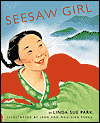
Jade Blossom is the daughter of one of the king of Korea�s advisors. She lives a sheltered life inside the walls of her family�s �inner court� (a kind of huge house/compound). But when her best friend, Willow, gets married and move away, Jade decides to venture out of the inner court and visit Willow. The results are not what Jade had expected.
The setting is key to the plot of this story and the behavior of the characters. The story is set in Korea in the seventeenth century, which the author explains in an author�s note at the end of the story. Korea followed a strict policy of isolationism, which means they didn�t have contact with other countries. Because of this, they had a very specific culture with unique ways of doing things. For instance, as we see in the book, Jade is not allowed to leave her house. Men outside of her family are not allowed to see her, unless there is a special occasion, like a wedding. This sheltered life she leads is essential to the entire plot and the thoughts and actions of the characters.
The main character is Jade. She is a young teen girl who, because of her family�s wealth and status, is not allowed to leave her family�s inner court. She does not act like a �young lady� should. She loves to play practical jokes and longs to journey outside the walls of the inner court and see the mountains. �Park balances realistic roles for women with Jade's longing for freedom� (Horn Book Guide 2000). Every child who has ever been forced to stay inside because of sickness or bad weather will understand Jade�s longing to see outside the walls. She is revealed through her thoughts and her actions. We see her total dedication and intelligence when she hides in the vegetable baskets in order to get outside the walls of the inner court (Park 33). We see her honesty and integrity when she asks her father to rehire the servant who was fired because of Jade�s actions (Park 60). �Even the minor characters have substance� (School Library Journal 1999). The other characters� actions are believable as well and reveal not only things about themselves, but about the culture too. For instance, Jade�s mother is very subservient and tells Jade that she wasn�t always happy with her life, but has learned to make her life �enough� for happiness (Park 54).
The plot is interesting and isn�t overwhelmed by boring history details. It is very realistic to the time period. After Jade�s best friend, Willow, is married and moves away, Jade longs to see her. After seeing the outside world, she longs to see it again and her little world inside the inner court isn�t enough for her anymore. The story doesn�t have a main exciting climax. There are moments of suspense, such as when Jade hides in the vegetable basket and later when she sees the strange men in the street. The resolution occurs when Jade gets her seesaw to work and is able to see the mountains. She realizes that this will someday be enough to make her happy. There�s a subplot based on an actual historical event that is nicely woven into the main plot. Some Dutch sailors get lost and end up on the Korean shore and are forced to stay in Korea by the king. This happened in real life, as the author explains in her note at the end of the story.
The theme is one of growing up and accepting your position in life, but finding happiness too. Jade comes to accept that she must stay inside the walls of the inner court and that one day she will marry and be head of a household. But she finds what eases her mind and makes her happy � seeing the mountains and painting them. This is a theme that all children will understand. There are things in life you don�t want to do, but you have to. However, there�s always a way to make those things bearable.
The story is told in third person point of view. The language of the time and culture is captured well. Jade speaks in very formal language to her parents. For instance she says to her mother �Yes, Mother, It shall be so� (Park 52). �Park explains Korean culture without condescension�� (Horn Book Guide 2000). The description of their culture is very specific. For instance, during Willow�s wedding, Jade thinks to herself how sad it is that Willow is not allowed to speak or smile during the entire celebration because this shows how she will honor her husband�s family. It doesn�t seem at all like the author is trying to give you a cultural history lesson. It fits in perfectly with how Jade would think. The mood of the story varies. When Jade is playing jokes, the mood is light and humorous. When Jade goes to see Willow and is turned away, the mood is sad. The ending is not exactly happy, but hopeful when Jade accepts that her life isn�t enough right now to make her happy, but one day it will be enough. There are black and white illustrations that help the reader visualize the time period. �The lovely, delicate illustrations detail traditional clothing, architecture, and decorative arts for visualization and context� (Booklist 1999).
�Park's novel offers readers a brief but enticing glimpse at another time and place� (School Library Journal 1999).
Booklist. 1999. Booklist. In Books in Print [database online]. Available from
http://www.booksinprint.com/bip. Accessed 10 November 2004.
Horn Book Guide. 2000. Horn Book Guide. In Books in Print [database online]. Available from
http://www.booksinprint.com/bip. Accessed 10 November 2004.
School Library Journal. 1999. School Library Journal. In Books in Print [database online]. Available
from http://www.booksinprint.com/bip. Accessed 10 November 2004.