Putnam's Sons. ISBN: 0399224130.
A young boy vanished and his parents think he is dead. He is later discovered to be living with seals and men from his parents' tribe bring him back to live with the tribe again. The boy belongs with the seals though and eventually returns to them.
Characters are revealed through their actions. The parents show their love for their son first when they refuse to leave without him and later when they let him return to the seals. The boy's longing to return to the seals is evident by the way he always sat staring at the sea.
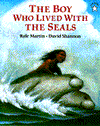
The illustrations portray these actions along with the feelings of the characters. We see the sad looks on his parents' faces as they push off their canoe after being unable to find their son. We see the boy working on his crafts all alone by the river and how said he looks after telling the tribe about the seals. Then at the end we see the joy that he feels once he is back with the seals.
Children will enjoy this story. They will wonder where the boy has vanished to, anticipate what happens when he is returned to his parents, and want to see where he will end up. The illustrations certainly help move the story along. While the story was actually taken from an oral story told by the Chinook people, it is highly unlikely that most children will be familiar with it. So while it may not be truly original, it will be to most readers. The plot follows a logical sequence of happenings. The story climaxes when we see the boy diving from the boat to rejoin the seals.
The story takes place on the bank of a river where it meets the sea. The exact location isn't stated, but is probably on the Northwest coast. The story is set either in a time before roads and technology, or in a place where these things don't exist. The illustrations are very important in establishing the setting. The text never describes the river or the bank or the island where the boy is discovered living with the seals. We see all these images in the illustrations so there is no need for the text to describe them.
The theme of this story might be if you love something let it go. It emerges naturally as we see the boy's parents realize that their son is happiest with the seals.
The story is told in third person with a limited narrator. We can't read what the characters are thinking or feeling though we can often tell by the illustrations. There is very limited dialogue, but this seems appropriate. The mood is one of sadness until the end. Once the boy is back with the seals the mood lightens because not only is he happy, but we see from the illustrations that his parents accept this and are okay with it. The story �employs lyrical language while carefully retaining a clarity appropriate for the intended audience� (Publisher's Weekly).
The illustrations are beautiful paintings. About half the illustrations are full page and the other half are on a two page spread. When the illustration is on only one page, the text is on the opposite page with a lot of extra white space. This really draws the reader's attention to the illustration. The text is large and easy to ready. Most of the illustrations are done with dark colors - blues, greens, browns and blacks. This helps create the mood of sadness. The one really bright illustration is the one of the seals and the boy basking in the sun on the island. They appear peaceful and content and the colors reflect this.
This is beautifully illustrated story with an interesting plot that will fascinate young children as well as older ones.
Amazon.com. 1993. Publisher's Weekly. Available from
http://www.amazon.com/exec/obidos/tg/detail/-/0698113527//qid=1095639679/sr=8-
1/ref=sr_8_xs_ap_i1_xgl14/104-3852363-4741553?v=glance&s=books&vi=reviews. Accessed
17 September 2004.