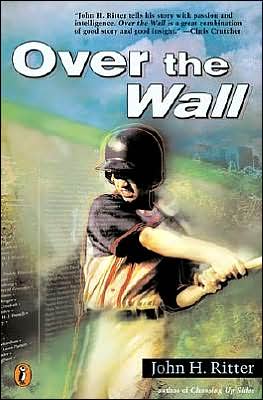
Tyler, from California, is visiting relatives in New York City for the summer in order to play baseball with a special summer league. He not only plays baseball, but learns some things about himself and his family.
Some aspects of the characters are believable, but others aren't. Tyler, the main character, is believable as a kid with a lot of pent up anger toward his father that he unwisely directs at others who are undeserving of that anger. He is not believable in the way that he does a complete 180 and becomes so obsessed with honoring dead Vietnamese from the Vietnam war. Breena, Tyler's cousin, is also not entirely believable. She acts more like a 28 year old hippy than a 13 year old girl. Strengths and weaknesses of characters are shown. Tyler can be a very good friend and open minded and caring, but has temper issues. Characters are revealed through thoughts, speech and action. There is definite character development by Tyler. He learns to let go of his anger and see people in a different way. �By the end, Tyler has gained a level of self-awareness by unraveling some of the tangled stories in his family's past and understanding the intricacies lying beneath the surface of life� (School Library Journal 2000).
The plot is interesting for the most part. There are several subplots and conflicts. The main conflict concerns Tyler's temper problem and being kicked off the baseball team. Subplots include Tyler's father who is depressed over the death of his daughter nine years ago, Tyler's crush on his cousin Breena and the characters' feelings on the Vietnam War. The Vietnam War conflict doesn't seem to fit into the story that well. It gets old after awhile. The climax occurs when Tyler gets arrested for putting up a memorial to the Vietnamese at the Vietnam War Memorial in Washington, DC. Another climax occurs when we find out that Tyler has not made the All Star team. The book ends with the coach asking Tyler to join the new traveling tournament team being formed.
The story is set mostly in New York City in the present time, but some takes place in Washington D.C. The bit city setting is important because it gives Tyler the opportunity to be anonymous and go off by himself, like he does when he's angry about baseball and rides off to the park (Ritter). The setting is also important because Tyler is isolated from his parents and their emotional problems. The theme is that every human life is important and you can't let anger overrule your life. The theme overpowers the story a bit. There's one too many heartfelt conversations between Breena and Tyler about the war.
The story is told in first person point of view by Tyler. Narration and dialogue are evenly balanced. Some of the dialogue doesn't seem natural at all. For example, there's a very awkward conversation between Breena and Tyler. Breena says �I like you, okay? I do. I even love you. So much so that I'll forget you just said what you said� (Ritter 277). The book is about 312 pages long and could've stood to be a good 50 to 80 pages shorter. �The overlong and over-plotted novel suffers from a lack of focus� (Horn Book Guide 2000). The story has some suspenseful moments, such as Tyler's arrest, when Tyler is kicked off the baseball team, etc. but there is not an overall mood of suspense. I didn't pick up on any specific overall mood at all in this story.
�Sports are just a part of this ambitious work that presents a compelling, multilayered story� (School Library Journal 2000). The book has its flaws, but does tell an interesting story that boys will enjoy.
Horn Book Guide. 2000. Horn Book Guide. In Books in Print [database online]. Available from
http://www.booksinprint.com/bip. Accessed 2 December 2004.
School Library Journal. 2002. School Library Journal. In Books in Print [database online]. Available from
http://www.booksinprint.com/bip. Accessed 2 December 2004.