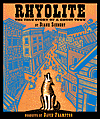
This narrative poem tells the true story of the town of Rhyolite, a prosperous mining town out west that became a ghost town.
This is not a collection of poems, but rather one long narrative poem. It is told entirely in rhyme. The poem is not humorous, but isn�t abstract either. It simply tells the account of Rhyolite�s rise and fall.
This poem contains a few instances of figurative language, but not many. An instance of personification occurs when the �engines groaned� (Siebert 12). There are several metaphors used as well. For instance, �the curtain fell on Rhyolite� and people were �hanging by a thread� (Siebert 24). A simile describes rooms that �stand like open, sunlit tombs� (Siebert 26).
The poem has a very even rhythm that would make it a good choice to read aloud to children. There is a constant �abab� rhyme scheme throughout the poem with no exceptions. With a few exceptions, every line contains eight syllables which creates the musical quality this poem has. Alliteration is used in several places including �burros� back� (2) and �tipplers, talk, and tunes (Siebert 12). There are a few instances of internal rhyme, such as �sly� and sky� (Siebert 28).
This poem is filled with distinctive words. Some of these words include �whist,� �toil,� and �woolly.� Not a lot of sense imagery is used, but the language helps the reader to visualize the scenes nonetheless. For instance the description, �including robberies and fights/ and drunken brawls on Friday nights, / it�s jailhouse greeting rowdy guests� helps the reader visualize a drunken bar brawl in some old saloon out west (Siebert 20).
Because this is just one narrative poem, there isn�t any need for a table of contents or index. There is an author�s note on the last page that gives some historical background on the actual town of Rhyolite. It�s short and sweet and includes some interesting tidbits that children might be interested in.
The illustrations suit this poem perfectly. They are woodcuts which either take up a full page or border the text on a page. Every page, with or without text, has pictures and color. The dominant colors are oranges, yellows and golds, which are really quite appropriate given the subject matter. � Frampton's woodcut illustrations use predominantly orange and sand tones to capture the sunbaked Western landscape, while occasional images of wild coyotes hint at the past (and future) of Rhyolite� (Horn Book Magazine). The illustrations really help the reader visualize this town. For instance, while the text describes the town�s bustling social scene, the border shows a marching band, a man playing tennis and a woman singing opera, while the picture on the opposite page shows a circus going through town on �Golden Street� (Siebert 14-15).
The author�s imagination is evident from the way she took this real life historical account of a mining town and shaped it into a lively and entertaining poem. Children of all ages will enjoy the story of the town of Rhyolite. This is a �A wonderful example of a well-crafted picture book� (School Library Journal).
Horn Book Magazine. 2003. Horn Book Magazine. In Books in Print [database online]. Available from
http://www.booksinprint.com/bip. Accessed 6 October 2004.
School Library Journal. 2003. School Library Journal. In Books in Print [database online]. Available from
http://www.booksinprint.com/bip. Accessed 6 October 2004.