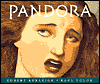
This is the classic story of Pandora's box. In this telling of the story, she is ordered not to open a mysterious jar, but the curiosity is too much for her. She opens the jar, unleashing all sorts of bad things into the world.
Pandora is revealed through her thoughts and actions. The text describes how she ponders the contents of the jar almost incessantly while the illustration shows her laying in a chair while she stares at the jar. Eventually we read how she opens the jar and then resolves to be brave.
Children will enjoy the story. Those who are not familiar with it will share in Pandora's curiosity over the contents of the jar. They will be eager to see if the opens it and what is inside. The plot starts off slowly, but speeds up as the story progresses. The climax occurs when Pandora is debating whether or not to open the jar and finally does.
The story is set in some ancient land. The place is not that important, though the time is. Pandora is the first moral woman and thus the story takes place long ago, in a time before war and hate. This story couldn't really be set in the present time. We see from the illustrations that Pandora lives in a nice palace out in the country somewhere and we can tell by her clothing that the story takes place long ago.
The theme of the story is to never give up hope. No matter how bad things seem, there will always be hope. This is definitely a theme worth telling and it emerges naturally at the end of the story.
The story is written in a sort of free verse. It is told in third person point of view, but Pandora's thoughts are written in Italics for readers to see. The writing is very descriptive and the author definitely didn't try to dumb the story down for children. He uses words such as �quivered,� �nagging,� and �gleamed.� There is some figurative language used. For instance, the jar's handles are described to be �like strange staring eyes.� The mood is one of mystery and suspense. Once Pandora opens the jar, there is a frightening illustration of black demon like creatures rushing towards her that really add to the mood. A foreword gives some background on the story of Pandora. There is also a pronunciation guide included.
I wasn't sure at first how the illustrations were done, but they look like old canvas paintings. You can see some sort of pattern of lines underneath the paintings like you would with a painting that was done on something like burlap. According to Kirkus Reviews, �Colon uses his colors lightly to show the texture of the paper, creating wonderful, almost iridescent effects.� The illustrations are very colorful but not bright. Many of the pictures have a sort of yellow/gold hue to them. The picture range from one page to one and a half pages to full two page spreads. The old look of the paintings fits the story well in that the story is set in an ancient place and time.
This retelling of a classic myth is captivating because of its style and beautiful illustrations. It may however, �have trouble finding its audience because of its mature treatment� (Kirkus Reviews). I think children will still enjoy it, regardless of whether or not they understand the full impact of the story.
Kirkus Reviews. 2002. Kirkus Reviews. In Books in Print [database online]. Available from
http://www.booksinprint.com/bip. Accessed 22 September 2004.