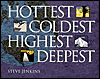
This book, as the title says, describes some of the most extreme places in the world, such as the windiest and the rainiest. The facts seem to be current and accurate for the most part. For instance, Jenkins names a spot on Mount Washington in New Hampshire as the windiest place on Earth, with winds of 231 MPH, but the Guam typhoon of 1997, had winds of 236 mph (Kirkus Reviews). Rather than a mistake or error, Kirkus Reviews viewed it as a �quibble� that makes �the book more valuable, inspiring readers to do further research after they�ve been visually seduced.� The most significant facts are included. Jenkins names the highest, deepest, etc. then gives the actual statistic and then talks about how they compare to other familiar figures. For instance, he compares the height of Angel Falls to the height of the Empire State Building. He also names other interesting facts such as the highest waterfall in the world compared to the highest waterfall in the United States. The author is a well known and respected writer and illustrator of nonfiction for children. There are no sources cited, which would have been nice.
The layout is logical and coherent. The topics are paired. For instance, Jenkins talks about the hottest place, then the next page is about the coldest place. He discusses the rainiest place, then the driest place. The information is presented in a clear framework. Jenkins discusses the extreme place, then gives additional information for each topic. There aren�t any reference aids included. An index or table of contents would�ve been nice, but they aren�t really necessary because the book is short.
The book is well designed and appealing. The illustrations are on two page spreads and are very colorful. For each two page spread, there�s a little inset map that shows where the extreme place is located within the country and then another showing where it is on the continent. There are other little insets that show the size, temperature, etc. in comparison to other familiar monuments, temperatures, etc. The main illustration is a �striking colorful paper collage� of whatever extreme place is being talked about and each picture has an animal somewhere in the picture just to add to the appeal (School Library Journal). For instance, for the highest place, Mt. Everest, there�s a collage of a mountain on a two page spread with a mountain goat on the mountain. The font size varies on the importance of the information being provided. For instance, the main information like the name of the place being described, is in regular sized font, but statistical information on places similar to the one being described are in smaller font off to the side.
There isn�t much text in this book. Jenkins basically just states the statistics and lets them speak for themselves. The book is full of fascinating comparisons that make the abstract more concrete. The comparison of Angel alls with Niagara Falls is particularly shocking. Readers will definitely come away from this book with a desire to learn more about the natural wonders of the world. The book is just long enough to pique their curiosity but not bore them. This is a fun and informative book that will intrigue children.
Kirkus Reviews. 1998. Kirkus Reviews. In Books in Print [database online]. Available from
http://www.booksinprint.com/bip. Accessed 15 October 2004
School Library Journal. 1998. School Library Journal. In Books in Print [database online]. Available
from http://www.booksinprint.com/bip. Accessed 15 October 2004