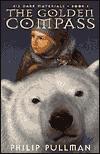
This is the first book in a three part series about Lyra. Her world begins to change when she learns about a particle called Dust that has something to do with the disappearance of children. Along with some newfound friends, she embarks on a journey to save the children, not knowing that she alone is destined to save the world.
The protagonist of this story is Lyra. She is smart and brave, but has a quick temper and tends to act before thinking. For instance, at the beginning of the book, she hides in the closet of the room where an important meeting is about to take place at Jordan College, without thinking about what the consequences might be. She is fiercely loyal as we see by her love and devotion to Iorek, the armored bear. Unlike many fantasy heroines, Lyra is not self doubting. She has her moments where she doubts her decisions, such as when she lies to Iofur and sets up a fight between him and Iorek (Pullman 304), but these moments are rare. Most of the time, she is self assured and confident. Lyra has an almost superhuman gift, the ability to read the alethiometer. As the story progresses, we see this ability grow and we see Lyra become more and more brave.
The main antagonist is Mrs. Coulter. She is coldhearted and won�t let anything get in the way of her plans. Lord Asriel is an antagonist as well, but we don�t learn this until very near the end of the novel. Even at the end, it�s hard to tell what his true intentions are. There are many complex and developed characters in this story. There�s Farder Corim who is like a father figure to Lyra. He is kind and patient with her. There�s also Iorek who is another of Lyra�s many protectors. Pan, Lyra�s daemon is another important character, even though he is a part of Lyra herself. He helps us to understand more about who Lyra is. The characters are revealed through their speech and their actions.
The plot is extremely complex. It focuses around Lyra�s quest to rescue the missing children and rescue Lord Asriel from prison. The main conflict is Lyra and her allies versus Mrs. Coulter and her allies. There are many life and death situations. One is when Lyra tumbles from the balloon (Pullman 282). Another occurs when Lyra is trying to escape from the children�s prison (Pullman 254). The book is filled with climactic moments. One of the most suspenseful moments is when Lyra discovers Tony and finally learns what the General Oblation Board has been doing to children (Pullman 187). Another big moment is the fight between Iorek and Iofur (Pullman 306). The novel�s main conflict is never fully resolved at the end of the story. Lord Asriel is free. The Children are free. Iorek is king again. But we find out that Asriel still wants to destroy all the Dust and Lyra realizes she has to stop him. The conclusion is definitely just setting the stage for a new journey to begin in another book.
The setting is extremely unique and yet still believable. Pullman has created this �lushly detailed universe� that is similar to ours, but yet completely different at the same time (Booklist 1998). Humans have animal companions, called daemons, which are almost a part of the person�s soul. They feel each other�s pain and sense each other�s feelings. These creatures can talk, as can some other animals, such as the armored bears. This story is set in only one world, but at the end of the story, the stage is set for the introduction of other worlds in the upcoming books in the series.
The themes are your basic good vs. evil, the power of friendship, and how one seemingly unimportant person can change the world. Mrs. Coulter and the Gobblers are evil, while Lyra and the gyptians are good. The power of friendship guides the entire story. Lyra is driven by her friendship with Roger and her desire to rescue him. Without the help of the gyptians or the witches or Iorek, Lyra would not have made it very far. Despite all the help she receives, we also see the huge impact this one little girl can have on the world around her. This is particularly apparent when she leads the children�s escape from the Gobbler prison.
The style is quite interesting. Pullman uses either made up words or words from another language occasionally. For instance the armored bears are also known as panserbjorne. The characters� names are very different and foreign sounding as well, such as Iorek, Asriel, Serafina, etc. Dialogue is extremely important in this story. Most of the important information we learn about is through character�s conversations. �There is a good balance between the amount of dialogue vs. narration� (School Library Journal 1999). Something unique about this story is the dialogue between Lyra and Pan. When they talk it�s like the reader is privy to an intimate conversation between soul mates or a conversation one is having with oneself aloud. The writing is extremely descriptive. My favorite parts are when the daemons or other animals are being described. For instance, there is a description of Iorek that says �once he was up on the quayside, he shook himself, sending great sheets of water flying in all directions, til his fur was standing up thickly again� (Pullman 146).
"Pullman is a master at combining impeccable characterizations and seamless plotting, maintaining a crackling pace to create scene upon scene of almost unbearable tension. Nothing short of breathtaking" (Publishers Weekly 1998) . This incredible story will appeal to all lovers of fantasy, young or old.
Booklist. 1998. Booklist. In Books in Print [database online]. Available from
http://www.booksinprint.com/bip. Accessed 30 October 2004.
Publishers Weekly. 1998. Publishers Weekly. In Books in Print [database online]. Available from
http://www.booksinprint.com/bip. Accessed 30 October 2004.
School Library Journal. 1999. School Library Journal. In Books in Print [database online]. Available
from http://www.booksinprint.com/bip. Accessed 30 October 2004.