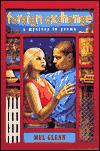
A small town agrees to host students from an inner city high school for a weekend. When a pretty local teen goes missing, everyone immediately blames one of the black inner city boys.
Characters are revealed through their poems and through what others say about the characters in their own poems. For instance, we know from Kirsten�s poem that she sleeps around (Glenn 81). There is a wide range of characters. We see strengths and weaknesses, but the characters aren�t fully developed. �At first glance, the selections appear to have captured characters but on closer examination they are stereotypes who never come to life� (School Library Journal 1999). This isn�t surprising considering the short length of the book and the multitude of characters. We know that Kwame is determined to make something of himself (55), but has a weakness for a pretty girl (Glenn 141).
The book tells a good story. Because there are so many characters, the reader will be kept guessing as to who murdered Kristen. The plot is original. The idea of a teen girl being murdered is not, but the whole student exchange concept is unique. The climax occurs when Amy comes forward about what she saw and John realizes who the murderer is (Glenn 152). The resolution occurs when Kristen�s father decides to move away and Kwame tries to go back to his life despite what has happened during the student exchange.
The story is set in a very small town with many close minded residents in present time. There is an underlying theme to not judge a book by its cover, like the town judges Kwame because of the color of his skin and his hometown. �Numerous prejudices are also revealed and demonstrate the ridiculousness of stereotyping. Glenn's subtlety shows that color has no barrier when one feels disappointment or abandonment or watches dreams drift away� (Voice of Youth Advocates 1999).
The story is told in first person point of view. Every page is a separate poem told in narrative form in first person by one of the characters. The story starts with the murder then flashes back to the weeks preceding it. Some of the poems are straight forward simple narration. Others are more descriptive or figurative. For instance, in one of Kristen�s poems she writes �And sing about the people/Who, after you pass by/Whisper, talk, and shout/Their fragile, sad messages to the world� (Glenn 66). Most of the poems don�t have any rhyming and they don�t have much of a rhythm either. The book reads more like prose than poetry.
�As with other books by Glenn, this one will appeal to readers interested in this particular format, especially our reluctant young adult audience� (Voice of Youth Advocates 1999).
School Library Journal. 1999. School Library Journal. In Books in Print [database online]. Available from
http://www.booksinprint.com/bip. Accessed 3 December 2004.
Voice of Youth Advocates. 1999. Voice of Youth Advocates. In Books in Print [database online]. Available from
http://www.booksinprint.com/bip. Accessed 3 December 2004.