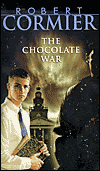
Jerry attends a private Catholic prep school where an unofficial club known as "The Vigils" rule the school. Jerry has to refuse to sell chocolates for the school's "voluntary" sale because of an assignment from the Vigils. But the assignment ends and Jerry still won't sell the chocolates which angers the Vigils and other students and teachers at the school.
The plot is unique and interesting. It's believable in regard to the sale and the way Jerry is pressured by other students. His thoughts and feelings are also believable. The main conflict doesn't emerge immediately but most readers will be able to guess what it will be due foreshadowing. The plot emerges naturally from the characters. Jerry wants to be an average kid and not make enemies so he does what the Vigils say. However when he goes beyond their assignment they get angry which creates the main conflict. The resolution is certainly believable but unexpected at the same time. We never expect the "bad guy" to win in the end, but in real life they sometimes do, which is the way the story ends as well.
The characters are believable and realistic. We see negative and positive qualities. Jerry is a good friend and student, but doesn't stick up for himself quite as much as he should. Characters are revealed through actions, thoughts and dialogue. We have the benefit of an omniscient narrator. The dialogue is direct and short. For example Jerry says "it's not the Vigils, Goob. They're not in it anymore. It's me." Goober replies simply "all right" (Cormier 128). Jerry has changed by the end of the story. When the Vigils' assignment ends, yet Jerry still refuses to sell chocolates, he's taking a stand that he never would've taken at the beginning of the story. Archie is another major character in this story. Unlike Jerry, we don't see much change in him. He starts off arrogant and mean and he ends that way as well. While he does feel sympathy at times for others that doesn't stop him from treating the person badly.
The setting of this story is a Catholic all male preparatory school, Trinity. This is extremely important to the plot. For starters, a club like the Vigils is much less likely to exist and be tolerated by the teachers at a public or coed school Secondly, the fact that the school is all male is important in that girls would add an entirely different dynamic to the school. The time is also important in that the story is set several decades go. In today's world where parents and teachers fear outcasts might bring a gun to school, the Vigils' antics would not be tolerated.
Readers are certainly left with something to think about at the end of this book. Sometimes the good guy doesn't win. Sometimes standing up for yourself and going against the standard way of doing things will get you hurt . This theme is obvious by the plot's resolution.
This story is told in third person point of view with an omniscient narrator. The reader not only sees Jerry's thoughts but Archie's and Goober's and other character's thoughts as well. The tone is definitely serious. I spent the whole book just waiting for something bad to happen. The language is mostly direct with a lot of internal monologues and dialogue. There are some instances of figurative language. "All of this in his mind, of course, as he tossed in his bed, the sheet twisted around him like a shroud, suffocatingly" (Cormier 119). Foreshadowing is also used, such as when Archie is making the assignments and he puts Jerry down for chocolates, but doesn't explain what this means (Cormier 15). The reader knows that this later play an important role in the plot.
The language flows well and readers will find themselves engrossed in the story. This story will appeal to any child or adult who has ever been bullied, wanted to fit in, or decided not to go along with the crows (or decided to go along with the crowd for that matter). �The masterful account of freshman Jerry Renault's own lonely battle against the ruling powers of his school is as provocative and disturbing today as it was to readers over twenty years ago� (Horn Book Guide).
Horn Book Guide. 1998. Horn Book Guide. In Books in Print [database online]. Available from
http://www.booksinprint.com/bip. Accessed 18 September 2004.