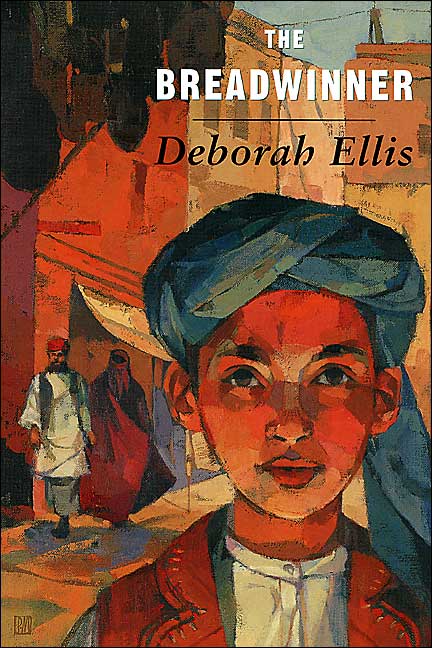
Eleven year old Parvana lives in Afghanistan with her family. Women are not allowed to work or be outside without a male member of their family. When Parvana�s father is arrested she must disguise herself as a boy in order to support her mother, two sisters, and baby brother.
The book contains realistic characters. Parvana is the main character. On one hand, she�s like any other eleven year old girl. Her older sister annoys her. She welcomed a vacation from school. She doesn�t want too much responsibility. But on the other hand, she is forced to be much braver and stronger than other eleven year old girls. She has to support her entire family by herself. She is often responsible for her younger siblings. She has to do most of the daily chores. Despite the fact that most readers have never been oppressed in the way Parvana and her family have been, she�s still a likeable character that we can relate to. She is revealed through her actions, speech and thoughts. We see her strengths and weaknesses. We see how she supports her family, but sometimes argues with them and doesn�t want to accept the responsibility that has been forced upon her (Ellis 52). Minor characters are well developed and believable as well. When Parvana�s father is arrested, her mother goes into a depression and sleeps for four days before accepting her position as head of the household. In such a situation of despair, it would be hard for readers to believe that she wouldn�t go through some period of depression or sadness. Nooria is also very believable. She frequently acts bitter and short tempered. She was a free, educated seventeen year old with a bright future when the Taliban took over the country. Now she is forced to stay inside her family�s one room apartment and take care of her siblings. It�s easy to understand how this would put her in a perpetual bad mood.
The plot is unique. There aren�t too many children�s stories out there about life in Afghanistan under the Taliban. The plot seems realistic. It�s easy to believe that Parvana�s father is arrested only because he is educated. It�s easy to believe that parvana is able to disguise herlsef as a boy to support her family. The story has a lot of movement. There are many suspenseful moments, such as Parvana and her mother�s visit to the prison where they are beaten by guards (Ellis 42). Another surprising moment is when Parvana discovers that her father has been released from prison. The climax seems to be when Parvana discovers her mother and siblings are probably in a refugee camp because the city they were going to has been invaded by the Taliban. The resolution occurs when she says her goodbyes and heads off with her father in search of her mother and siblings. "Unfortunately, the novel never deals with the religious facets of Afghan life, failing to explain that the Taliban sees itself, essentially, as a religious group� (Booklist 2001).
The story is set in Kabul, Afghanistan in early 2000, around the time the Taliban had taken over the country. The setting is extremely important because the entire story relies on it. Parvana is forced to become a boy because women aren�t allowed to work in Afghanistan. She�s forced to work because her father has been arrested simply because he was educated outside of Afghanistan. Her mother isn�t allowed to shop or work because they live in Afghanistan. The entire plot of the story and actions of the characters are dependent on this setting. �The book lacks the details about this region and culture that would help unfamiliar readers understand that world more clearly� (School Library Journal 2001).
The theme is the importance of bravery and strength and accepting responsibility. Parvana doesn�t want to pretend to be a boy or go to work, but she must to keep her family alive. In the face of all the hardships she faces, including her father�s arrest, and news that her family might be dead, she remains brave and does what she knows she has to do.
The story is told in third person point of view. The narrator can read Parvana�s mind, so we know her thoughts and feelings. Narration and dialogue are well balanced. There is a mood of suspense and fear. The reader worries that Parvana will be discovered to be a girl or that her mother�s attempt to publish an underground magazine will be discovered and she will be imprisoned or killed. �The story's tensions sometimes seem forced (e.g., Parvana's own fear of stepping on land mines)� (Publishers Weekly 2001). The book has some clunky moments and dialogue, such as when Parvana fails to recognize Mrs. Weera on the street. Mrs. Weera says �Oh, that�s right, my face is covered. I kep forgetting.� �Dialogue like this keeps the book from being totally successful� (School Library Journal 2003).
�The Breadwinner is a potent portrait of life in contemporary Afghanistan, showing that powerful heroines can survive even in the most oppressive and sexist social conditions� (Booklist 2001).
PuBooklist. 2001. Booklist. In Books in Print [database online]. Available
from http://www.booksinprint.com/bip. Accessed 28 November 2004.
Publishers Weekly. 2001. Publishers Weekly. In Books in Print [database online]. Available from
http://www.booksinprint.com/bip. Accessed 28 November 2004.
School Library Journal. 2001. School Library Journal. In Books in Print [database online]. Available
from http://www.booksinprint.com/bip. Accessed 28 November 2004.