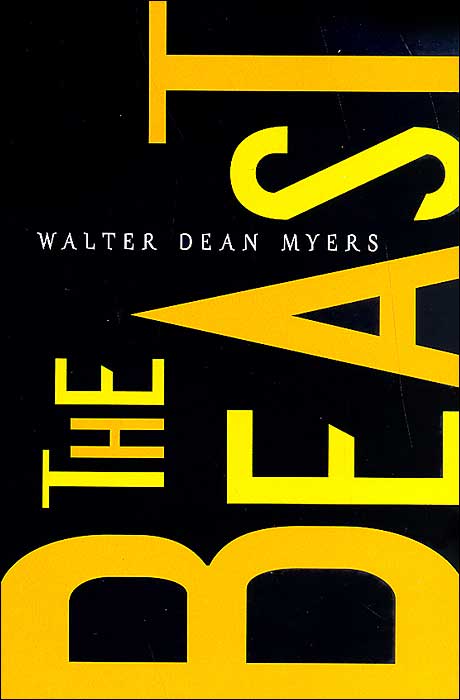
Anthony (aka Spoon) comes home to Harlem for Christmas break from his prep boarding school to find that his girlfriend is using heroin. Spoon tries to understand why and to help her.
The characters seem realistic for the most part. Some of Spoon and Gabi's thoughts and speech seem way too advanced for high school seniors, but they both are extremely smart, so I can almost make myself believe that they really talk like that. Spoon is extremely realistic as a teen who comes home to find that �home� isn't as he remembered it being. Many readers will be abl to relate to this feeling. He is also realistic as someone who is torn between two relatinships. There's Gabi, his first real love, but because of the distance and drugs, the relationship isn't doing so good. Then there's the possibility of a new relationsip with Chantelle. She's smart and goes to school with Spoon, but she's not Gabi. We see the characters' srenghts and weaknesses. Spoon will do anything to help Gabi; but this may mean ealling so behind in school that he can't catch up. Gabi takes care of her blind grandfather and tries to take care of her brother, but can't take care of herself. Characters are revealed through speech and actions and Spoon's thoughts.
The plot is interesting and believable. The main conflict is Spoon trying to deal with his feelings and Gabi. The story definitely moves. Myers does a great job of hitting the reader with a pig piece of information when the story begins to slow. For instance, Spoon has been home a few days and worries Gabi sis cheating on him. Then we find out that she's so distant because she's using heroin (Myers 56). The climax occurs when Spoon goes into the drug house to find Gabi. It's suspesenful because we don't know if Gabi will be okay or if something bad might happen to Spoon. The resolution occus when Spoon and Gabi are discussing their future several months later. Gabi is off drugs, but has no money for college and has put that plan on hold. Spoon has gotten a full scholarship to college and the two are trying to make things work between them.
The story is set in Harlem in present day. It is the perfect setting for this story. It is entirely believable that Gabi could have gotten into drugs here and that her brother could be gang banging. But it's also believable that it's Spoon's home and he loves it and sees all the good that is there and doesn't want to see it go down the tubes. �Myers's descriptions of the streets and people-the bright, clean, working-class hope and the slate-gray bankruptcy of drugs and crime-are photographically authentic and dizzyingly musical� (School Library Journal 2003).
The theme is dealing with change and the old cliche, �you can never go home again.� The theme emerges naturally as we see Spoon's struggle to fit back in with his friends and figure out where his true home is. �But Myers captures the disorientation of living between worlds, where home is the same, but not the same� (Booklist 2003).
The story is told in first person point of view by Spoon. The writing is very philosophical and figurative at times. One example is when Spoon thinks to himself, �At that moment, I didn't know what to say... except that I knew, or was beginning to know, that all journeys are harder than they appear, and that there are often hard roads to climb and beasts to slay along the way� (Myers 159). Myers does a good job with dialogue, especially between Spoon and his friends. There is a mood of sadness and lack of hope throughout the story. The reader will feel pity and despair that Gabi and Spoon are being forced to face such serious ordeals at such young ages. �Avoiding street slang and profanity, Myers deftly contrasts Anthony's Wallingford life and Spoon's return to the hopelessness of Harlem's streets without becoming didactic� (Voice of Youth Advocates 2003).
�Spoon's sharp observations about race and love will resonate deeply with teens, as will his ambivalence about the future: I don't know. I'm not even sure what there is to know� (Booklist 2003).
Booklist. 2003. Booklist. In Books in Print [database online]. Available from
http://www.booksinprint.com/bip. Accessed 30 November 2004.
School Library Journal. 2003. School Library Journal. In Books in Print [database online]. Available from
http://www.booksinprint.com/bip. Accessed 30 November 2004.
Voice of Youth Advocates. 2003. Voice of Youth Advocates. In Books in Print [database online]. Available from
http://www.booksinprint.com/bip. Accessed 30 November 2004.