0064407667.
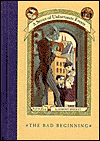
The three Baudelaire siblings have been sent to live with their evil cousin, Count Olaf, following the death of their parents in a fire. They find out that he is interested onlky in obtaining their parent�s fortune and it�s up to the children to stop him.
�While the misfortunes hover on the edge of being ridiculous, Snicket's� literary flair makes it all perfectly believable� (Library Journal 1999). The plot is certainly original and creative. The children are sent to live with a distant relative who is after their money. The main conflict is first the children�s plain unhappiness at living there and being Olaf�s slaves. Later the main conflict becomes the fact that Olaf has taken the youngest sibling and is threatening to kill her if Violet, the oldest sibling, doesn�t marry Olaf. The story moves at a fast pace. The readers will be constantly on edge wanting to know what bad thing will happen to the children next. From the book�s popularity at stores and libraries, I think it�s obvious to say that children enjoy the story. The climax occurs during the wedding scene in Olaf�s play when Violet says �I do� and Olaf reveals his evil scheme to everyone (Snicket 144). There is a quick resolution when Violet explains how she has foiled Olaf and the marriage is not legal. Olaf escapes and the children return to live with Mr. Poe until another relative can be found for the children to live with.
The story is set in a large British city, probably London or someplace similar. The time isn�t specified, but the book definitely has a Victorian feel to it. Violet speaks of �the banking district� and there�s no mention of computers or modern technology. The setting is appropriate because it seems very drab and miserable, which complements the children�s feelings and helps create an appropriate mood.
The main characters are the Baudelaire siblings, Violet, Klaus and Sonny. �The Baudelaire children are truly sympathetic characters who encounter a multitude of distressing situations� (Kirkus Reviews 1999). The main antagonist is Count Olaf. The children are not entirely believable. Violet and Klaus are supposed to be extremely intelligent, yet neither of them have the sense to go to the police when their baby sister is stuck inside a birdcage and hung from a tower (Snicket 105). Count Olaf, unfortunately, is entirely believable. He is abusive and cruel and treats the children like slaves. He cares only about getting their money and then plans on getting rid of them. The characters are revealed through their speech and actions, but mostly actions. For instance, we see Olaf hit Klaus and it�s obvious from this how cruel he is (Snicket 53). We also see how Violet and Klaus take care of their baby sister and how much they love each other. We see their devotion and intelligence when they research marriage laws in the library and Violet creates a grappling hook to try to rescue Sonny from the tower (Snicket 120).
The theme seems to be that bad things often happen to good people and when nobody will help you, you have to help yourself. Awful things happen to these children and Mr. Poe won�t help them, so they take matters into their own hands and foil Olaf on their own.
The story is told in a unique point of view, switching between second and third person, by a narrator who narrates a bit too much. Frequent asides are included to provide definitions of words that readers might now know. They would have been better in a footnote or not included at all, as they interrupt the flow of the story. The children speak very formally. They don�t use slang or contractions, which is appropriate considering these are wealthy British children in an age similar to the Victorian era. The mood is definitely gloomy and depressing with some suspenseful moments thrown in. There is definitely a very dark sort of humor used by Snicket. �The droll humor, reminiscent of Edwin Gorey's, will be lost on some children�but plenty of children will laugh at the over-the-top satire� (Booklist 1999).
Booklist. 1999. Booklist. In Books in Print [database online]. Available
from http://www.booksinprint.com/bip. Accessed 12 November 2004.
Kirkus Reviews. 1999. Kirkus Reviews. In Books in Print [database online]. Available
from http://www.booksinprint.com/bip. Accessed 12 November 2004.
Library Journal. 1999. Library Journal. In Books in Print [database online]. Available
from http://www.booksinprint.com/bip. Accessed 12 November 2004.