| San Giovanni Rotondo |
| San Giovanni Rotondo (at 600 meters on the sea level) where still lingers the great spirit of Father Pio of Pietrelcina, and of the pilgrimages. The new Saint of Gargano - writes Giovanni Bronzini in his essay on " the land and the people of Puglia " - who have inherited the attributes and the power of the previous Garganic personalities, " who was loved and feared as Saint Michele ". Even now crowds of pilgrims and of tourists coming from all regions of Italy and from all over the world, come to San Giovanni Rotondo, to pray to His Tomb on the Krypton of the Sanctuary of Saint Mary Delle Grazie, and to beg the Lord to cure them of all spiritual and physical evils. A famous gift pertaining to the Christian charity of these people, in the region of Puglia, is their hospitality, gratified by Father Pio and named by him the house of Suffering and of Comfort, which was joined then by the humble convent of the Cappuccini Fathers. This place now is a Hospital donnated with the most modern sanitary equipments. San Giovanni Rotonto, placed on the peak of Gargano, is an ideal place to spend, in spiritual serenity, a healthy vacation, far away from the frenetic daily life. In the summer time it is easy to get to the beach on the Garganic Riviera, since it is placed at a short distance. The mountain air, coming from the forests close by, in pure, fresh and aromatic; it helps restore your senses, damaged by the city pollution, in a peaceful and natural way. Behind the monastery, on the cliffs of Monte Castellano, you find the monumental Via Crucis, which is adorned by shrines, made out of solid granite, which cherish bronze statues representing the Fourteen " stations ", having been sculpted by a famous artist, Francesco Messina. |
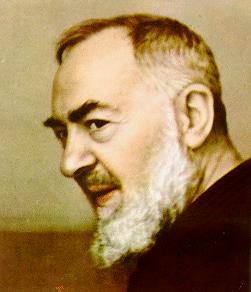 |
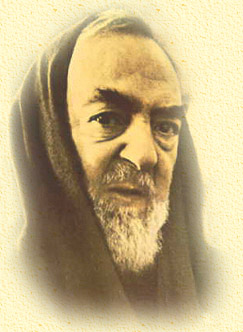
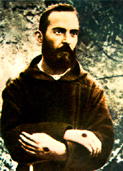
| Padre Pio was the first priest in the history of the Roman Catholic Church to bear the wounds of Christ (the stigmata) on his body. He bore the stigmata for 50 years, and lived in the twentieth century in Southern Italy, passing away in 1968. Though basically a cloistered monk, he erected one of the greatest hospitals in all of Europe, which he called the House for the Relief of Suffering. He spent most of his time in the confessional, where he could read the sins of penitents in their hearts, and often reminded them of transgressions that they themselves had forgotten. His miracles are so many and so fantastic that one has to be prepared to learn about them a little at a time; otherwise it would lead to incredulity. The words of Christ, "greater signs than these you shall do because I go to the Father" were fulfilled in the life of Padre Pio. The Church on December 18, 1997, the first step on the way to canonization, declared him Venerable. He had many detractors and suffered great persecution, in addition to the painful wounds of the stigmata, most of his priestly life. |
 |
 |
| Blessed Padre Pio beatified in Rome on May 2, 1999 by Pope John Paul II. |
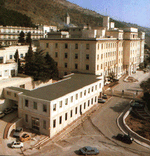 |
| House for the Relief of Suffering |
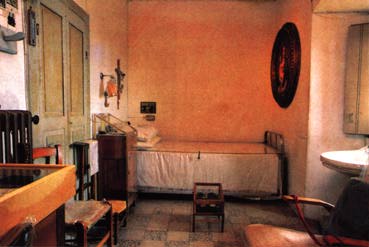 |
| Padre Pio's Cell |
 |
| This page was built and is maintened by: Friendly ' Puters. Hastings,MN. na[email protected] |

|
| In the Cell Padre prayed and suffered. Here he also died and ended his life on earth, entering Our Lord's House. We can see the following: A small table, on the left, where there are his fingerless gloves, some blood stained white socks, a little cloth to dry the chest sore, a reliquary containing some stigmata scrubs, some religious books. A prie-dieu and handkerchief used by Padre Pio to bless the pilgrims form the window, situated over the sink (on the right). A bedside table with a small fluorescent statue of Our Lady, some holy images, two alarm clocks, a watch, and a little book about Genoveffa de Troia, God's servant. In a reliquary, the slippers worn till the last hour of his life. Beside the armchair there is a small table where there are some mementoes: the girdle, the rosary, a relic of S. Cross, some little medals, some confetti (candies) he gave the children, a little box used as a "snuff-box" from where he picked up a "pinch" of tobacco for him and his friends. A sink, situated under the window in the benediction area, which replaced the basic supported by a wrought iron stool. The armchair: from this little armchair, place of divine and human knowledge, Padre Pio mediated deeply, got ready for the Holy Mass, heard his spiritual children's suffering and joy, and, in the tranquility of the death, he left for the Heaven. |