 |
| LORETO |
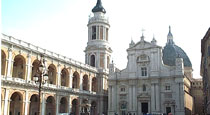
| Loreto (127 mlm, 10.500 inhab.) stands on a hill blanketed with cultivated fields extending onto the Musone and Potenza valleys. Loreto is the realization of a typical case of a Shrine generating a town. From the early 1300s a church dedicated to the Madonna of Loreto stood on the site of the present shrine. Even at that time the fame of the Sanctuary attracted pilgrims from all over Europe. Among the most illustrious visitors to the shrine were Columbus, Galileo, Descartes, and Mozart. Pope Sisto V elevated Loreto to the dignified rank of Diocese and city. So the small town developed quickly: hospitals, shops, hospices were built to satisfy the needs of the numerous pilgrims. The Papal possession of Loreto turned into French with the arrival of Napoleon and, at last, the town was included in the Kingdom of Italy. After the end of the 2nd World War the city center has extended outside the walls. Worth a view are: Commune's Bastion (1518-1519), Sisto V road, Lotto square, Boccalini walkway, where can be found traditional handicraft production of religious objects. The main events are la corsa del drappo (the cloth-race) in September and la Festa della venuta (the arrival festival) in December |
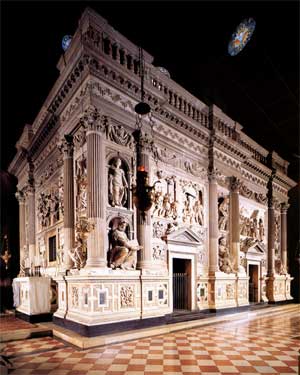 |
| When one speaks of Loreto, thoughts immediately turn to the Marian Sanctuary. The profound theological significance of this monument, together with the great relevance of its message for today and the exceptional richness of history and art which it condenses within the narrow bounds of its four walls, combine to make it one the most celebrated sanctuaries of its kind in the entire Catholic world. The Sanctuary of Loreto is the result of a definite tradition the outcome, that is, of a story that for two centuries was transmitted exclusively in oral form, and which was set down in writing only in the second half of the 15th century. Critical interpretation of these later documents, moreover, is not easy. The Loreto tradition runs as follows. In 1291, when the Crusaders were forced to abandon the Holy Land with the evacuation of the port of Acri, the House of Mary was conveyed by angelic mission from Nazareth to Tersatto in Dalmatia. |
| From here on the night of the 10 December 1294, it was taken to the Hill of Laurels in the Province of Recanati. Only that part of the House that had actually been constructed by man was transported by the angels from Nazareth. This was the section of the building that had been located in front of or slightly above the Grotto. The Grotto is still visible today in the great Basilica of Nazareth; it is considered by archaeologists to represent no more than the basement of the House of the Holy Family - the same House that now stands at Loreto. The first document that specifically refers to the Translation of the House can be dated between 1464 and 1472. It was written by Pier Giorgio Tolomei (alias Teramano), who was at this time employed as its keeper. Despite the existence of archaeological and (above all) iconographic evidence that bears witness to the miracle many years before the account of Teramano, the lack of incontrovertible contemporary documentation of the Translation, together with the truly e event itself, gave rise to doubts regarding its authenticity.Truth to tell, both supporters and opposers of the story can be accused, with hindsight, of rigidity and unequivocalness: for the former it was an indisputable miracle, while for the latter it was no more than a simple legend. Consequently, the Loreto question has remained open to this day. |
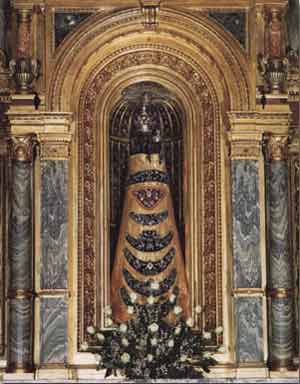 |
| The Basilica (1469 - 1750 ca.)Construction of the present church began in 1469. The interior is late Gothic in style; the facade, in Renaissance style, was completed in 1587. Three Bronze doors embellish the facade. The great architect Vanvitelli added the bell tower in 1755. Widespread devotion to the Madonna of Loreto and Holy House led to the construction of chapels by different nationalities around the main altar. Outside the church, there are rooms for thousands of pilgrims in the beautiful Piazza della Madonna, studded with a statue of Pope Sisto V and a Renaissance fountain by Maderno. |
| The Holy House of Loreto |
 |
| (click the cross to go back) |
| This page was built and is maintened by:Friendly ' Puters. Hastings, MN. [email protected] |

|