
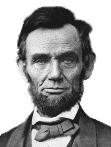
Lincoln thought secession illegal, and was willing to use force to defend Federal law and the Union. When Confederate batteries fired on Fort Sumter and forced its surrender, he called on the states for 75,000 volunteers. Four more slave states joined the Confederacy but four remained within the Union. The Civil War had begun.
The son of a Kentucky frontiersman, Lincoln had to struggle for a living and for learning. Five months before receiving his party's nomination for President, he sketched his life:
"I was born Feb. 12, 1809, in Hardin County, Kentucky. My parents were both born in Virginia, of undistinguished families--second families, perhaps I should say. My mother, who died in my tenth year, was of a family of the name of Hanks.... My father ... removed from Kentucky to ... Indiana, in my eighth year.... It was a wild region, with many bears and other wild animals still in the woods. There I grew up.... Of course when I came of age I did not know much. Still somehow, I could read, write, and cipher ... but that was all."
Lincoln made extraordinary efforts to attain knowledge while working on a farm, splitting rails for fences, and keeping store at New Salem, Illinois. He was a captain in the Black Hawk War, spent eight years in the Illinois legislature, and rode the circuit of courts for many years. His law partner said of him, "His ambition was a little engine that knew no rest."
He married Mary Todd, and they had four boys, only one of whom lived to maturity.
In 1858 Lincoln ran against Stephen A. Douglas for Senator. He lost the election, but in debating with Douglas he gained a national reputation that won him the Republican nomination for President in 1860.
As President, he built the Republican Party into a strong national organization. Further, he rallied most of the northern Democrats to the Union cause.
On January 1, 1863, he issued the Emancipation Proclamation that declared forever free those slaves within the Confederacy.
Lincoln never let the world forget that the Civil War involved an even larger issue. This he stated most movingly in dedicating the military cemetery at Gettysburg: "that we here highly resolve that these dead shall not have died in vain--that this nation, under God, shall have a new birth of freedom--and that government of the people, by the people, for the people, shall not perish from the earth."
Lincoln won re-election in 1864, as Union military triumphs heralded an end to the war. In his planning for peace, the President was flexible and generous, encouraging Southerners to lay down their arms and join speedily in reunion.
The spirit that guided him was clearly that of his Second Inaugural Address, now inscribed on one wall of the Lincoln Memorial in Washington, D. C.:
"With malice toward none; with charity for all; with firmness in the right, as God gives us to see the right, let us strive on to finish the work we are in; to bind up the nation's wounds.... "
On Good Friday, April 14, 1865, Lincoln was assassinated at Ford's Theatre in Washington by John Wilkes Booth, an actor, who somehow thought he was helping the South. The opposite was the result, for with Lincoln's death, the possibility of peace with magnanimity died.

This work is exclusively the work of politicians: a set of men who have interests aside from the interests of the people, and who, to say the most of them, are taken as a mass, at least one long step removed from honest men. I say this with the greater freedom because, being a politicians myself, none can regard it as personal.
Bank Speech
January 1837
"Captain I have as brave as Julius Caesar ever had: but, somehow or other, whenever danger approaches, my cowardly legs will run away with it."
Treasury Speech
December 20, 1838
It's better only sometimes to be right than all the times to be wrong
Address to the people of Sangamon
County
March 9, 1832
Others have been made fools of by the girls, but this can never with truth be said of me. I most emphatically,in this instance, made a fool of myself.
Letter to Mrs. Browning
April 1,1838
I suppose I cannot reasonably hope to convince you that we have any principles. The most I can expect is to assure you that we think we have, and are quite contended with them.
Speech in Congress
July 27, 1848
It is not in the nature of man to be driven to anything: still less to be driven about that which is exclusively his own business; and least of all where such driving is to be submitted to at the expense of pecuniary interest or burning appetite.
Temperance Address
February 22, 1842
I never encourage deceit, and falsehood, especially if you have got a bad memory, is the worst enemy a fellow can have. The fact is, truth is your truest friend, no matter what the circumstances are.
Letter to George Pickett
February 22, 1842
Free labor has the inspiration of hope; pure slavery has no hope. The power of hope upon human exertion and happiness is wonderful.
On Slavery
July 1, 1854
We know that some Southern men do free their slaves, go North and become tip-top Abolitionists, while some Northern ones go South and become cruel slave-masters.
Speech at Peoria, Illinois
October 16, 1854
No man is good enough to govern another man without that other's consent.
Speech at Peoria, Illinois
October 16, 1854
The very first invention was a joint operation, Eve having shared with Adam the getting up of the apron. And, indeed, judging from the fact that sewing has come downto our times as "woman's work" it is very probable she took the leading part - he, perhaps, doing no more than to stand by and thread the needle.
Lecture on Discoveries, Inventions and Improvements
February 22, 1859
When we were the political slaves of King George, and wanted to be free, we called the maxim that "all men are created equal" a self-evident truth, but now when we have grown fa, and have lost all dread of being slaves ourselves, we have become so greedy to be masters that we call the same maxim " a self-evident lie." The fourth of July has not quite dwindled away; it is still a great day - for burning firecrackers!!!"
Letter to George Robertson
August 15, 1855
Familiarize yourself with the chains of bondage and you prepare your own limbs to wear them. Accustomed to trample on the rights of others, you have lost the genius of your own independence and become the fit subject of the first cunning tyrant who rises among you.
Speech at Edwardsville, Illinois
September 13, 1858
Whatever woman may cast her lot with mine, should any ever do so,it is my intention to do all in my power to make her happy and contented: and there is nothing I can imagine that would make me more unhappy than to fail in the effort.
Letter to Mary Owens
May 7, 1873
It is not entirely safe, when one is misrepresented under his very nose, to allow the misrepresantation to go uncorrected.
Speech at Columbus, Ohio
September 16, 1859
Do we gain anything by opening one leak to stop another? Do we gain anything by quieting one clamor merely to open another, and probably a larger one?
Telegram to Colonel McClure
June 30, 1836
