 |
 |
| ASSISI |
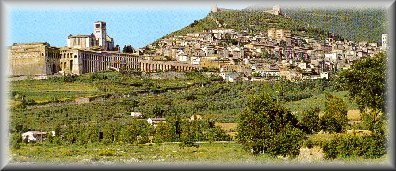
| Assisi is famous the world over, thanks to her favorite son, St. Francis. However, the city importance is also tied to other events that, over the course of the centuries, have marked its moments of splendor, as well as to other less fortunate occurrences that were tragically connected with war. There are numerous legends that claim the city had noble origins, but what is certain is that Assisi was a center founded by the Umbrian tribes. It was later influenced by the Etruscans, as documented by the few artifacts that have come down to us, but the Romans were the ones to give it its well-established identity. |
| In fact, there are still numerous vestiges of the municipium known as Asisium, such as the lovely Temple of Minerva, several remains of pagan temples, the Forum, the amphitheater, epigraphs, cisterns, statues and parts of the Roman walls. After the fall of the Roman Empire, the city was attacked and conquered by the Goths (545 AD) and was then taken over the Byzantine people. It later fell under the rule of the Longobards and followed in t he footsteps of the Duchy of Spoleto. Towards the year 1000, it began to establish its independence as a commune and was influenced to some extent by the religious and cultural reawakening that was spreading rapidly throughout the rest of the Italian peninsula as well. Churches and monasteries were founded and castles were built or fortified. Following the patient reclamation work conducted by the Benedictines, the valley was used for farming. Eager to free themselves of the oppressive rule of Frederick I, known as Barbarossa, there was a popular uprising which was immediately put down by the imperial army and the town was then entrusted to the Duke of Spoleto. It was during this period that St. Francis was born and because of this, Assisi has earned its place in Italian and, indeed, world history. In 1198, the Duke of Spoleto gave the city up to Pope Innocent III, who confirmed the privileges of the church in Assisi through a papal bull. During the following century, the city boundaries were quickly extended and government authority came to be centered on the figure of the podest�. After these periods of imperial and then papal rule, city life was greatly influenced by the animosities between many of the families of the local noblemen and condottieri. These struggles for freedom went hand in hand with internal fighting and here, two main families predominated: the Nepis family (upper part of the city) and the Fiumi family (lower part of the city). The city was sacked again during the war between Assisi and Perugia and earthquakes, famine and plagues added to the town's misfortune. There was a succession of Seignories, including rule by Gian Galeazzo Visconti, the Montefeltro family, Braccio Fortebraccio and Francesco Sforza, until the middle of the sixteenth century, when Paul III and the city conquered Umbria finally regained its peace and tranquility. Assisi has given the world a number of distinguished figures, first and foremost of whom are St. Francis and St. Clare. Other famous names include the Roman poet Sextus Propertius and painters Tiberius of Assisi and Dono Doni. More recently, nineteenth- and twentieth-century writers and historians such as Antonio Cristofani, Francesco Pennacchi and Arnaldo Fortini have contributed enormously to making this city famous throughout the world. |
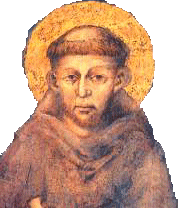 |
| Francis was born at Assisi in Umbria in 1181 or 1182. His father, Piero Bernardone, was a prosperous merchant, and Francis planned to follow him in his trade, although he also had dreams of being a troubadour or a knight. In 1201 he took part in an attack on Perugia, was taken hostage, and remained a captive there for a year. As a result of his captivity and a severe illness his mind began to turn to religion, but around 1205 he enlisted in another military expedition, to Apulia. However, he had a dream in which God called him to his service, and he returned to Assisi and began to care for the sick. In 1206, he had a vision in which Christ called him to repair His Church. Francis interpreted this as a command to repair the church of San Damiano, near Assisi. He resolved to become a hermit, and devoted himself to repairing the church. His father, angry and embarrassed by Francis' behavior, imprisoned him and brought him before the bishop as disobedient. Francis abandoned all his rights and possessions, including his clothes. Two years later he felt himself called to preach, and was soon joined by companions. When they numbered eleven he gave them a short Rule and received approval from pope Innocent III for the brotherhood, which Francis called the Friars Minor. |
| Francis of Assisi c. 1181 - 1226 |
| The friars returned to Assisi and settled in huts at Rivoreto near the Porziuncola. They traveled throughout central Italy and beyond, preaching for people to turn from the world to Christ. In his life and preaching, Francis emphasized simplicity and poverty, relying on God's providence rather than worldly goods. The brothers worked or begged for what they needed to live, and any surplus was given to the poor. Francis turned his skills as a troubadour to the writing of prayers and hymns. In 1212 Clara Sciffi, a girl from a noble family of Assisi, left her family to join Francis. With his encouragement she founded a sisterhood at San Damiano, the Poor Ladies, later the Poor Clares. In 1219 Francis joined the crusaders and preached to the Sultan of Egypt. Francis did not wish to found and 'order', but in time the brotherhood became more organized. As large numbers of people, attracted to the preaching and example of Francis, joined him, Francis had to delegate responsibility to others. Eventually he wrote a more detailed Rule, which was further revised by the new leaders of the Franciscans. He gave up leadership of the Order and went to the mountains to live in secluded prayer. There he received the Stigmata, the wounds of Christ, and composed his famous poem, the Canticle of Brother Sun (cantico del sole). He returned to visit the Franciscans, and Clara and her sisters, and a few of his followers remained with him. He died at the Porziuncula on October 3, 1226. Francis called for simplicity of life, poverty, and humility before God. He worked to care for the poor, and one of his first actions after his conversion was to care for lepers. Thousands were drawn to his sincerity, piety, and joy. In all his actions, Francis sought to follow fully and literally the way of life demonstrated by Christ in the Gospels. Feast Day: October 4 |
 |
| This page was built and is maintened by: Friendly ' Puters. Hastings, MN. [email protected] |

|