Spoken photos
[Main page]
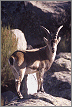
Spanish IbexCapra hispanica (male) in Serra de Gredos
by Tiago Silva
In January I visited the Serra de Gredos in Central Spain, to look for the Spanish Ibex.
Right from the Madrid-Badajoz highway the snow covering all of the central system was already visible.
At 1300 m high, in Puerto del Pico, we found the first signs of the Ibex.
In the following morning we hiked a trail to the upper plateau.
On the way up we saw a female and young about 1km away, looking down from the top of a valley.
We hiked down and tried a less visited trail to the summit.
When we were already thinking about starting the descent, we found a group of 50 animals next to a summer pasture.
We approached from below and by rocky terrain in order to make them more confident.
The male in the image was part of this group.
This individual seemed to look at me with curiosity, confident on his capacities on rocky terrain over the clumsy photographer burdened with equipment.
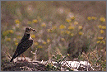
Calandra lark Melanocorypha calandra carrying insects
by Tiago Silva
This discrete but elegant bird, typical of arid, open areas, is usually quite shy.
Nevertheless, this particular bird was eager to deliver a bill full of insects to its chicks at the nest
and approached me as I was crossing its territory.
It landed for a few seconds, giving me the opportunity to make this image.
The slightly lowered wings of the bird, shows its anxiousness and defiance.
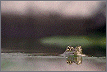 |
Edible frog Rana perezi at the water surface.
by Tiago Silva
We commonly look at frogs in the water from above, seeing their arms and legs spread alongside the body.
But it is not the way frogs normally see each other. They are also leveled with the water surface, so the most prominent
feature they show should be the large eyes.
This posture is ideal to hunt or simply not be hunted by other water creatures.
To see without being seen...a common adage in the natural world.
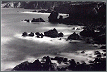 |
Bulb fiction
by Alexandre Vaz
I wanted to capture the power of the waves, and I decided to do it with a long exposure
during a full moon night.
After making some calculations I figured that this enterprise would demand either lots of film or lots of luck.
In order to achieve the desired results it was necessary bracket both of exposure and focus for each composition.
The resulting number of combinations is scary. I had only one roll of film, so I had to bet on luck.
My short experience in this theme suggests me that, whenever possible, the focus and composition should be
studied before sun set.
Regarding the exposure I found a rule of thumb that should be used only as guide,
and that I pompously called the rule of the 3 fours: with full moon and clear sky,
with 400 asa film at f4, the exposure is 4 minutes.
This seems to be valid for the reciprocity failure of the Kodak TMAX 400.
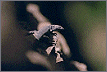 |
Male Lacerta dugesi lizard in a stone wall
by Tiago Silva
Before the discovery of the Madeira Archipelago by the Portuguese in the XV century, this lizard species could only be found
there - meaning it is endemic of this archipelago.
Somehow it was later introduced on the Azores archipelago.
There, it was the only terrestrial reptile, and soon it became naturalized and widespread.
This male had its kingdom in a few feet of stone wall where dozen of other lizards dwelt.
It moved trough the interior of the wall, looking for food, but when a intruder was detected,
it moved to a well placed stone in order to assess the situation.
 |
Sandhill
by Alexandre Vaz
In 1993 I went with some colleagues to Florida to learn something about capturing cranes.
At that time ICN intended to capture those birds in Portugal, so we traveled to USA where a
team had been doing so with a similar species, the Sandhill Crane Grus canadensis,
for two decades.
The method used by the American team consisted in giving an oral tranquilizer through bait.
It seems relatively simple, but if we take into account that: each individual should ingest only
one dose of tranquilizer; this drug takes at least half an hour to take effect; we were trying
to capture 10 individuals at the same time, and that it is necessary to avoid attacks from the
bald eagles on the sleepy cranes, then one sees how complex this operation can be.
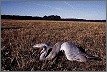
The picture shows the moment wen we approached a dizzy crane in order to capture it.
Fortunately in this case everything went out just perfect.
[Main page]