 Nature Group IIC
- Back
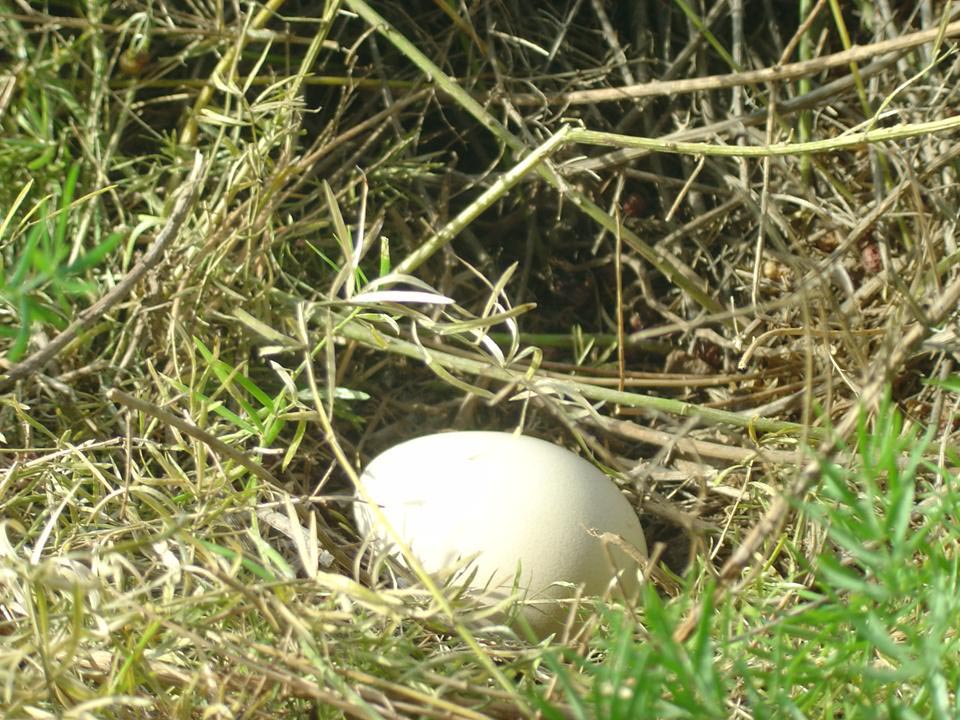
The first egg
discovered on the
ledge in May.
Photo: Hemant Misra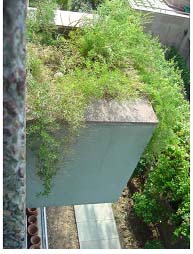
The ledge in the
IIC Annexe facing
the Islamic Centre.
Photo: Hemant Misra
The first egg
discovered on the
ledge in May.
Photo: Hemant Misra
The ledge in the
IIC Annexe facing
the Islamic Centre.
Photo: Hemant Misra
The India International Centre, (IIC) in the national capital is a happening place, known for its literary and cultural activities and as a popular meeting ground for its large number of members and their guests. Now interestingly, the IIC has also become a favoured nesting place for the Indian Peafowl or Blue Peafowl (Pavo cristatus), which is India's national bird and easily one of the most glamorous birds of the world.
The adjoining spacious Lodi Garden and the premises of the Mausam Bhavan have been supporting a population of the Indian Peafowl over the years. Occasionally, some of these birds venture into the IIC premises, but they do not stay for long. However, in recent years a new and very unusual development has been occurring that relates to some peahens nesting on selected window ledges, at considerable heights in the IIC Annexe building during the pre-monsoon period.
It is noteworthy that the peafowl are essentially ground dwelling birds, but they roost at night on big trees. During the breeding season, the peahen almost always nests on the ground under a shady bush and incubates its eggs there over a period of about 25 to 28 days. All available records and field observations indicate that the normal behaviour of the species is to nest on the ground and cases of peafowl nesting on buildings are rare. In any case, there is no record of peafowl nesting on buildings in the urban areas, even though sizeable populations of the bird exist in and around several towns and cities in the country, including Delhi.
Even the legendary ornithologist the Late Dr. Salim Ali did not record any such case. In fact, in their monumental work titled Handbook of the Birds of India and Pakistan (together with Bangladesh, Nepal, Bhutan and Sri Lanka), Salim Ali and Dillon Ripley (1983) mentioned the following on the subject:
Nest, a scrape in the ground, sometimes unlined and at others roughly so with sticks, grass and leaves. Usually well concealed in thorny undergrowth (e.g. Lantana, Zizyphus). Semi-feral birds may nest at times in ancient forts and ruined buildings, and even on the flat roofs of houses in villages.
In this background, recent cases of peafowl nesting at considerable heights on some window ledges in the IIC premises located in the heart of the national capital are quite unique and merit attention as well as careful study. In the past four years or so, one particular window ledge facing south towards the Islamic Cultural Centre and abutting the dining room on the second floor of the IIC Annexe building has been favoured by the peahens for nesting.
Each year some peahen would lay eggs (3 to 5) on it and then incubate them there till the chicks were hatched. Some eggs or some of the newly born chicks fell prey to the crows and cats that abound in the area, while the lucky survivors vanished with their mother into the adjoining Lodi Garden. The IIC staff members have been witnessing this drama with interest and have also taken steps, when the occasion comes, to prevent disturbance to the birds and to provide protection to the extent feasible.
This year the story has taken a more interesting turn, with three different peahens laying eggs in three different window ledges, including the one mentioned above, between 13th and 21st May 2007. Two of these window ledges, one facing north towards the World Bank office and the other facing south towards the Islamic Cultural Centre, abutting the busy and noisy dining room are at a height of about 24 ft,while the third ledge on the third floor is about 30 ft above the ground.
The peahen that laid three eggs on the south facing ledge as well as the peahen that laid an egg on the third floor ledge were not consistent in sitting over their eggs, most probably due to some disturbing factors. As a result, the crows ate up two eggs of the first clutch on 25 May. The remaining two eggs were rescued and sent for artificial incubation to the National Zoological Park.
As for the peahen that laid three eggs on the window ledge facing north towards the World Bank office, it has been very particular in sitting over its eggs, at least throughout day-time, and has been in that position since 19 May. Interestingly, the incubating peahen has been aptly named Matari, meaning Mother. If all goes well, hatching will take place within two weeks. Meanwhile, there is considerable excitement among the concerned staff and interested members of a recently started Nature Group at the IIC, who are working in tandem to ensure privacy for the bird and also keeping a watch on possible predators. A major concern relates to the safety of the newly born chicks and how they will descend to the ground from a height of about 24 ft. Hence, preparations are afoot to address this problem.
In all this, the key issue is that this kind of very unusual behaviour of the peahens using window ledges at considerable heights in a busy building for nesting over an extended period is clear indication of a situation in which excessive human activity and other disturbing factors in the adjoining parks are compelling the birds to seek safe refuge elsewhere. It is very necessary for the management of such parks in Delhi to take serious cognizance of this development and to take corrective steps for providing some undisturbed spots for facilitating the breeding and nesting of ground-dwelling birds, especially the Indian Peafowl. It is also necessary to study the impact on the population of the species, especially in view of reports of declining numbers in recent years.
On the other hand, it is a tribute to the gardens in the relatively small IIC premises which attract a variety of birds and the architecture of the IIC buildings that has found favour with the beleaguered peahens. Perhaps, it is time for the IIC management to consider a separate category of membership for these lovely birds, which have to be admired also for displaying remarkable intelligence and adaptability, a major reason for the survival of the species in sizeable numbers even in an urban setting.