Identifiers
A valid identifier is a sequence of one or more letters, digits or underscore characters (_). Neither spaces nor punctuation marks or symbols can be part of an identifier. Only letters, digits and single underscore characters are valid. In addition, variable identifiers always have to begin with a letter. They can also begin with an underline character (_ ), but in some cases these may be reserved for compiler specific keywords or external identifiers, as well as identifiers containing two successive underscore characters anywhere. In no case can they begin with a digit.
Another rule that you have to consider when inventing your own identifiers is that they cannot match any keyword of the C++ language nor your compiler's specific ones, which are reserved keywords. The standard reserved keywords are:
asm, auto, bool, break, case, catch, char, class, const, const_cast, continue, default, delete, do, double, dynamic_cast, else, enum, explicit, export, extern, false, float, for, friend, goto, if, inline, int, long, mutable, namespace, new, operator, private, protected, public, register, reinterpret_cast, return, short, signed, sizeof, static, static_cast, struct, switch, template, this, throw, true, try, typedef, typeid, typename, union, unsigned, using, virtual, void, volatile, wchar_t, while
Additionally, alternative representations for some operators cannot be used as identifiers since they are reserved words under some circumstances:
and, and_eq, bitand, bitor, compl, not, not_eq, or, or_eq, xor, xor_eq
Very important: The C++ language is a "case sensitive" language. That means that an identifier written in capital letters is not equivalent to another one with the same name but written in small letters. Thus, for example, the RESULT variable is not the same as the result variable or the Result variable. These are three different variable identifiers.
Fundamental Data Types
When programming, we store the variables in our computer's memory, but the computer has to know what kind of data we want to store in them, since it is not going to occupy the same amount of memory to store a simple number than to store a single letter or a large number, and they are not going to be interpreted the same way.
The memory in our computers is organized in bytes. A byte is the minimum amount of memory that we can manage in C++. A byte can store a relatively small amount of data: one single character or a small integer (generally an integer between 0 and 255). In addition, the computer can manipulate more complex data types that come from grouping several bytes, such as long numbers or non-integer numbers.
Next you have a summary of the basic fundamental data types in C++, as well as the range of values that can be represented with each one:

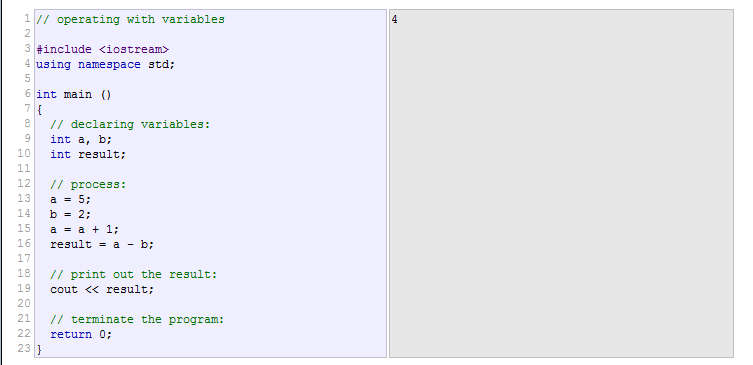
Here is a Sample Program: