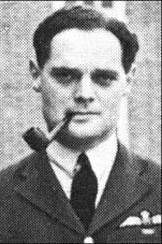
When I was about 12, I had to have my left foot amputated. In an effort to help me deal with it, my father (who was never good with stirring "pep talks,") bought me Paul Brickhill's biography of Douglas Bader, called "Reach for the Sky." Despite losing BOTH legs in an accident prior to WWII, Bader went on to become one of the RAF's top fighter pilots, and was recognized and respected by both Allied and Axis forces as a man of uncommon ability and remarkable courage.
In spite of his inability to be a "cheerleader," my father knew what he was doing. Reading Bader's story thrilled me, and made me realize that nothing could prevent me from accomplishing what I wanted, if I really set my mind and heart to it. Bader became one of my personal heroes, and an ongoing inspiration to me.
Many years later, by chance, I had the opportunity to meet Bader and talk to him briefly, and it was a conversation I will never forget. Separated by a couple of generations, and experiences I can never truly fathom, Bader and I still shared a common bond. He was delighted that a kid like me even knew who he was; I was delighted that he would take half an hour out of a very busy schedule to speak with me. We got along famously, and shared several laughs. To this day, Bader�s story, as told so well by Brickhill and others, continues to inspire people around the world, and I consider it an honour to have met and talked with the man.
Below are two internet-based accounts of Bader�s amazing story. Any decent search engine will also turn up dozens upon dozens of further references to this brave and determined man. For those who would like more information, I can think of no better resource than the book that first captured my imagination at age 12, Paul Brickhill�s �Reach for the Sky.� Written in 1954, it is still in print, and most good bookstores carry it, or can order it in. If you prefer, you can also order it online from amazon.com
************************************************************************
Few men become legends in their lifetime. Douglas Bader was one of these men. Fighter ace, international sportsman, constant rule-breaker and incorrigible escaper, he spread exasperation and irritation wherever he went. Yet his courage and determination in the face of crippling injuries continue to inspire people all over the world to this day.
Douglas Robert Steuart Bader was born on February 10, 1910, in London, England, son of Frederick Roberts Bader and Jessie Bader. From the start, his life followed no placid pattern. When Douglas was a few months old, his family returned to India, where his father worked as a civil engineer. Young Douglas was left behind because his family thought him too young for India's harsh climate. He did not rejoin them until he was 2 years old, beginning a long life as a loner. The Bader family returned to England in 1913. The following year, when World War I began, Frederick Bader went with the British army into France. It was the last time Douglas saw his father, who died in France of complications from a shrapnel wound in 1922 and was buried near the town of St. Omer. Twenty-one years later, his son would be held prisoner in a hospital not far from where his father was buried. Jessie Bader later married a mild Yorkshire clergyman, Reverend William Hobbs. Throughout his early years, Douglas showed a fierce spirit of independence and nonconformity. He excelled in sports such as rugby football; when he was captain of the rugby team, his natural leadership abilities became apparent.
In 1923, Douglas stayed with his aunt Hazel Bader and her husband, Flight Lieutenant Cyril Burge, who at the time was adjutant at the Royal Air Force (RAF) college in Cranwell. That's when he first became interested in airplanes. In 1927, Douglas decided he wanted to fly in the RAF, despite disapproval of his family. In the summer of 1928 he had won his cadetship. Bader reported to Cranwell in September 1928, and his flight training went satisfactorily. Not all of his flying was regulation and his superiors did not like his rebellious nature. Halfway through the two-year course, when the cadets took progress exams, Bader came out 18th out of 21 cadets. Cranwell's commandant, Air Vice Marshal Halahan , warned him: "You're young, I can understand your trouble, but the air force won't go on understanding. They want men here, not school boys." Bader emerged from Halahan's tirade considerably shaken, knowing the commandant was right. He studied harder, and his flying became better than ever. Bader missed being awarded the sword of honor, which was given to the top graduating cadet, but he came in a close second.
After graduating from Cranwell in 1930, Bader was commissioned a pilot officer and posted to No. 23 Squadron at Kenley Airfield, flying tubby Gloster Gamecock biplane fighters. Soon afterward, 23 Squadron was reequipped with Bristol Bulldog fighters. The Bulldogs were faster than the Gamecocks but heavier and liable to loose height rapidly in low-altitude maneuvers.
On Monday, December 14, 1931, Douglas Bader flew from Kenley to Woodley airfield along with two other pilots from his squadron. In the Woodley clubhouse a young pilot was discussing acrobatics with Bader, the Hendon star, and suggested that he give a demonstration of low flying. Bader refused, citing his inexperience flying acrobatics in a Bulldog. The matter was dropped until Bader and the other pilots were leaving. Someone dared him to do it. In some agitation Bader took off, then turned back toward the field. Flying low and fast across the field, Bader began a slow roll, but in his inexperience with the Bulldog he flew too low. The Bulldog's left wing struck the ground, and the plane cartwheeled quickly into a tangle of wreckage. Both of Bader's legs were crushed, his left leg under the seat, his right tom by the rudder pedal. Bader was pulled from the Bulldog's wreckage by shocked onlookers and taken immediately to the Royal Berkshire Hospital, where he was placed in the care of Dr. Leonard Joyce, one of England's best surgeons. Joyce immediately amputated Bader's right leg above the smashed knee and, several days later, the left leg six inches below the knee. After his second amputation, Bader's condition worsened. None of the doctors expected the 21-year-old pilot to survive. But Bader had great will to live.
After a long, painful recovery, Bader was transferred to the RAF Hospital in Uxbridge in 1932. While there, he became acquainted with the Dessoutter brothers. Marcel Dessoutter had been an aircraft designer until he, too, lost a leg in an air crash. Afterward he started a firm that made artificial legs of light metal alloys like aluminum. Douglas Bader was the first customer to require two artificial legs. Despite the physical impediment, Bader began to remake his life both physically and mentally. After several months of agonizing and determined effort, Bader learned to walk on both "tin" legs. He refused to use a walking stick, saying, "I'm going to start the way I mean to go on." He soon began driving a car again, with the pedals modified to accommodate his tin legs. Bader's thoughts then returned to flying. After a weekend spent with the Under-secretary of State for Air, Sir Phillip Sasson, in June 1932, Bader's desire to fly reached fever pitch. His host, who lived near Lympe airfield, arranged a flight for him in an Avro 504 trainer. Bader's handling of the Avro left nothing to be desired. Later, an RAF medical board found him fit for restricted flying duties. Soon afterward, in April 1933, Bader was informed by the air force that he was to be retired on grounds of ill health, which left him feeling shocked and numb. Within weeks, Bader left the RAF on a total disability pension.
For six years following his retirement from the RAF, Bader worked at a desk job with the Asiatic (now Shell) Petroleum com- pany. His future, at least at the beginning, looked bleak, but he was lucky in his marriage to Thelma Edwards, whom he met while at Uxbridge when she was working as a waitress at a pub called the Pantiles. They married in 1935, and she was devoted to him for 37 years. Once asked how he survived, Bader replied, "I wouldn't have stuck it out without Thelma."
Despite his new life, however, Bader longed to fly again. In September 1939, after the start of World War II, Bader again applied to the RAF for flight duties and was helped in his quest by an old squadron friend, Geoffrey Stephenson, who was posted to the Air Ministry. He attended a selection board headed by his old Cranwell commanding officer, Air Vice Marshal Halahan, who suggested to "give him A1B (flying duties) category and leave it to the Central Flying School to assess his flying abilities." Bader walked out of the Air Ministry feeling that he was picking up life again from the moment he had crashed. Bader's acceptance was conditional on his passing a flying test at the RAF's Central Flying School (CFS) in Upavon.
On November 27, 1939, eight years after his accident, Douglas Bader flew solo again at the controls of Avro Tudor K-3242. Once airborne, he could not resist the temptation to turn the Tudor biplane upside down at 600 feet inside the circuit area. Bader soon moved up into the Fairey Battle, a single-engine, two- seater day bomber, then to the Miles Master, the last step an RAF pilot took before going on to Supermarine Spitfires and Hawker Hurricanes. Two weeks after flying the Master, Bader was delighted to get his chance inside the cockpit of a Hurricane. From the start he felt a part of the Hurricane, which was the most responsive aircraft he had yet flown; after 20 minutes in the air, he made a smooth landing. In February 1940, Bader joined No. 19 Squadron at Duxford. At age 29 he was older than most of the other pilots in the squadron. Two months later he was appointed flight commander in 222 Squadron, another Duxford-based unit, reequipping from Blenheim bombers to Spitfires. Before he took up the appointment, Bader carelessly took off with his section with his Spitfire's propeller set to coarse pitch (used for low rpm cruise) instead of fine pitch that gave high rpm for takeoff power, and he crashed. Bader was uninjured, except for bent legs and a badly dented ego. Shocked by his stupidity, Bader freely admitted his mistake to 12 Group's commander, Air Vice Marshal Trafford Leigh Mallory, who saw it as a one-time mistake and did not cancel Bader's appointment to 222 Squadron as flight commander, or his promotion to flight lieutenant. Bader immediately began training his 222 flight pilots in his own style of fighting, quick to see that the standard Fighter Command tactics were a waste of time. Afterward came hours of dogfighting practice and convoy patrols. Yet nothing happened at Duxford for 222 Squadron until June 1940. The squadron was sent, along with other RAF squadrons, to cover the British and French evacuation from Dunkirk. On one mission over Dunkirk, while leading his flight after some fleeing Messerschmitt Me-110s, Bader sighted four Me-109s approaching his flight. Bader went after the German fighters. "A 109 shot up in front; his thumb jabbed the firing button and the guns in the wings squirted with a shocking noise," wrote Brickhill, Bader's biographer. The 109 burst into flames and spun into the ground - Bader's first kill.
In June 1940, Bader was given command of 242 Squadron. A Canadian unit, the only one in the RAF at the time, 242 had been badly mauled in France, and its morale was low. When Bader first arrived at the squadron's headquarters at Coltishall airfield, most of the squadron's pilots were skeptical of their new legless squadron leader, who, they thought, would lead them from his desk. Bader quickly dispelled the idea by taking one of 242's Hurricane fighters and performing acrobatics over Coltishall for a half hour, deeply impressing 242's pilots. Bader quickly transformed 242 into a tight, tough squadron through his courage, leadership and uncompromising attitude toward his pilots, ground crews and the RAF high command, with whom he soon had a major brush. After taking charge of 242 Squadron, Bader soon discovered that the unit did not have the spare parts or tools to keep its 18 Hurricane fighters operational. After trying to sort out the problem through official channels, Bader signaled 12th Group Headquarters: "242 Squadron operational as regards pilots but non-operational as regards equipment." And he refused to announce his squadron as operational until its lack of tools and spares was rectified. Within 24 hours, 242 Squadron had all the tools and spares it needed, and Bader signaled 12th Group: "242 Squadron now fully operational."
The squadron, however, took little part in the early stages of the Battle of Britain, flying only convoy patrols and going after occasional high-flying Dornier bombers. Bader shot down one of these on July 11 during a rainstorm that prevented him from getting a section of fighters off the ground. Bader took off alone in a Hurricane, found the Dornier despite the bad weather, and attacked it. He killed its tail gunner and saw it disappear into a cloud. Certain it had gotten away, Bader returned to base. Five minutes after he landed, Bader was informed that a ground observer had seen the Dornier crash into the sea. On August 30, 242 Squadron intercepted a group of 30 German bombers and fighters attacking North Weald airfield. Bader shot down an Me-110, and the rest of his squadron claimed 11 kills. It was a respectable total, but Bader believed that if they had had three or more squadrons attacking the huge German formation, all of the attacking planes would have been shot down. Thus, the "Big Wing" concept was born. Supported by Leigh Mallory, Bader was convinced that launching a large number of fighter squadrons against the Luftwaffe armadas was essential for the RAF's success in the battle. Leigh Mallory decided to try Bader's wing in action. He grouped 242 with two other fighter squadrons - 19 Squadron and the Czech 310 Squadron - at Duxford.
Bader led the wing into action for the first time on September 7, 1940, against a large German formation heading for London. "We had been greatly looking forward to our first formation of 36 fighters going into action together," Bader wrote years later, "but we were unlucky." Having been scrambled late, the wing was underneath the bombers and their fighter escorts when they intercepted them north of the Thames. All 242 and 310 could do was attack as best they could while 19 Squadron's Spitfires tried to hold off the attacking Me-109s. The wing managed to destroy 11 aircraft, with only two Hurricanes shot down. Bader himself got a cockpit full of bullets and the right aileron shot off his Hurricane. After several sorties with three squadrons, two more - the Polish 302 Hurricane Squadron and Auxiliary 601 Spitfire Squadron - were added to the so-called Duxford Wing, giving it five squadrons and 60 fighters. "We thus had three Hurricane Squadrons which flew together at the lower level (20,000 feet if we were called in time) with the Spitfires protecting us 5,000 feet higher," Bader said. "It worked like a charm once or twice, and the arrival of this large formation in support of hard-pressed 11 Group squadrons was highly satisfactory." The tactic really paid off on September 15, 1940, when Bader's Duxford Wing helped 11 Group to break up a massed Luftwaffe attack on London.
When the Battle of Britain ended, Bader was awarded the Distinguished Flying Cross (DFC) and Distinguished Service Order (DSO) for gallantry and leadership of the highest order and became commander of the Duxford Wing, which was later credited with destroying 152 German aircraft with the loss of 30 pilots. The Big Wing's effectiveness became controversial - but not Douglas Bader's leadership of it. In March 1941, Bader, now a wing commander, left 242 Squadron and took over the "Tangmere Wing." Consisting of three Spitfire Squadrons - 145, 610 and 616 - plus a Beaufighter squadron, the wing began a series of air attacks against targets in northern France and the Low Countries. While commanding the wing, Bader introduced the so-called "finger four" formation, where the two pairs of fighters flew beside each other, scrapping forever the unwieldy three-aircraft section. Based on the Luftwaffe's Schwarm formation, the finger four later became standard throughout both the British and American air forces. Bader really came into his own commanding the Tangmere Wing. His teamwork with Wing Commander A.G. Woodhall, the ground controller during the wing's raids, was exceptional. Receiving the broad picture from the ground controller, Bader handled his three squadrons with remarkable dexterity, seemingly able to foresee the critical points in an upcoming engagement. He was able to keep track of events around him to a remarkable degree. "Dogsbody" (the call sign for Bader's wing) became an unwelcome and frequent visitor to the other side of the English Channel. Often, coming back across the Channel after a mission, Bader would flip back the canopy of his Spitfire, unclip his oxygen mask and, while holding the stick between his good knee and his tin knee, light up his pipe. Pilots flying alongside Spitfire DB would sheer off, half in jest and half in earnest, in case Bader's plane blew up. For his brilliant and inspiring leadership of the Tangmere Wing - which he christened "The Bee Line Bus Service. The prompt and regular service. Return tickets only" - Bader was awarded a bar to his DSO.
Bader seemed invincible - but he was not. While leading his wing over France on August 9, 1941, he suffered a mid-air collision with a Messerschmitt Me-109 and captured by the Germans. He would spend most of the war in captivity, including time at the castle-prison Colditz for his escape attempts. Finally, in the spring of 1945, the American First Army took Colditz, liberating its prisoners, including Bader. Once released, he rushed to Paris demanding a Spitfire for one last fling before the war ended. Permission was refused; Bader's personal tally would stand at 22.5 German aircraft destroyed. Bader returned to England and took command of the Fighter Leader School at Tangmere, where he was promoted to group captain. Later that year he commanded the Essex sector of 11th Group at North Weald, and on September 15, he personally led the victory flypast of 300 RAF planes over London. The RAF offered him the rank and seniority he would have enjoyed if he had not been shot down, but Bader felt the peacetime air force would be anticlimactic after his wartime experiences. Shell Oil Company offered him a job in its aviation department, with his own airplane. Bader thought about it for four months, then resigned from the Royal Air Force for the last time.
After leaving the RAF in late February 1946, Bader flew all over the world, often with Thelma, touring Europe, Africa and America. He spent many hours visiting veterans hospitals. In 1976 Bader was knighted by Queen Elizabeth for his services to amputees, "so many of whom he had helped and inspired by his example and character." After Thelma's death, he married Joan Murray, who shared his interest in public work for the disabled. His workload would have been exhausting for anyone, let alone a legless man with a worsening heart condition, but iron willpower drove him on until August 1982, when he suffered a mild heart attack after a golf tournament in Ayrshire.
Three weeks later, on September 5, 1982, after serving as guest speaker at a London Guildhall dinner honoring the 90th birthday of the Marshal of the Royal Air Force, Sir Arthur "Bomber" Harris, Douglas Bader died of a heart attack. He was 72 years old. "He became a legend at first in the personification of RAF heroism during the Second World War," the London Times obituary said.
[Internet source: http://www.elknet.pl/acestory/bader/bader.htm ]
************************************************************************
With war looming in 1939, Bader wrote to the RAF as he knew they would need more pilots. Air Marshal Sir Charles Portal replied that there was nothing he could do in peace time but if war came, they would need him. So Bader almost began to hope for war, such was his intense desire to fly again. He even started pestering friends at the air ministry to help move his application along (Brickhill, 2000). In October 1939, he was asked to go to the Air Ministry, but the RAF saw things differently and were only going to give him a ground job. Luckily, the man interviewing him was an old friend, his ex-commandant from Cranwell who agreed to help try and get him flying duties. Bader got another medical board, and this time he was in if the Central Flying School passed him, which of course, they did (Brickhill, 2000). On the 27th November 1939, eight years after his crash, he took his first solo flight, and by February 1940, he was posted to 19 Fighter Squadron to fly Spitfires under the command of his best friend from Cranwell, Geoffrey Stephenson. It must have been odd for Bader. Now nearly 30, he was one of the oldest flying officers in the RAF. All his old friends were now squadron leaders or higher, and Bader's fellow pilots, section leaders, and flight commanders were so much younger than him. He probably wouldn't have minded so much if he hadn't felt that many of his superiors lacked his experience and ability. Bader had even decided that many of the tactics the RAF were teaching for fighters were useless and sometimes almost suicidal (Brickhill, 2000). Bader felt that that they had forgotten all they had learned in World War I; he did not agree that these tactics were obsolete as the key to the battle was still having the height and the sun behind you. However, as a humble flying officer, there was little he could do to change things. Besides, he had enough to cope with, making sure his flight leader didn't lead him into a tree or get the flight lost. He tired of their incompetence, but was soon promoted to section leader. Then, he was offered a place as flight leader in 222 Squadron and a promotion to Flight Lieutenant which Bader jumped at (Brickhill, 2000). The added seniority finally made Bader feel more at home and comfortable around his old Cranwell class mates.
Bader loved commanding a flight. He dutifully taught his men the Air Force tactics, but also taught them his own dog fighting style. Nevertheless, they were all getting restless for action. Bader's first real taste of action was flying fighter support over Dunkirk during the evacuation, where Bader shot down his first German Messerschmitt 109. It was also the first time he had to deal with the loss of men he had trained with and got to know well, his first taste of war, and the first time he and the rest truly realised war wasn't just an exciting adventure (Brickhill, 2000). In June 1940, Bader was given promotion to Squadron Leader and command of 242 Squadron. He had gone from Flying Officer to Squadron Leader in only eight weeks, which must be a record! He was now truly on par with his contemporaries, and now he also had the chance to introduce his own ideas on fighter tactics.
242 Squadron was mainly a sqaudron of Canadians. A rough and ready lot, they took a pounding in the battle of France, and had pretty much lost faith in their commanders with morale at rock bottom. Bader turning up didn't improve things much and at first they did not respond well to him. Seeing a legless man, they felt he wouldn't be much good, and they didn't want a commander who was going to lead them from behind a desk. Yet, as soon as he took his new Hurricane into the air and threw it around the sky with his practiced skill at aerobatics, he soon won a few admirers (Brickhill, 2000).
Bader's first problem was that the squadron had no supplies. They had been forced to leave them in France, and the notorious Air Force red tape meant it was unlikely they would get any. So Bader, in his typical no nonsense manner, refused to make his squadron operational until he got everything the squadron needed. It ruffled a few feathers among his superiors, but he got his supplies. This finally got him the squadron's full support and admiration (Brickhill, 2000). Soon, the squadron was one of the best and most efficient fighter sqaudrons in the RAF.
As Churchill so eloquently put it, the Battle of France was over, and the Battle of Britain was about to begin, and Bader and 242 Squadron were ready. The problem was that 242 Squadron was in 12 Group north of London, and most of the fighting would be with 11 Group in the south. The fact that 11 Group seemed to be getting all the glory dismayed the restless 242 Squadron, no one more so than Bader, who even begged his group commander to let them in on the action! By the end of August, 242 Squadron would have more of a chance to join the battle when they were asked to move to Duxford nearer the fighting (Brickhill, 2000). They were scrambled on the 30th August and vectored in to engage the enemy. Bader, though, disobeyed the directions, as he wanted to get up sun of the Germans so they wouldn't see him. Bader dove into the tight German formations. They broke them apart, shooting down twelve German planes. Bader knew his tactics were right. Height and sun would win the battle, and by piling into the formations, they could break them up so the Germans could not make a concentrated bombing attack. The controller even forgave Bader for disobeying orders! (Brickhill, 2000). Bader constantly complained throughout the battle that the controllers were not getting him airbourne quickly enough so he could gain the sun and height. You see, the controllers were loath to commit their fighters early in case the Germans were faking. They didn't want to leave areas exposed if the Germans attacked when the fighters had been forced to land and refuel because thay had been scrambled too soon (Brickhill, 2000). It had also occurred to Bader that if they had more aircraft, they would have shot down more Germans. He felt it was a mistake to attack forces of 100+ with only 12 planes if you could do it with 50 or 100 aircraft of your own. His group commander Air Vice Marshal Leigh-Mallory warmed to Bader and his ideas, so Bader was given two more squadrons to try his group attack tactics. He now had two squadrons of Hurricanes to attack the bombers and one of Spitfires to take on the fighters. It would be known as the 12 Group Wing or the Duxford Wing (Brickhill, 2000). The tactics worked, and the Wing were knocking down the Germans at a ratio of around 5 to 1, and that was all that mattered. As a result, Bader was given two more squadrons for his wing. In the huge German attack of September 15th, it is claimed Bader's wing shot down 52 German planes in one day (Brickhill, 2000). On the 18th September, they shot down 36 German planes out of 40, almost the entire German raid with no casualties of their own. Bader himself now had 11 confirmed kills for the battle (Brickhill, 2000). Attacks were less now, and Bader's wing was engaged a few more times, but by October, Hitler postponed the invasion and the Battle of Britain was effectively over, and Bader was awarded the DSO and the DFC. Bader's wing had shot down 152 planes for the loss of 30 pilots (Brickhill, 2000). Bader was even invited to a conference at the Air Ministry were he gave an impromptu lecture on his idea of fighter tactics, many of which would later become standard RAF recommended fighter tactics.
After the great battle, flying convoy patrol and bomber escort was almost dull for Bader. He enjoyed 'Rhubarbs', a feat usually accomplished by two airplanes darting over to France to beat up German targets of opportunity (Brickhill, 2000). Bader was then promoted again to Wing Commander, to take charge of a new fighter wing for further attacks into France, known as the Big Wing Strategy, which he had done so much to develop. He was moved to Tangmere Airfield and forced to leave 242 Squadron behind, which dismayed him and almost convinced the Squadron to revolt as the pilots were not especially inclined to be commanded by anyone else. One man, Stan Turner, a rowdy Canadian that Bader had a hard time winning over early on, almost attacked the AOC for transferring his commander. He kicked up such a fuss that he was given command of a squadron in Bader's new wing to shut him up! (Brickhill, 2000)
Bader relished the new challenge, shooting down 12 more Germans in 1941, and his total tally of 23 made him the fifth highest ace in the RAF, a remarkable achievement for a man who, if the RAF had had its way, wouldn't have been in an aircraft at all! In August 1941, his amazing luck ran out when he was forced to bail out over France when he collided with a Messerschmit. He survived, though his legs were badly damaged. He was still remarkably lucky; his legs had been trapped, and if he had real legs he would never have got out of the plane! The Germans agreed to have new legs dropped to him by the RAF; they never really saw a man with tin legs as a flight risk!
Bader could not stand being a prisoner, and he did manage to escape from his hospital, although betrayed, he was eventually recaptured. He attempted escape again on several occasions, dreaming of stealing a German airplane and flying home. Eventually, he was taken to Colditz, the allegedly escape-proof prison for troublesome prisoners (although many found it not so escape-proof!). By now, Bader's tin legs were not in good condition which made further escape attempts impossible. He remained a prisoner until the end of the war. When he returned to Britain, he was promoted to Group Captain. Bader was given the honour of leading the victory fly past. He left the RAF in 1946 even though now the RAF really wanted him to stay!
The peacetime air service must have seemed rather tame to Bader. He became Managing Director of Shell Aircraft, and later a member of the Civil Aviation Authority. He was awarded the CBE in 1976 for his work with amputees and sadly died in 1982.
Douglas Bader was a true hero, the very epitome of the courage, determination, and flying ability that helped the RAF do the impossible and win the Battle of Britain. His ideas and tactics also helped make the RAF an efficient fighting force; a lesser man would never have dared challenge the traditional RAF orthodoxy like Bader did. He was only one man and didn't win the Battle of Britain single handedly, but without Bader and his Duxford Wing, Britain might easily have lost the battle. Bader was driven by a demon that demanded he be the best, he had this even before he lost his legs, losing them just meant he felt he had more to prove, and he never failed. He was the best. The fact he lost his legs hardly ever got in his way, and he achieved more than many fully able bodied people could even dream of. The man was a hero, an ace, and truly an inspiration, proving that a disability never has to be a handicap.
References and Further Resources
Brickhill, Paul. Reach for the Sky. Cassell Military Press, 2000 (first published 1954).
[Internet source� http://britishhistory.about.com/library/weekly/aa011503b.htm ]