
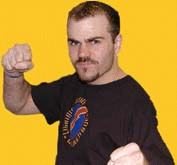
Mike Quackenbush is argueably one of the most talented independent wrestlers in the United States. "Quack" uses his own blend of humor and seriousness to talk about everything from his beginnings in wrestling, his book, and the CHIKARA school and promotion.
--------
STEIN: For those who might not have seen you before, how would you introduce yourself?
QUACK: I'm the skinny white guy that does all the wacky moves.
--------
STEIN: What motivated you to start wrestling?
QUACK: I was attracted to the grace of wrestling, the beauty of it. I saw a Jushin Liger and Brian Pillman match that was an aerial masterpiece. That's what made me want to be a wrestler. It wasn't guys like the Ultimate Warrior, that did the same four moves in all his matches.
--------
STEIN: Where did you start your wrestling career? Where did you get trained? What would you say to someone looking into training?
QUACK: I guess there's two ways of answering that. I started in West Lawn, PA in 1991. Then, after breaking in as a self-trained guy, I got the opportunity to train under Ace Darling for a while in 1997, which was sort of a new beginning for me.
For those thinking of breaking into the business, I would advise you to examine your motivations. If you're doing this for money, or fame, you'll never last. Do it because you love wrestling more than anything else, and commit to it wholeheartedly.
--------
STEIN: What interested you in pro wrestling? If particular influences, how so?
QUACK: The thing that I've always been most interested in are the moves, the actual wrestling moves themselves. I was always drawn to the wrestlers that could execute or apply exotic or new holds. If you can get past the punch, kick, and 15-minute promos, there's a beautiful art to professional wrestling.
--------
STEIN: You've written "From Bell to Bell" in 'The Wrestler', your own book 'Headquarters,' and other articles. What is your love with writing?
QUACK: Even before I wanted to be a wrestler, I was a writer. To a degree, wrestling is a creative outlet for me. Writing is as well, much more so, in fact.
I'm not a painter, or a musician, or craftsman of any kind. I like writing because it's something I can do every day, I can be as creative or wacky as I want to be, and there's no risk, no physical danger to it.
Wrestling is perilous, daring at times, and together, the two of them (wrestling and writing) give me a great array of ways I can express myself creatively.
--------
STEIN: Would you ever make a choice between wrestling and writing?
QUACK: I don't know that I'd ever have to, I do both, as often as I want, without compromise. However, I can only wrestle for so long. My body won't allow me to do this when I'm sixty. Provided I don't land on my brain too many more times, I should be writing long after I stop wrestling.
--------
STEIN: Any good books...next to 'Headquarters' you'd recommend?
QUACK: Right now, I'm reading "The Adventures of Kavalier and Clay," by Michael Chabon. It's very good, won the Pulitzer a year or two ago. I also read "Pure Dynamite" recently, by the Dynamite Kid Tom Billington. Excellent stuff. And I never miss an issue of "Black Panther," the comic by Marvel.
--------
STEIN: Why the name 'Headquaters'?
QUACK: There were many reasons, really. There's an allusion to it, in a symbolic sense, in the first chapter of the book. In the first chapter, I talk about a headquarters, a place where my best friend and I would go, and change into these ridiculous super hero costumes when we were kids. It's a place of transformation, and that theme carries through all twenty chapters. That's why I picked the title, or at least, that's the abridged version, anyway.
--------
STEIN: What is something you feel is still left to accomplish in your wrestling career?
QUACK: I have yet to tour Japan. It has been my goal, seemingly, for an eternity now. I will get there.
--------
STEIN: What do you like most about pro wrestling? What would you change?
QUACK: Right now, what I enjoy most is the variety. There's Osaka Pro and T2P and ARSION and EMLL and a world of products to choose from that are different, unique, fun and exciting. I like to look at wrestling in a global sense, and see what's going on not only here, but in Mexico, Asia, Europe and elsewhere.
In truth, American wrestling tends to bore me, but the reality is that groups like the WWF are just a small part of the global wrestling pie. I could tell you what I'd change in pro-wrestling, but that would take so long, it would be my next book.
--------
STEIN: Any plans FOR a 'Headquarters II'?
QUACK: Not at the time. Although there are a boatload of stories that didn't fit into "Headquarters," I think a sequel will have to wait. If the entire first print run of "Headquarters" sells out, then I think it would become a reality much quicker.
--------
IN: What is your comparison of American pro wrestling to Japanese Puroresu and Mexican Lucha Libre?
QUACK: There are similar elements, especially between pro-wrestling and puroresu, but really, they are three totally different things. There's the common thread of grappling, the archetype of the Greek morality play at work, the struggle of man against man, they all hold these things in common.
Beyond that, each style is about something totally different. They are related, but, like cousins that live in different parts of the world, they are each uniquely customized for the culture of which they are a part. There's a reason why lucha baffles some American fans. It's designed to work in a Mexican culture. Some people will get it. Some will not.
--------
STEIN: You're known to be quite inventive with your wrestling repetoire. What or who do you think is your biggest influence with your actual in-ring ability? What are some of your favorite moves that you've either created or brought into your wrestling from other places?
QUACK: My style at first was very much a Jushin Liger/Tiger Mask swipe. Now, it's more an equal blend, one part puroresu, one part lucha libre. Still, Tiger Mask and Liger are two predominant influences. One of my favorite moves was, in a way, handed to me by Mae Young and the Fabulous Moolah. I had the chance to chat with them a bit about Mildred Burke, the star around whom women's wrestling was built in the 1930's. Mae and Mildred wrestled a number of times through the years. They showed me Mildred's finishing move, called the Alligator Clutch. With their blessing, I've added the move to my repertoire, and use it as a finisher myself.
--------
STEIN: What is your opinion of the independent promotions in the PA/NJ area?
QUACK: There's a lot of good groups out there, and a lot of rotten ones as well. I've had the chance to work with some of the best groups out in this region of the country. Sadly, I've also had to suffer through tenures with the worst as well. It's a very competitive region, and I think when we launch CHIKARA as a promotion, what we do will be far removed from every existing product.
--------
STEIN: When do you expect CHIKARA to open as a promotion?
QUACK: We are targeting the spring/summer time to launch.
--------
STEIN: How do you think your training experience and professional experience will play into the program you and Reckless Youth have created at the Chikara Wrestle Factory? Why did you start the school?
QUACK: We formed the Chikara Wrestle Factory to answer what we saw as a growing need across the country. First, there are very few wrestling schools out there worth mentioning. Less than a handful. The Steel Dominion pops to mind. Maryland's Bonebreakers is an excellent school, and I'd wager that Pro Wrestling Iron in California will be turning out quality students in no time.
Beyond those, though, it seems like there's a school opening up on every corner, and there aren't enough good instructors to go around. We decided to pool our talents, Reckless and I, and form something that would both impact the independent circuit in a positive way, and be rewarding for us as well. Our emphasis will be on all styles of wrestling, not just the American style, and our goal is to create the most well-rounded students possible.
--------
STEIN: Where is the Steel Dominion training school?
QUACK: I could be wrong, but I think it's in Minnesota
--------
STEIN: When do you expect your first class of students to graduate from Chikara?
QUACK: That's up to them. We won't graduate anyone until we feel, and they feel, completely ready. I would say there won't be anyone ready to go before May.
--------
STEIN: Where does the name Chikara come from?
QUACK: It is the Japanese word for 'strength' or 'power.'
--------
STEIN: If there was ONE immediate change you could make in the way Americans think of the WWF as "the only way" for professional wrestling, what would it be?
QUACK: Well, that's a very foolhardy notion, to think that pro-wrestling begins and ends with the WWF. In fact, I feel sorry for those that watch nothing but WWF. Go to an independent show, for Pete's sake! Open your eyes to the world of wrestling that's out there!
--------
STEIN: Who is someone you've yet to wrestle that you want to go up against?
QUACK: Catherine Zeta-Jones. But don't tell Michael Douglas I said that.
--------
STEIN: Is there anything else you would like to add?
QUACK: If you want to look deeper into independent wrestling, please support my new book "Headquarters." It is not in bookstores. You can buy it through my website, www.MikeQuackenbush.com.
Please forgive the shameless plug, but copies of the book are starting to pile up in my basement. Buy three! Give them as gifts!