I. IDENTIFICATION (five of ten)
1. Gospel of Peter
The Gospel of Peter is an example of apocryphal literature arising out of the early gospel traditions. The Gospel was discovered in 1884 in a tomb at Akhmimin, Egypt (Gospel of Peter, Noncanonical Homepage, Introduction). It mostly likely dates around the 2nd century, based roughly on citations in the writing of Justin Martyr and other early Patristic period authors. Only fragments of the text have survived with the existent fragments presenting one of the earliest uncanonical accounts of the Passion and Resurrection. The fragments suggest a familiarity with the canonical Gospels. It is characterized by its anti-Jewish sentiment and Docetic tendencies. The Gospel does not hesitate to draw attention to the Jewish peoples sole responsibility for the death of Jesus. Even Pilot appears to escape from the blame attached to the Jews. “But of the Jews no man washed his hands.” (Gospel of Peter I.1) It can be interpreted as Docetic in because it appears to split the character of Jesus and Christ. Jesus is presenting as a kind of stand in for Christ, a laughing servant, and the humanity of Christ is rejected. At the Crucifixion, Jesus does not to suffer, overwhelmed by the spirit, “ he kept silent, as one feeling no pain.” (Gospel of Peter IV.11) At the tomb, angels descend into the tomb and reappear carrying another man, “the two sustaining the other, and a cross following after them.” (Gospel of Peter, X.39) When a voice from Heaven asks, in X.42, if everything has been accomplished, it is the Cross, not the body, that responds.
2. Gospel of Thomas
The Gospel of Thomas, dating from around the 2nd century, was discovered in 1945, in Egypt, among the Nag Hammadi codices. (Irvin & Sunquist p53) The text claims, “these are the secret sayings which the living Jesus spoke which Didymos Thomas wrote down.” (Gospel of Thomas, Gnostic Society Library) The “Gospel” is a collection of 114 sayings of Jesus, comparable more to the hypothetical Q sayings source than the narrative of the canonical Gospels. The sayings are clumped together with no apparent organizational principle, narrative or context. Many corroborate with canonical Gospel sayings, but lack of exact agreement suggests sources from earlier oral traditions.
The Gospel of Thomas contains many characteristics commonly associated with early Gnostic or Wisdom traditions. The sentences are allegorical, cryptic and oftentimes poetic in literary style: “Where the beginning is, there the end will be.” (Gospel of Thomas, 18) Jesus is depicted as a revealer of secret wisdom whose sayings are intended to lead an elect to recognize their spiritual origin and identity. In sentence number sixty-two, Jesus says, “It is to those who are worthy of my mysteries that I tell my mysteries.” Knowledge of self is equivalent with knowledge of the divine. “When you come to know yourselves...you will realize that it is you who are the sons of the living father.” (Gospel of Thomas, 3) A flesh-spirit dichotomy is evident in sentences such as number 29, “I am amazed at how this great wealth [spirit] has made its home in this poverty [flesh].”
3. Polycarp
Polycarp, one of the Ancient Church Fathers, was Bishop of Smyrna, appointed by the Apostles, and eventually martyred in 156 C.E. As a Bishop and theologian he defended the apostolic teachings and addressed some of the concerns of the early Church. Irvin and Sunquist note Polycarp visited Anicetus to discuss the dating of Easter. (IS, p79) He was a strong opponent of Marcion. Additionally, he addressed the Docetist heresy by seeking to “draw a boundary to acceptable Christian diversity regarding the reality of the flesh and blood of Jesus.” (IS, p43) In the Epistle of Polycarp to the Philippians (New Advent) he states, “For everyone who does not confess that Jesus Christ has come in the flesh is antichrist.” (Epistle of Polycarp, VII) In the Encyclical Epistle of the Church at Smyrna, Concerning the Martyrdom of St. Polycarp (New Advent) his martyrdom is described as a sort of exhortation to remember and honor the saints and martyrs. He is depicted in Christ like imagery and his martyrdom follows a similar sequence of events as that of the Passion of Christ.
4. Homoousios
Translated, “consubstantial”, the word takes its meaning from the greek words “homo” meaning “same” and “ousios” meaning “substance” or “nature”.The word occurs at the center of the Arian controversy which denied the divinity of Christ. The pre-nicean Church struggled with the apparent contradiction presented in Scripture of Jesus as the Son of God and as the eternal logos of John’s Gospel. Using Hellenistic philosophy, theologians such as Arius and Athanasius, attempted to understand the relationship between the Father and the Son. Arius denied the divinity of Christ because he held that God is ingenerate and since the Son came from the Father, he is generated and therefore can not be the same as nor equal to God. Concerned with the disunity these theological discussions produced in the empire, Constantine called together the Council of Nicea in 325 C.E. The Council concluded with a brief creedal formula that affirmed belief in Jesus Christ as the only begotten of the Father, begotten not made, of the same substance with the Father (homoousion). It then proclaimed anathema on those who maintain “another hypostasis or another substance” than the Father. (Nicean Creed, New Advent)
5. Diocletian
Diocletian, who persecuted the Christian Church between 297-306 C.E., became emperor of Rome during a period of internal and external crisis. In order to stabilize the empire, suffering from boarder disputes and increased rebellion and unrest, he established a tetrachy, dividing the empire into four regions, creating a virtual West-East split, with two pairs of Augustus-Caesar rulers. He lead the final wave of Roman Christian persecutions under the rationale that “Christians disrupted the unity of the empire by refusing to participate in its imperial religion.” (IS p161) Diocletian was a pious emperor who was worried about Christians who “refused devotion to the gods who supposedly look after Rome’s well being.” (IS p161) He required a libelli as proof of a citizen’s sacrifice to Roman gods, and the Imperial Cult. He forced Christians out of the imperial army, imprisoned clergy, destroyed buildings, and confiscated books. (Persecution Handout, p4) The persecution was greatest in the West.
II.b.The Christian theology of martyrdom was profound. Using two of the documents you read, describe their theological reflections on Christian martyrdom and identify what you see as the most important elements of that theology.
The early Church was heavily persecuted by Rome resulting in a profound theological understanding of Christian martyrdom in light of the Passion and Resurrection of Jesus Christ. Emperors who were concerned with stability and crisis were worried about impiety and lack of reverence for the roman gods who protected the empire. Diocletian, for example, required citizens to make sacrifices to the gods, and as proof obtain libelli. Christians who refused to worship the roman gods were accused of being atheists, and often sentenced to death.
The theology of martyrdom that developed emphasized apocalyptic expectation with a focus on the end times. Martyrs were considered powerful witnesses to the faith, and oftentimes described as athletes, who through perseverance in observance of Christ’s commands, received a crown for their victory over Satan. Often they were described in biblical imagery, either in terms of Christ himself or with Old Testament themes such as Daniel in the Lion’s Den or the Companions in the Fiery Furnace. Origen furnishes several characteristics of martyrdom in his Exhortation to Martydom. He considers Christ the True Martyr who works in the lives of believers. The martyrs following in his pattern are configured to him and join him in his fight against Satan. Christ leads the martyrs to participate in his crucifixion which is a sign of their love for him. By their martyrdom they become the elect of God and are numbered among the Apostles. Termed “baptism in blood,” martyrdom is considered a means of atonement for sins. Two texts which illustrate some of these characteristics include The Encyclical Epistle of the Church at Smyrna, Concerning the Martyrdom of St. Polycarp (New Advent) and Eusebius’ account of the martyrs of Gaul under Verus, highlighting the martyrdom of Blandina, in Historia Ecclesiastica, Book V, Chapter I (New Advent).
Polycarp, the Bishop of Smyrna, was executed under the pretense that he was “the destroyer of the gods” and that he taught “many not to sacrifice and not to worship.” (IS, p71) The narrative is similar in sequence and draws its imagery from the Passion narrative of Jesus. Polycarp prophecies his death (V), is betrayed and handed over to Herod (V). “This all happened that he might fulfill his special lot, being made a partaker of Christ.” (VI) His betrayer suffers, “the punishment of Judas himself.” (VI) Polycarp like Jesus, is led into the city on an ass on the Sabbath. He is brought into a stadium where he is asked to sacrifice and curse Christ. (VIII) A voice from heaven urges him to be strong, and thus he refuses to revile Christ and confesses himself a Christian. (IX-X) He is threatened by wild beasts, but is sentenced to die by fire when he reacts obstinately to their threats. (XI) He is lead, “filled with confidence and joy” (XII) to the pyre, built with the fuel collected by the Jews. He is bound, looking “like a distinguished ram taken out of a great flock for sacrifice,”(XIV) and prays in thanksgiving, that he should be worthy of such a sacrifice and counted among the martyrs. In the chapters that follow, he is placed in the fire, but uninjured in a scene reminiscent of the three companions in the fiery furnace in the book of Daniel. “For the fire, shaping itself into the form of an arch, like the sail of a ship when filled with the wind, encompasses as by a circle the body of the martyr.” (XV) A guard is ordered to pierce his side, from which a dove and blood pour forth extinguishing the fire. (XVI) The authorities, refuse to give the body to the Christians, “lest forsaking Him that was crucified they begin to worship,” Polycarp as well (XVII). The document concludes with praise of the martyrdom of Polycarp, “whose martyrdom all desire to imitate,” because it was “consistent with the Gospel of Christ”. (XIX) The author remarks that it was through patience that he overcame evil and “thus acquired the crown of immortality,” and is now, “with the apostles and all the righteous in heaven.” (XIX)
Eusebius describes the persecutions in Gaul under Emperor Verus in Chapter I, Book V, of the Historia Ecclesiastica. He tells the “tale of men doing brave deeds for truth,” in order to “hand down to imperishable remembrance the discipline and much-tried fortitude of athletes of religion, the trophies won from demons, the victories over invisible enemies, and the crowns placed upon their heads.” (Intro) The martyrs in his account are characterized as athletes, who endure multiple trials or contests to win the “crown incorruptible.” No figure exemplifies this more than the woman Blandina who was tortured “from morning till evening in every manner,” until her persecutors were forced to “acknowledge they were conquered and could do nothing more to her.” (P2) Eusebius remarks that she was a “blessed woman, like a noble athlete” who strengthened and confirmed her companions and astonished her assailants by her endurance. She is eventually lead into the amphi-theater to be exposed to wild-beasts. There she is suspended on a stake, appearing “as if hanging from a cross.” (P4) She inspired the others with her, who “beheld with their outward eyes, in the form of their sister, him who was crucified for them.” (P4) Reminiscent of Daniel in the lion’s den, none of the beasts touched her, and she was returned to prison, although some days later killed.
III. a. Cornel West has said that tradition is something that must be fought for. Identify and discuss three issues that the Church had to resolve in order to ensure its own tradition in the face of divergent groups and theology.
The history of the early Church is certainly bloody. It would seem Cornel West is correct in his assessment that tradition must be fought for. Yet Catholic tradition has never been static, and I would further emphasize that not only must it be fought for to ensure its survival but also to necessitate its development. The Christian persecutions, which produced both confessors and apostates, raised the issues of authority and group identity and contributed to the deepening of the understanding of the unity of the Church and the role of the Bishop. Marcion’s rejection of Jewish Scriptures forces the early Church to formalize the canon of Scripture. Finally, the iconoclast crisis, which resulted in considerable bloodshed, led theologians like John of Damascus to probe deeper into the mystery of the Incarnation.
The Christian persecutions under emperors like Diocletian, previously discussed in more depth elsewhere in this document, lead many Christians to apostatize. Even if not formally rejecting Christ and making sacrifices to the roman gods, many Christians were known to have purchased libelli rather than be executed. The rigorism of the early Church considered these acts serious enough to put the individuals outside of salvation permanently, thus raising the question of who could be accepted back into the Church. Besides the apostates, another class of Christians arose out of the persecutions. The confessors were men and women who having been subjected to torture, had endured the test and proven their faith. Since martyrdom was linked to charismatic prophecy in popular Christian thought, they were given a certain authority which brought them into direct tension with ecclesial leaders. With respect to apostates, confessors where generally more forgiving, since they had first hand experience of the suffering persecution entailed, and more anxious to reconcile them to the Church than the bishops. Thus the Christian persecutions opened up serious questions about the identity of Christians, who was “in” and who was “out, as well as the issue of authority.
Cyprian the Bishop of Carthage in his treatise, On the Unity of the Church (New Advent), attempted to resolved these issues, which were particularly significant to him as bishop because he had fled persecution and lost face to those who stayed behind. His solution was to emphasize the unity of the Church, centered around the bishop, stressing Matt 18:20, “wheresoever two or three are gathered together in my name, there am I in the midst of them.” (I.12) He considered the “concord of peace” a prerequisite for an individual to be a member of the Church and held that those people who are not in union with their bishops, even if slain, cannot be martyrs since they were not technically in the Church. (I.13) He lessened the status of confessors by acknowledging that confession does not make a man free from the snares of the devil, and highlighting the hypocrisy and sinful behavior of some confessors.
The formation of the canon of Scripture was as much of a theological brawl as the early struggles between the bishops and confessors. At the center of the battle was Marcion and his followers, who wanted a Christianity uncontaminated by Jewish influence. Marcion believed the Jewish Scriptures could not be reconciled with the New Testament, and completely rejected the Old Testament. He held that the Creator God of the Jews was not the same God as the Father of Jesus Christ, who was the Supreme God. He edited passages he considered to be influenced by Judaism. He held that the Apostles and Evangelists had misunderstood the teachings of Christ. Therefore, he accepted a limited canon of the New Testament, which only included one of the four canonical Gospels, Luke.
The issue of Marcion was addressed by Irenaeus in his work, Adversus Haereses, Book IV (New Advent). He disagreed with Marcion and held that the One God, whom Jesus preached, was the same God of both covenants. Not only was the Old Testament inspired by the same God who inspired the New Testament, but everything in the Old Testament foretold Jesus’ Advent and Passion. (IV.9.1) He quotes John 5:46, “For if you believed Moses, you would believe me, for he wrote of me.”
Perhaps one of the bloodiest and longest battles centered in the East over the issue of icons. “Throughout the churches of the Greek East, icons had long been a prominent part of the devotional life of the people.” (IS,p360) They were venerated, not for their material value, but for the spiritual realities they embodied. Influenced by the rise of Islam in the East, had a definite prohibition against images in worship, many considered the veneration of icons contrary to the commandments of God. Exodus 20:4-5 states that, “You shall not carve idols for yourselves in the shape of anything ... you shall not bow down before them or worship them.” In 730 C.E. Emperor Leo issued an edict prohibiting icons. Soldiers stormed the cities pulling down icons. The people rioted. In 743 C.E., Constantine V called together an iconoclast Council that reinforced the edict of his father Leo. They held that depiction of the divinity was impossible, that images only depicted the humanity of Jesus, and mindful of Nestorianism they rejected anything which appeared to separate the natures of Christ. Many iconophiles were martyred in the aftermath, and many monasteries raided and destroyed.
John of Damascus attempted to solve the icon problem by considering it from a Christological perspective. He “located the theological foundation for the practice of venerating icons in the event of the Incarnation.” (IS,p363) He held that in the Incarnation, material had been the vehicle for the divine. He maintained that divinity could be represented by material images in much the same way that divinity was represented in liturgy. Another great theologian, Basil the Great, attempted to solve the problem by positing the idea that the honor given to the image passes to the prototype, that he who reveres an image reveres the prototype. His idea was later picked up by the iconophile Council of Nicea II in 787 C.E., which citing tradition and Basil, affirmed that churches should have icons and allowed for a widespread acceptance of them.
IV. a. What is a Gnositic? Compare and contrast Tripartate Tractate 14 with Clement of Alexandria’s Stromateis IV.22.
The term “gnostic” is derived from the Greek word “gnosis” meaning “knowledge” or “wisdom.” It is difficult to define Gnosticism because numerous and varied instances of gnostic interpretation exist. In addition, much of what is known of the early gnostics comes from anti-gnostic sources. In the most general sense, Gnosticism is characterized by the idea that knowledge, by experience rather than reason, is the result of an interior divine spark. The divine spark is part of the uncreated divine and dwells inside people where it is in need of freedom from the prison of the material body. Freedom is achieved by recognition of the true spiritual identity of the divine spark. Salvation is achieved by the experience of knowledge which allows the divine to recover its heavenly origin. This duality of spirit and matter, regarded the spirit as good, uncreated, original whereas the flesh or matter was considered bad, created and fallen. Such a metaphysical view tended to support a threefold social division, or caste system: the elect or pneumatics were associated with the spirit, the psychic class with both spirit and body, and the hylics with the realm of matter.
A rather intricate cosmology, heavily influenced by Hellenistic and Platonic concepts, was developed by the gnostics to explain the creation of sinful or fallen matter. The first principle was pure spirit. The original unity of the first principle split into a hierarchy of emanations, called Aeons, forming a heavenly “pantheon,” termed the Pleroma, that represented the realm of pure spirit of which the material order is a reflection. Accidently Sophia, the lowest Aeon, created a new entity named the Demiurge. The creation of the Demiurge and his subsequent material realm upset the balance of the Pleroma. Christian influenced gnostics believed Christ, was the Savior Aeon sent to restore balance to the Pleroma.
Gnosticism had a significant effect on the formation of the early Christian Church. One of the preeminent gnostic teachers, Velantinus, was even considered for the papacy. (IS,p115) Many Christians attempted to re-articulate the gospel of Jesus in light of gnostic teaching, and many Christians were well versed in gnostic principles. “Gnostics valued the names of several of the women disciples, such as Mary Magdalene and Salome more than the Catholic writers.” (IS, p88) Gnostics claimed to be Christians and followers of Christ but their appeal to outside, higher spiritual realities, reserved for the elite and not for everyone, put them in opposition to the Church authorities. Many early Church leaders, such as Irenaeus, heavily rejected Gnosticism which they considered a serious threat to the stability of the Church. The distinction between Gnosticism and early Christianity was not clear and the problem of how to handle the “attraction of a separate Gnostic movement,” (IS,pg90), greatly influenced Clement who sought to be faithful to the apostolic teachings and faith of the Church while seeking a “universal philosophical framework in which the articulation of the mystery of the Christian faith could be understood by those who were truly wise.” (IS,p124) Clement held that all philosophies could be useful for understanding the gospel because all wisdom that taught righteousness had been inspired by God. (IS,p123) Although, more sympathetic to the gnostics than Irenaeus, he did not endorse Gnosticism, rather he admonished Christians not to reject the unity of the Church and cautioned against causing others to stumble. (IS, p123)
The Tripartite Tractate 14, from the Nag Hammadi codices (Gnostic Society Library) describes a gnostic understanding of the partition of mankind into three types: the spiritual, the psychic, and the material. The author holds that the types of mankind are distinguished “by their fruits,” which can only be known in light of the Savior who reveals them. He characterizes the spiritual race, as being like “light from light”, pure spirit. They receive the knowledge of the Savior eagerly and therefore will receive salvation. The material race, is the opposite of the spiritual, they are “alien in every way”, being like darkness, they shun the light of knowledge, are hateful and seek to destroy the Lord and his revelation. Thus, they will receive destruction rather than salvation. The psychic race, is like “light from a fire,” members of this class hesitate to accept the knowledge of the Savior and they occupy a middle ground in terms of salvation. They are brought forth and created according to their determination for good and evil. Those with a good disposition are saved, but those brought forth from wrath must learn to relinquish wrath in order to receive the reward of salvation else they will suffer the punishment of destruction. The document concludes with the remarks that “those that do not acknowledge that the Son of God is the Lord of all and Savior...will receive judgement for their ignorance and their senselessness,” while those that “confess the Lord and the thought of that which is pleasing to the church...will have a share in her hope.”
In contrast, Clement rejects any kind of notion of a class system and appeals to a more universal understanding of human nature in Stromata IV.22. He holds that a man of true understanding and wisdom does good without regard for punishment or reward, but only for the sake of the good itself. He continues, “to desire to knowledge of God for any practical purpose ... is not proper to the Gnostic ... people who devote themselves to knowledge for the sake of knowledge are subject to prolonged ‘perpetual exertion’.” He considers the teachings of several prominent Hellenistic philosophers including Socrates, Heraclitus and Epicurus. He criticizes Epicurus’ view, that the wise man “would not do wrong to anyone for the sake of gain; for he could not persuade himself that he would escape detection,” on the grounds that if this where true then and the wise man could get away with it, he would do evil. He concludes the chapter by stating that the wise man, or true Gnostic, is one who obeys, “neither from fear, nor for enjoyments,” and is on his way to knowledge being “drawn by the love of Him who is the true object of love.”
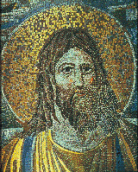
V.b. What is the connection of this image with Athanasius’ Trinitarian theology? How did Athanasius revolutionize Trinitarian thought?
Rome: Santa Pudenziana.
Apse Mosaic: Christ. 390 C.E.
The image of Christ from Santa Pudenziana is characteristic of the change in Christ imagery that occurred following the Council of Nicea in 325 C.E. The council, inspired by Athanasius’ revolutionary Trinitarian theology and use of the term ‘homoousios’ to describe the relationship between the Father and the Son of God, was an immediate reaction to Arianism which denied the divinity of Jesus and a proximate reaction to the plethora of Trinitarian theologies that arose out of the first three centuries of Christian reflection on the mystery of the Godhead. The Apostolic Fathers, writing from pastoral need, referred to the Father, Son, and Spirit but were not troubled by the relationship between the distinct persons. As Hellenistic philosophy began to make significant inroads into mainstream Christianity, individuals began to consider more philosophically the relationship between persons and the seemingly contradictory statements of Scripture. Questions such as how to understand “Son of God” (Matt 11:27) and the pre-existing eternal logos of John 1:1. Or how to interpret the subordination of the Son to the Father in Phil 2:6, ““though he was in the form of God, he did not regard equality with God something to be grasped.” Or how to reconcile the pre-existing logos that was equal to God in John 1:1 with the unequal “image of God” and “firstborn of creation” of Col 1:15.
Arius attempted to solve the problem by establishing a contradistinction between the Son and the Father. He held that only God is unoriginate or ingenerate. The Son, in so far as he is the offspring of the Father, is generated, having at one time not been. He concluded the Son is not the same nor equal to the Father. In a manner similar to the Neoplatonic Divine Intellect, Arius subordinated the Son to the Father. For him, the Son was created by the divine will, before time, but not like other creatures, and acts as a sort of mediator between God and the created order. (Comparison of Arius and Athanasius handout)
Athanasius believed that if Christ was not God then there was no hope for salvation. Like Arius he acknowledged one God, alone ingenerate, but who begat an “Only begotten Son” not in semblance but in reality and not as a creature produces offspring. In De Decretis (Trinitarian Theology Handout) he explained “men’s generation is in one way, and the Son is from the Father in another.” (pg25.11) “God, in that he ever is, is ever Father of the Son.” (pg26.12) Using the analogy of the “illustration of light and radiance” he states “truly the light and the radiance are one, and the one is manifested in the other, and the radiance is in the sun,” (pg27.24) He quotes Theognostus, “the essence of the Son is not procured from without ... but it sprang from the Father’s essence, as the radiance of light ... [which is not] the sun itself, nor is it alien.” (pg28.24) Thus, Athanasius defined the doctrine that would later be accepted by the Council of Nicea: Jesus is the only begotten Son of God, born of the Father before all ages, begotten not made, consubstantial to the Father.
Early Christians had no problem adapting for Christian usage pagan images which they considered as having been inspired by God. The Christ Helios mosaic from the Vatican Necropolis, as well as the Jesus as the Good Shepherd from the Crypt of Lucina in the Catacombs of Callistus in Rome, demonstrate a conscious effort to utilize pagan symbols and typologies to depict the person of Jesus. Prior to the Council of Nicea, one of the most commonly used typologies was that of the young beardless Greek god Apollo. One of the greatest of the Olympian pantheon, he was the god of intellect, wisdom and prophecy. In contrast, Zeus the father of Apollo, was the powerful chief of the olympian gods, and was depicted as an old man who was often seated as a sign of his authority and power. Thus the Christian use of the Apollo image, conveyed the Christological understanding of Jesus as the Word and Wisdom of God, and the Son of God who was the subordinate offspring of the eternal ingenerate Father God. After Nicea, there was a deliberate effort to depict Jesus as the “visible image of the invisible Father” (Col 1:15) after the manner of Zeus, like the older bearded Christ from Santa Pudenziana. The sudden shift in Christ imagery that followed reflected the revolutionary understanding of Athanasius that affirmed the identity of Jesus as the only begotten Son who is consubstantial to the Father.