THE CATHOLIC UNIVERSITY OF AMERICA
A PHILOSOPHICAL DEFINITION OF COMIC STRIPS
By
Nathan D. March
Dr. Druart
PHIL 353 History of Ancient Philosophy
18 November 2002
Aristotle asserts that all art is a mode of imitation. In the modern era comic strips are a popular art form. Following Aristotle’s definition of Tragedy in the Poetics, a comic strip can be defined as an imitation of an action that is comedic, complete in itself, with incidents of the ridiculous that accomplish a catharsis of such emotions signified by the arousal of laughter. Aristotle claims the aesthetic arts are philosophical since their nature is of the universal. Therefore, the laughter that arises from the recognition of the ridiculous in the comic strip must serve a philosophical purpose namely to point to the existential comedic dimensions of the ontological human experience.
Each form of art differs from other forms in their means, objects, and manner of imitation. (Poetics 1) Comics are distinct forms of art in that they are printed media intended for distribution in periodicals such as newspapers. They are composed of lines, shading, and dots created with pens, pencils, paintbrushes, or other such instruments by the comic artist. They make use of written language and visual elements such as recognizable images and familiar characters.
A comic strip is a representation of an action or actions, either as a combination of incidents forming a sequence with an end, or the final end of action itself, with the intent of producing a comedic catharsis signified by laughter. Catharsis occurs for the reader at the moment of instantaneous recognition of the ridiculous discovered in a play on words, a double entendre, or an unpredicted or implausible outcome of an action.
Each comic strip is complete in itself, although possibly situated within a larger whole or history. Individual frames form self-contained incidents. Each frame contains agents who exist for the sake of the action and who possess qualities of character and thought. The agent is a caricature similar to a human person in likeness but not image. The caricature is often represented with distorted or exaggerated physical features and sometimes as anthropomorphic animals or objects. However, in each case the caricature is similar in likeness to human persons in that they posses an analogous nature with the capacity for moral and human like action. The thought of the agent is shown in all that the agent says. The character allows the reader to ascribe moral and human qualities to the agent. Together they highlight the distinction between virtue and vice as a necessary dimension of human nature. (Poetics 2) They reveal the ridiculous, illogical or ironic consequence of the action performed. In doing so they derivatively reveal something of the possibility of human action.
The three comic strips chosen for this paper include one comic from Mike Twohy’s series “That’s Life”, one from Frank Cho’s series “Liberty Meadows”, and another from Scott Adams’ “Dilbert” series. Each of these comics was obtained from the Comics.Com web site and is nationally syndicated, appearing daily in multiple newspaper publications. I chose these comics for their varied use of color, style, layout, situations, and characters. I believe they represent a broad spectrum of the entire comic strip genre.
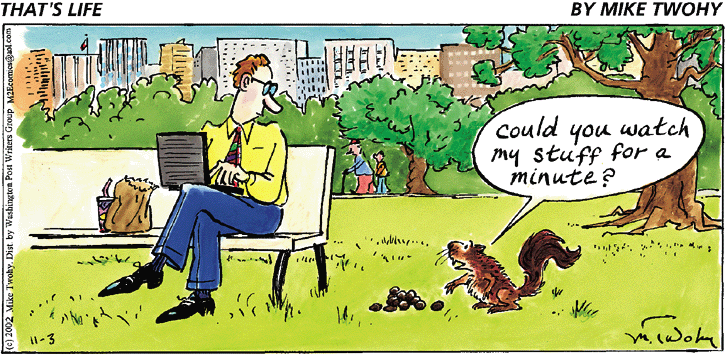
The first comic strip, from Mike Twohy, imitates a conversation between a businessman working on a park bench and a busy squirrel. The comic contained in a single frame, represents the action of being interrupted at work by another person with a request. The comic is in color, most likely inked in pen then colored with a marker or watercolor paint. The action depicted in the frame is the ridiculous situation of the squirrel initiating a conversation with the man on the park bench. The two agents of the action are caricatures, one of a stylized stereotypical businessman with glasses, tie, laptop, and pointy shoes, the other of a busy, scraggly squirrel with a stack of harvested nuts. The squirrel possesses human like qualities such as the ability to talk. The situation and setting of the scene is familiar; many readers may have had an experience of going about daily activities outside and observing squirrels harvesting nuts. However, this situation is humorous because the squirrel initiates a conversation. The moral character of the two agents is juxtaposed calling into question the relationship between the two. Is the significance the importance humans place on their work and activities? Is the businessman inconvenienced by the request? Is his work more important and of greater moral significance? The comic asks the reader to question the conventions that ascribe meaning to work and occupational roles.
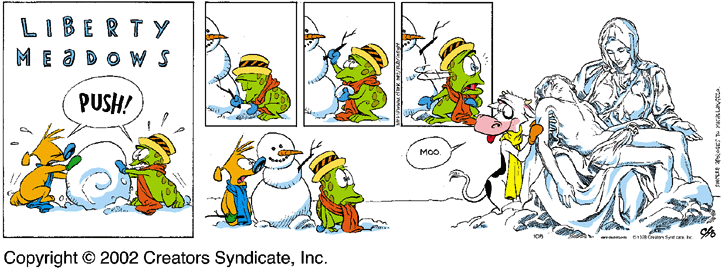
The second comic strip taken from Frank Cho’s “Liberty Meadows” series presents two animals, Leslie the frog and Ralph the midget circus bear, struggling to build a snowman only to finish the arduous task and discover a cow has effortlessly constructed a replica of Michaelangelo’s Pieta. Like the comic before it, it is in color and makes uses of anthropomorphic animals capable of human action and speech to represent the action. Multiple frames are utilized to establish the difficult sequence of events the two heroes engage in to produce their simple snowman. Although the comic is complete in and of itself, it can be understood within the larger context of the “Liberty Meadows” corpus. Leslie and Ralph are two reoccurring figures in the series. Additionally, this comic falls within a series of strips depicting the snow sculpture competition between the two heroes and the cow. The ridiculous part of the comic is the juxtaposition of two characters struggling to construct a basic snowman with the master work created by a simpleton like character personified by the cow who can only exclaim, “Moo.” The strip reveals the arbitrariness of assignment of artistic talent to individuals.
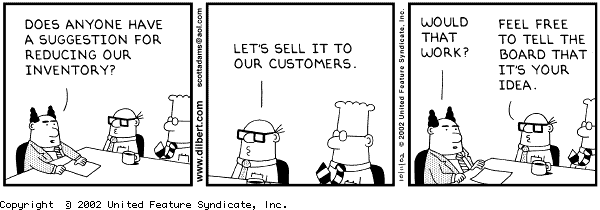
Finally, the Dilbert comic strip imitates an all too familiar scenario for the reader in today’s technologically driven corporate world. At a company meeting, the boss asks the engineering staff for suggestions to reduce inventory, with Wally the engineer replying, “Sell it to customers.” Unlike the previous two comic strips this strip is only drawn in black and white and does not make use of animal caricatures. The comic follows a series of actions, specifically moments of conversation between persons. The characters are stylized and stereotypical. The reader is meant to ascribe moral characteristics to each character. The manager or boss, who wears a sports jacket, is pointy haired, ignorant and considered of bad moral character. In contrast the engineers, depicted as wearing glasses, drinking coffee, and intelligent as evident by the pens and pencils in their shirt pockets, are to be considered of good moral character. The irony of Wally’s statement is that inventory is supposed to be sold to customers and true reduction of inventory occurs when customers buy it. The humor is found in the fact that the engineer seems to grasp the nature of business better than his manager. The comic strip therefore reveals the arbitrary assignment of positions of responsibility regardless of moral worth or qualification of the individual.
Comic strips are popular because people enjoy reading them. People find pleasure in comic strips because as human beings they delight in learning and learn by modes of imitation. (Poetics 4) Pleasure is a feeling that arises at the completion of an activity. (Nicomachean Ethics X:4) For the spectator, the activity of reading a comic strip is culminated in the final end of discovering the ridiculous. In this was a comic strip is pleasurable independent of the particular feelings of deformity and ridiculousness it produces. Aristotle explains the similar significance of tragic catharsis, as a relief of the emotions of fear and pity, although he gives very little information concerning the catharsis of comedy. Perhaps the purpose of comedy is to release the emotion of resentment or anger associated with the recognition of the arbitrariness of human life regardless of justice or moral character.
The relationship between tragedy and comedy is interesting. Aristotle presents tragedy in terms of its effect on the spectator to produce feelings of pity and fear arising from the revelation of the heroic but doomed struggle of man against fate. What makes tragedy tragic is that it offers no solution but to accept fate. In this respect tragedy is an appeal to tradition and religion. Comedy on the other hand reveals the potentially conventional and arbitrary nature of life and encourages the spectator to question the assumptions and foundations of his or her understanding of reality. In this respect comedy is a more philosophical activity. Perhaps this is why Plato places Agathon’s speech after Aristophanes’ speech in the Symposium.
Comic strips are philosophically significant because they force a confrontation with the ridiculous and encourage reevaluation of the ontological. Since comic strips end with an illogical, unpredicted or ironic outcome they instantaneously reveal something new, what was not predictable by reason, a new possibility. Discovery as an action is always associated with pleasure. Thus comics are a philosophical activity that forms a mode of imitation, of discovery and learning, which is pleasurable and enjoyable.