
 |
 |
|
|
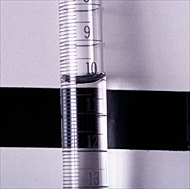
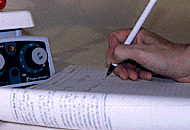
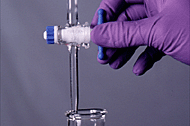
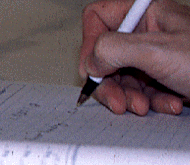
Take an initial volume reading and record it in your notebook. Before beginning a titration, you should always calculate the expected endpoint volume. |
 |
|
|
|
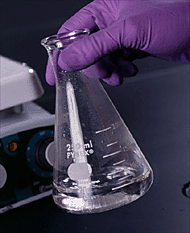
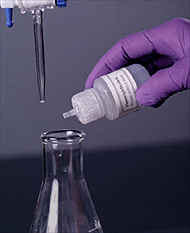
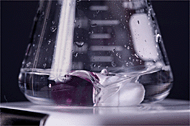
Prepare the solution to be analyzed by placing it in a clean Erlenmeyer flask or beaker. If your sample is a solid, make sure it is completely dissoloved. Put a magnetic stirrer in the flask and add indicator. |
 |
|
|
|
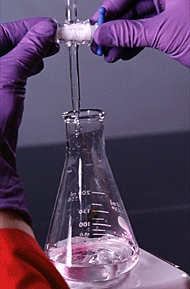
Use the buret to deliver a stream of titrant to within a couple of mL of your expected endpoint. You will see the indicator change color when the titrant hits the solution in the flask, but the color change disappears upon stirring. |
 |
|
|
|
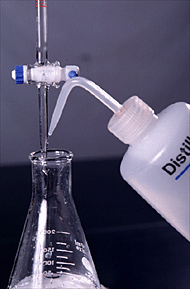
Approach the endpoint more slowly and watch the color of your flask carefully. Use a wash bottle to rinse the sides of the flask and the tip of the buret, to be sure all titrant is mixed in the flask. |
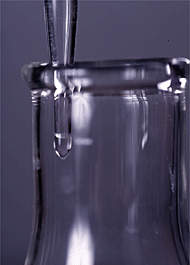
As you approach the endpoint, you may need to add a partial drop of titrant. You can do this with a rapid spin of a teflon stopcock or by partially opening the stopcock and rinsing the partial drop into the flask with a wash bottle. Ask your TA to demonstrate these techniques for you, in the lab.
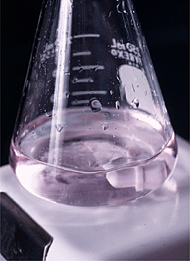
Make sure you know what the endpoint should look like. For phenolphthalein, the endpoint is the first permanent pale pink. The pale pink fades in 10 to 20 minutes.
If you think you might have reached the endpoint, you can record the volume reading and add another partial drop. Sometimes it is easier to tell when you have gone past the endpoint.
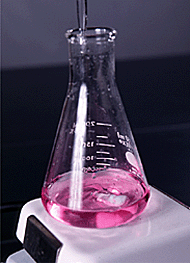
If the flask looks like this, you have gone too far!
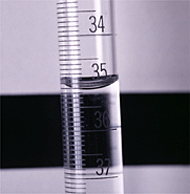
When you have reached the endpoint, read the final volume in the buret and record it in your notebook.
Subtract the initial volume to determine the amount of titrant delivered. Use this, the concentration of the titrant, and the stoichiometry of the titration reaction to calculate the number of moles of reactant in your analyte solution.
|
HOME |