Introduction | Task | Process | Evaluation| Conclusion | Other Resources
Is there intelligent life in the universe? Unless one is a complete cynic the answer is obviously yes. It is beyond dispute that the third planet in the system of Sol, which we know as Earth, supports intelligent life forms known as humans. This much is evident. But what about elsewhere? This is a question which has haunted scientists, philosophers, visionaries, and even theologians for hundreds, if not thousands of years.
But let us step back for a minute and think about non-intelligent life. The aforementioned planet Earth is home to millions of non-intelligent life forms, but what about other planets? This question is the crux of the relatively new scientific field known as astrobiology.
Although there is no answer to this question yet, and no evidence save some highly disputed fossils which are smaller than bacteria, there is no shortage of opinions. Some, such as astronomers Frank Drake and the late Carl Sagan, believe that the universe around us is virtually teeming with life, while other thinkers, such as biologist Ernst Mayr and physicist Frank Tipler, believe that humans are the sole inhabitants of the cosmos. Many others hold views between these two extremes.
Science fiction has produced a number of images of imaginative aliens. Authors such as Greg Bear, Gregory Benford, Ben Bova, David Brin, Jack L. Chalker, C.J. Cherryh, Hal Clement, Philip K. Dick, Harlan Ellison, Philip Jose Farmer, Harry Harrison, Nancy Kress, Anne McCaffrey, Larry Niven, Jerry Pournelle, Robert Silverberg, Clifford D. Simak, Vernor Vinge, and James White have had particularly interesting ideas on extraterrestrial life.
In this activity, you will be asked to research questions regarding astrobiology after viewing web-based information regarding the field. In many of these questions you will be required to provide an opinion and defend that opinion using the information you have acquired. Some questions are mathematically based and may require the use of a calculator or Excel spreadsheet.
LIFE
| 1. What element is human life based upon? | |
| 2. Is this the only element upon which life can be based? If not, what other element(s) do scientists believe are viable, and why? | |
| 3. What are the chances that extraterrestrial life forms will look like humans? | |
| 4. Explain the theory of panspermia. | |
| 5. What are extremophiles? How do they relate to astrobiology? What are some examples of extremophiles? |
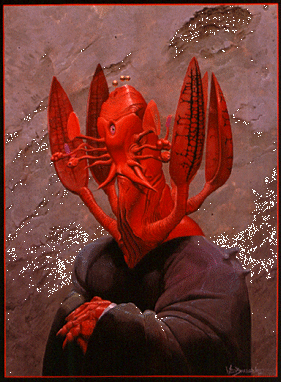
Image from http://www.artsforge.com/gallery_new/giger/barlowealien.gif
SPACE
| 1. If we are interested in finding life on other planets, why do we not simply send spaceships to look for it? | 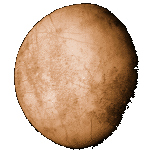 |
| 2. What is the main instrument being used to search for intelligent extraterrestrial life? |
3. Within our solar system, what do you believe are the most likely locations life outside Earth will be found (hint: remember water is an essential ingredient for the development of life)?
4. What is Fermi's Paradox?
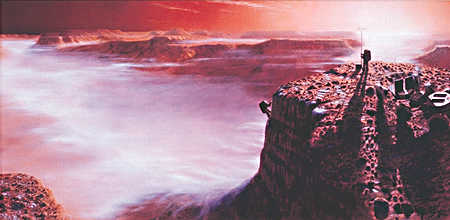
Image from http://seds.lpl.arizona.edu/nineplanets/nineplanets/europa.html
DRAKE EQUATION
1. State the Drake Equation.
| 2. Solve the Drake Equation for
the following parameters: a.) There are 100 stars formed each year in the Milky Way. b.) Planets encircle fifteen per cent of these stars. c.) There is only one “earthlike” planet around each star. d.) Life develops on ten per cent of these planets. e.) Intelligent life evolves on fifty per cent of these planets. f.) Seventy per cent of these life forms develop advanced technology. g.) The “lifetime” of these civilizations is one hundred thousand years. |
 |
3. If any of the parameters in the Drake Equation are zero, how many civilizations should we expect to hear from?
Image from http://www.seti-inst.edu/Welcome.html
LIFE
| 1. The element human life is based upon is _________. | [7 kb] 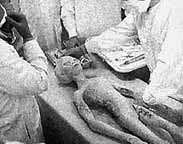 |
| 2. The other element upon which life can be based is ____________. | |
| 3. The chances that alien will look like humans are_________________. |
4. The theory of panspermia is __________________________________
_______________________________________________________________.
5. Extremophiles are defined as ______________________________________
__________________________. They are relevant to the study of
astrobiology because _______________________________________________
__________________________________________________________________.
Some examples are ________________________________________________.
Image from http://www.trudang.com/autopsy/autface1.html
SPACE
| 1. We do not send spaceships
for the following reasons: ________________ ________________________________________________________________. |
 |
| 2. The main instrument being
used to search for extraterrestrial life is the ____________________________________. |
|
| 3. The most likely locations
are ____________________________________ _______________________________________________________________. |
|
| 4. Fermi's Paradox is
_______________________________________________ ________________________________________________________________. |
Image from http://www.hobbyspace.com/SolarSciFi
/DRAKE EQUATION
| 1. The formula for the Drake Equation is _____________________________. |  |
| 2. The number of civilizations we can expect to find is ________________. | |
| 3. The number of civilizations we can expect to find is _________________. | |
IImage of Dr. Frank Drake from http://www.seti-inst.edu/seti/seti_science/Welcome.html
Web page of the SETI Institute:
http://www.seti-inst.edu/Welcome.html
For specific information on the Drake Equation:
http://www.seti-inst.edu/seti/seti_science/Welcome.html
Astrobiology at NASA
http://astrobiology.arc.nasa.gov/
For information on panspermia:
http://astrobio.net/news/article318.html
For information on extremophiles:
http://www.astrobiology.com/adastra/extremophiles.html
The Encyclopedia of Astrobiology, Astronomy, and Space Flight:
http://www.angelfire.com/on2/daviddarling/ETEmain.htm
The Nine Planets: A Multimedia Tour:
http://seds.lpl.arizona.edu/nineplanets/nineplanets/
SETI Institute Education Projects:
http://www.seti-inst.edu/epo/Welcome.html
The Astrobiology Index:
http://www.lyon.edu/webdata/users/dthomas/astrobiology/astrobiology.html
Sites for aspiring astrobiologists
Center for Astrobiology at the University of Colorado:
http://argyre.colorado.edu/life/CAB.html
Astrobiology Department at the University of Washington:
http://depts.washington.edu/astrobio/
More on “life at the edge:”