A discussion of the various approaches attempting to enlighten the links between intelligence, cognition and language and their relevance to literacy practices.
Literacy has been generally defined as the ability to read, write, use numbers and to find information and use it appropriately. Recent research and projects implemented worldwide are based on the believe that literacy, as an Industrial Age concept, has transformed to include affective as well as cognitive understanding, in the culture of the Information Age. Despite some scholarly tilting, or lexical inflation, of the polemics revolving around literacy, there is considerable support for viewing literacy as a continuously evolving concept allowing for a more liberal understanding and hence development of the initial ideal of the universal right to be able to read and to write. Because literacy depends on information, and because information is expanding at a fast rate, the mere ability to read and to write is being translated into the ability to read, write, and to develop the capacities to understand, absorb, assimilate, and digest information.
Literacy In Malaysia
In Malaysia there is a growing concern for developing literacy at the national
level, be it in English or in the national language, Bahasa Malaysia. Reading
and writing have been acknowledged as important aspects of the curriculum. The
Education Ministry as the mainstay of literacy development has embarked on
various reading and writing projects at the school and tertiary levels. In the
1970's the ELRP programme was implemented in selected secondary schools. The
implementation of the KBSM syllabus saw the introduction of the The Class
Readers Programme.(Mukundan et.al.1998:2) Graded readers were sent to primary
and secondary schools through the country. The most recent attempt to increase
literacy and encourage the reading habit was the implementation of the
Literature in English Programme.
Literacy and Early Learning Theories
French philosopher Jean Jacques Rousseau(1712-1778) advocated a liberalism in
education. Rousseau believed that a child's learning unfolds naturally and
should not be tampered with. He believed that children learn through curiosity
and imposing learning on them disturbs the equilibrium. According to him
children can only learn when they are ready and each child has a unique way of
learning which is distinct from others.
Pestalozzi was influenced by Rousseau's ideas on natural learning, however he
also believed that it was idealistic to expect children to learn on their own
without adult supervision and instruction. Hence he came up with a strategy to
amalgamate Rousseau's ideas of natural elements with informal instruction. He
believed that children could learn to read on their own but parents had the
responsibility to create the right environment and climate for the child's
continued development. He proposed a hands on approach with the manipulation of
"objects and learning about them through touch, smell, language, size and
shape."(Morrow, 1993:5)
Froebel's ideas were nonetheless a continuation of Rousseau and Pestalozzi. Like
Rousseau he believed that a child's learning should be allowed to unfold on it's
own and like Pestalozzi he provided plans and ideas for instruction. Froebel's
contribution was the inclusion of play in the learning environment. He included
songs and games in his lessons. He is also credited with inventing the word
kindergarten which literally means children's garden.
John Dewey was influenced by Froebel in constructing his theory of education. He
proposed a child-centered curriculum. His proposition was built around play and
social interaction. He believed that children learn best when they are
interested or motivated to learn. Many recent developments in literacy education
are based on child-centered learning approaches. Games and other interactive
elements are seen as important classroom techniques.
Maria Montessori had different ideas compared to the philosophers mentioned thus
far. Learning for her was an organized, systematic approach. Children were given
specific materials with specific manipulative targets. Play for her was a waste
of time if the child's natural curiosity was not harnessed into a working and
learning environment. She also believed that children have optimum learning
periods which parents and educators should take advantage of.
Constructivist Theory
Any discussions of learning and literacy approaches is not complete without
mention of the constructionist theory of language and learning. This theory was
based on the study done by Jean Piaget. Even though Piaget himself never
proposed any direct methodological precepts of language and learning, research
done on his theory of language and cognition had given rise to many
methodological inceptions important to literacy practises. Piaget held that
language was a result of cognitive development. In other words conceptualization
precedes language.(Cox, 1999:50) Even though he believed that language and
cognition were interdependent; language for Piaget was eventually a product of
cognitive development. Ideas and notions are preconceived through the
interaction of cognition and experience before language gives it an expressive
form. Based on such a theory literacy practises would have to make amendments to
allow language to follow experience. In order to support language and literacy
development teachers have to provide students with the necessary situations and
opportunities for self discovery. The process approach in writing is one
approach that proximates Piagets's theory of allowing students to develop their
abilities on their own in stages. In reading comprehension teachers have to
consider the importance of schemata activation as well as the accommodation and
assimilation of new knowledge into existing schemas. The concept of assimilation
and accommodation is derived from Piaget's metatheory. Assimilation and
accommodation are the dual implements of adaptation working towards a goal of
achieving equilibrium.
Social Interactionist Theory
The social interactionist theory was inspired by the works of Russian
psychologist Lev Vygotsky(1896-1934). Unlike Piaget, Vygotsky as a psychologist
was more involved with the study of language and social interactions. His
principles had direct relations to the advancement and progress of literacy.
Vygotsky believed that the prerequisites for language development is the
interaction between physical, linguistic and social factors.(Cox, 1999:52)
Children who during their formative years are exposed to a rich linguistic
environment are able to pick up language faster than those who grow up in a
language deficient environment. This argument holds water when viewed in light
of the Malaysian ESL context where rural students exposure to English is limited
to the classroom. The limited exposure and lack of interaction in the language
is a major stumbling block. The recent announcement by the Minister of Education
that English would be used during physical education and living skills lessons
is indeed laudable. However the feasibility of enforcing such a regulation is
yet to be seen. A more feasible and realistic alternative would be to increase
lesson time and encourage teaches to use interactive techniques such as role
play and drama in lessons. Based on the Vygotskien principle the onus is on
adults; parents and educationist to provide a stimulating environment for the
language development of the child. Another important construct proposed by
Vygotsky is the Zone of Proximal Development which Eggan & Kauchak define as
a range of tasks that a child cannot yet do alone but can accomplish when
assisted by a more skilled partner.(1999:49) Translated into methodology, the
first step the teacher has to take is asses the child's ability in relation to
the task at hand. The second step would be to guide the child through the
reading or writing task by applying step by step processes such as the
scaffolding technique. Examples of scaffolding provided by Eggan & Kauchak
are modelling, think aloud, questions, adapting instructional materials and
finally prompts and cues.(1999:52)
Intelligence and Cognition
Eggen & Kauchak define intelligence as a three dimensional construct:
a) the capacity to acquire knowledge
b) the ability to think and reason in the abstract
c) the capacity to solve problems(1996:103)
They further illustrate that the capacity to acquire knowledge has also been
called aptitude. A person with a higher aptitude would need less time and
quality of instruction to master a subject than a person with a lower level of
aptitude. In language acquisition research it is common to hear of the term
language aptitude. There is a likelihood that a person with a higher language
aptitude may need less time and instruction to master a language. Research on
human intelligence has shown that intelligence is not a narrow conception
confined to traditional academic subjects. Howard Gardner's Theory of Multiple
Intelligence "describes eight major and relatively independent dimensions
of intelligence and makes a persuasive argument for the idea of multiple
talents." (Eggen & Kauchak, 1996:104) Gardner's theory has a big impact
on the teaching and learning of language and literacy skills. It calls for a
consideration of multiple approaches in classroom techniques of teaching reading
and writing as students from different backgrounds have relatively different
learning modes and capacities. In terms of mass education and scarce resources
the notion of pandering to the individual needs of students intelligence may
seem rather idealistic and far fetched but it is a move in the right direction
in view of child entered teaching methods. Simple techniques such as drama,
mime, art and music in the language and literacy class can be implemented.
Robert J. Sternberg proposed a contextualist view of
intelligence. His idea of intelligence consist of "purposive selection and
shaping of and adaptation to real-world environments relevant to one's
life"(1984). Based on his contextualist view Sternberg (1985:62) proposed a
triachic model of intelligence composed of processing components, contextual
components and experiential components. The Processing component consist of a
knowledge acquisition component, a performance component and a metacomponent. In
writing an essay for example all three components come together in identifying a
title, researching for ideas and doing the actual writing. Contextual components
operate for example when a student adjust reading strategies in relation to
understanding a text. Experiential components work to apply and modify existing
knowledge in problem solving situations.
Weschler on the other hand defines intelligence as "the
aggregate or global capacity of the individual to act purposefully, to think
rationally and to deal effectively with his environment." (Haris &
Sipay, 1980:262) One cannot deny that acting purposefully, thinking rationally
and dealing effectively with one's environment calls for a great deal of mental
capacity. Hence intelligence can also be defined in terms of mental capacity. A
simple decision making process such as deciding whether to use a pen or a pencil
involves assessing the situational needs and recalling prior knowledge and
experience before making a decision. All this may happen in a split second
without much conscious evaluation of the process on the part of the person. The
process of thinking and attainment of rational conclusions about matters at hand
involve different levels of thought processes. This leads researchers to the
idea of cognition.
In psychological terms Jahnke & Nowaczyk explain
cognition as "understanding the contents and working of the mind and in
determining their relation to behaviour."(1998:1) In order to understand
the conception known as cognition one has to firstly understand the workings of
the mind in encoding and recalling information. Thought process is made up of
memory banks such as Long term Memory, Short Term memory, Working Memory and
Sensory Memory. The following diagram illustrates this concept:
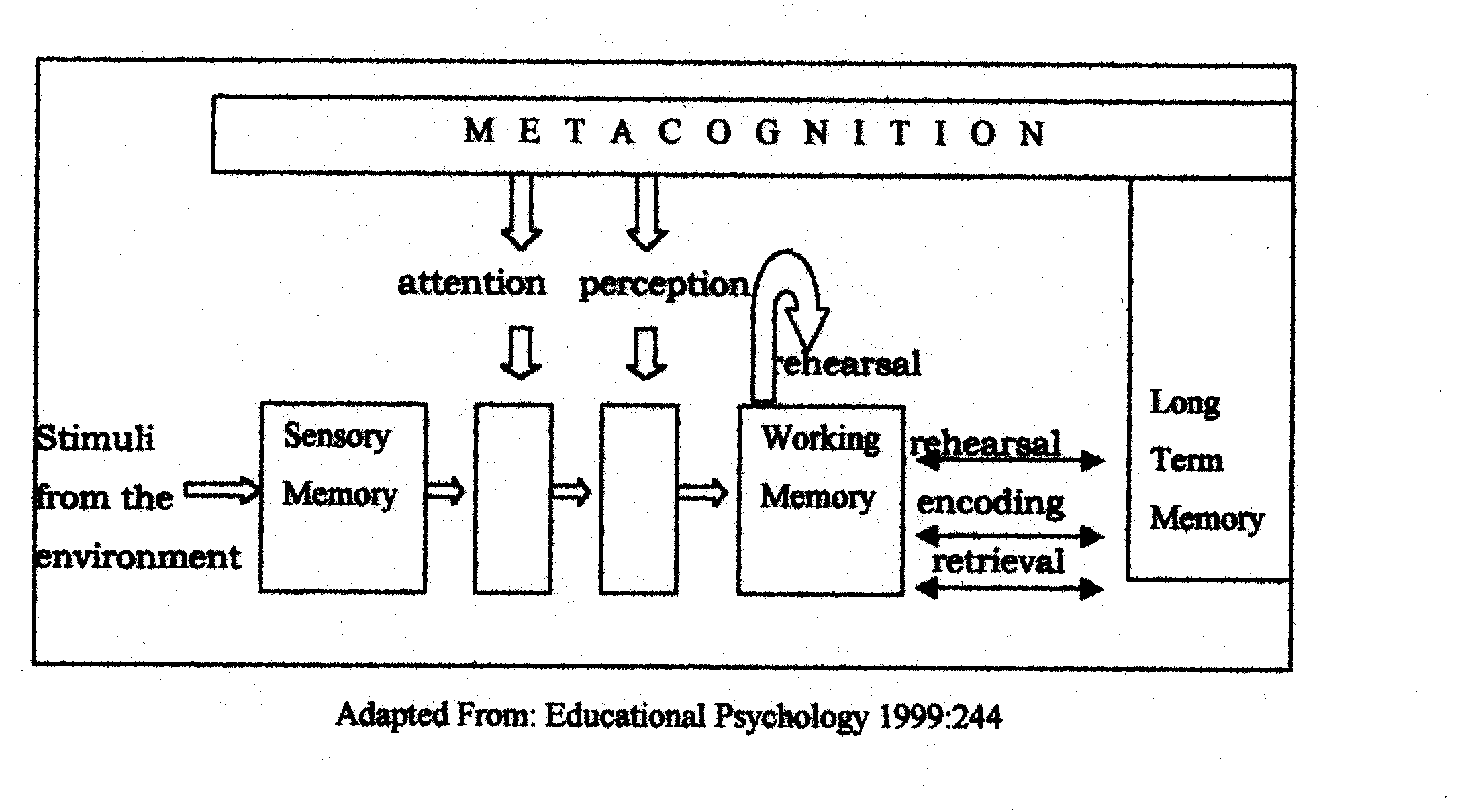
Information stores such as sensory memory, working memory and long term memory work like filing cabinets, computer files or address books where people store information. Cognitive processes are intellectual processes such as attention, perception, rehearsal, encoding and retrieval which move information from one store to another. A third component is metacognition which is defined as "knowing about and having control over cognitive processes."(Eggan & Kauchak, 1999:244) Applied to the reading comprehension situation for example, the metacognitive construct would hold the pattern of reading skills and strategies. Cognitive processes inherent during reading would involve the invoking of schemata, linguistic knowledge and discourse patterns kept in the memory stores. Other intellectual processes that act in tandem would be the application of attention, perception, rehearsal, encoding and retrieval. The entire complex intellectual process of reading for comprehension may be monitored by conscious metacognitive thought processes in the implementational form of reading strategies and skills.
Advancements in cognitive science and research in areas of
literacy has provided teachers and learners with several modals and approaches
to teaching and learning literacy skills. In the area of oral reading two early
modals proposed are Gough's Model and Goodman's Model. Gough's model compares
oral reading to listening. The pronunciation or sounding of printed matter is
equivated with the capacity to listen in listening comprehension. The weakness
of the model lies in the fact that it overlooks situations where children may be
able to pronounce words and read fluently but are not comprehending what is
read.
Goodman's Modal formulated by Kenneth S. Goodman defines
reading as a "process in which a reader uses syntactic, semantic and
graphophonic systems to reconstruct printed words into their oral equivalents to
which meaning can be associated."(Singer & Donlan, 1988:75) Goodman is
also credited with the statement describing reading as a psycholinguistic
guessing game. Efficient processing of information on the part of the reader
does depend in part on the readers functional knowledge of the grammar of the
language. The teaching and learning of reading and literacy skills starts with
the understanding of the syntactic, semantic and graphophonic elements or the
grammar of the language. However once the reader has mastered and internalised
the grammar of the language, there is a possibility that reading comprehension
may bypass the stage of oral reconstruction and go straight to the meaning. This
is the limitation of the Goodman Modal. The inadequacies of Oral reading modals
lead to research in silent reading approaches. Among the theoretical catalyst
for silent reading was Thorndike's definition of reading as reasoning(Singer
& Donlan, 1988:80)The objectives of silent reading vary from oral reading in
the sense that in silent reading the aim of the reader is decoding the message
inherent in the text whereas in oral reading clarity, fluency and intonation are
important for the audience to understand the text.
Research in cognitive psychology and intelligence has divided
language capacity and verbal ability into two separate skills: verbal fluency
and verbal comprehension.(Sternberg, 1985:66) Verbal fluency refers to a persons
ability to produce strings of words fluently. Sternberg explains Verbal
comprehension as the capacity to understand linguistic material either in print
or oral form. In line with the information processing model, three major
approaches had been proposed in understanding the nature of verbal
comprehension:
a) The Knowledge Based Approach
The amount of knowledge and information a person has about a thing, matter or occasion kept in memory stores is termed as background knowledge. Background knowledge or otherwise known as prior knowledge (Reed, 1996: 326) is stored as structures of schemas or scripts. Scripts are further defined as "an organised plan of action of a particular situation."(Eggan & Kauchak, 1996:250) According to the schema theory every new input of knowledge must be mapped against existing structures of knowledge in order for comprehension and understanding to be effective. (Carell & Eisterhold, 1987:220) According to Slavin (1994:216) "one of the most important determinants of how much you can learn about something is how much you already know about it." Slavin's statement is akin to Krashens i + 1, Input Hypothesis (Krashen,1985:2) which states that language learning and teaching must take into account the students previous knowledge and thereon language ought to be taught in incremental stages. Understanding of background knowledge has important implications to the teaching of literacy skills. Apart from considerations of Krashens Input Hypothesis, selection of material in literacy education has to consider the students background knowledge on the subject matter . For example, in a hypothetical situation, one can say that Ahmad a low proficiency student living in a village in Malaysia would be able to read and comprehend a passage on "Hari Raya" and "lemang" rather than a passage on Christmas, snow and Santa Claus. The same considerations apply in the teaching of listening, speaking and writing skills. Background knowledge may help in the low proficiency and beginning readers and writers classroom. However at a later or advanced stage, material selection should not be stifled or hindered by such content paradigms, because lack of exposure may actually impede the overall intellectual growth of the child. For example the introduction of snow and Santa Claus in a rural Malaysian school may actually lead to some interesting discussions and the process of learning is brought a step further. Schema theory and background knowledge may be instrumental in explaining the rudiments of comprehension but we cannot forget that making things easier for the child does not mean that learning is taking place. Research has shown that learning also occurs when the child is motivated and intellectually challenged. A more cogent argument against the schema theory was presented by Peters et.al(1988). They say that computationally fixed mental structures such as scripts are too inflexible to serve the purposes for which they were originally designed. Peters et. al quote Barsalou(1987) who says that "the variables active for a schema vary across contexts in which a schema is used."(1988:126)This means that people have different schemas based on different context situations and different people may have different schemas for the same context situation.
b) The Bottom-Up Approach
The bottom-up approach is employed when the reader finds it difficult to understand the text. The difficulty may be due to a single word, sentence, paragraph or even the whole text. The reader may not understand the vocabulary or is not familiar with the content. In other words the reader does not have the prior knowledge, background knowledge or the relevant schemata to understand the text. In such a situation the reader may employ a word by word or sentence by sentence scrutiny of the text in order to derive meaning. The bottom-up approach is usually termed as a data driven approach.
c) Top-Down Approach
The top-down approach is described as a conceptually
driven approach. Based on this approach the reader takes on a cognitive,
information processing mode of deriving information from the text. The reader
draws upon his intelligence and experience as well as predictions that he can
make based on the schemata that he has acquired to understand the text. (Nuttall,
1996:16) The reader takes a position of scrutinizing the text from the outside
in. He looks for overall meaning by applying his own knowledge and predictions.
This model has similarities to Goodman's model of reading as a psycholinguistic
guessing game, as in both approaches the reader surfs through the text looking
for meaning by predicting and being selective in using linguistic cues.
Both processes are subconscious processes but a good reader may employ both
processes consciously in comprehending meaning and sense. The readers focus can
shift from a top-down to a bottom-up approach in relation to the difficulty of
the text. This has become known as interactive reading. Both approaches can be
mobilized by conscious choice and both are important strategies for readers. (Nuttall,
1996:17)
Conclusion
Literacy and education are constantly evolving subjects. Research and studies done in the area of intelligence and cognition have provided Literacy practitioners; mainly teachers, curriculum planners and language policy makers with an array of theories and principles. Classroom applications in the process of teaching and learning have been enriched with the creation of various methodology and techniques in teaching and learning literacy skills. Teachers today are able to better understand the developmental aspects of their students in terms of cognition and intelligence. Literacy practices today place emphasis on the learners and how they organise their knowledge. Instead of repetition and drills learners are taught how to analyse problems and how to think for themselves. Language is viewed as an active process in which learners are required to apply different rules to different situations in deriving meaning from text and engaging in encoding meaning in writing themselves. During this process learners may commit errors. Nevertheless errors are a sign of learning and experimentation. Based on the research done in cognition and intelligence, literacy practises acknowledge that classroom practise should be learner centred and focus on discovery learning via inductive as well as deductive approaches. Reading, writing, listening and speaking skills and strategies are taught explicitly because of the believe that students would be able to make use of them by way of metacognition. The knowledge of ones conscious thought processes or metacognition is itself a product of research on cognition and information processing models. In fact the many new approaches to language learning such as Communicative Language Teaching, Total Physical Response, The Silent Way, Community Language Learning, Collaborative Learning, The Natural Approach and Suggestopedia, to name a few, draw their strength from the outcome of research done on cognition and intelligence.
References
Carell, Patricia L. & Joan C. Eisterhold.. 1987 Schema Theory and ESL
Reading Pedagogy Methodology in (Eds.) Michael H. Long & Jack C. Richards
TESOL: A Book of Readings. Boston: Heile & Heinle
Cox, Carole. 1996. Teaching Language Arts. USA: Allyn & Bacon
Eggen, Paul & Don Kauchak. 1999 Educational Psychology. New Jersey:
Prentice Hall.
Harris, Albert J. & Edward A. Sipay. 1980. How to Increase Reading
Ability.
New York: Longman.
Hassan, Azmi. Access to ICT Key in Bridging Digital Divide. NST. 20 11.00
Krashan, S. D. 1985. The Input Hypothesis: Issues and implications.
London: Longman
Morrow, Lesley Mandel.1993. Literacy Development in the Early Years.
Boston: Allyn & Bacon.
Mukundan, Jayakaran et.al. 1998 Class Readers:Theory & Practice. Pataling
Jaya: Longman Malaysia Sdn. Bhd.
Nuttall, Christine. 1996. Teaching Reading Skills in a Foreign Language.
Oxford: Heinemann
Pandian, Ambigapathy. Ed. 1999. Global Literacy:Vision Revisions and
Vistas in Education. Serdang: Universiti Putra Malaysia Press.
Peters, Sandra L. et. al. 1988 "Flexible Natural Language Processing and
Roschian Category Theory." Tenth Annual Conference of the Cognitive
Science Society, August 17-19 Canada:Lawrence Erlbaum Associates.
Reed, Stephen K. 1996 Cognition. USA: Brooks/Cole Publishing Company.
Singer, Harry & Don Donlan. 1988. Reading and Learning from Text.
New Jersey: Lawrence Erlbaum Associates.
Slavin, Robert E. 1994. Educational Psychology: Theory & Practice.
Massachusetts: Allyn & Bacon.
Sternberg, Robert J. 1985 Cognitive Aproaches to Intelligence Handbook
of Intelligence. Ed. Benjamin B. Wolman. Wiley Interscience
Publication: New York
Sternberg, Robert J. 1991 A Contextualist View of The Nature of Intelligence
Changing Conceptions of Intelligence and Intellectual Functioning: Current
Theory and Research. Ed. Prem S. Fry. Amsterdam: Elsevier Pub.
Essay_1.html