Is this cool or what?
How it all Works
So what do we have so far? A magnet that vibrates for an almost incalculable fraction of a second when it gets super cold. Where do we go from here? That was exactly the question David and his team of NASA scientist were asking themselves. But, unlike us, they were able to come up with a solution. They combined the superconducting magnets and extremely fast vibrations through a high power solid state switch. (A solid state switch is the path an electrical signal takes through a solid piece of semi-conductor, the conductor controls the flow of the signals through something, i.e. a circuit). The first 100 nanoseconds are the non-solid state in which the matter is unstable and virbrating quickly. So what they came up with was a device that cooled and charged 400,000 times per second and produces 9000 volts each time; when putting these ultra fast ultra powerful vibrations into a direction, you get the ability to travel extremely fast.
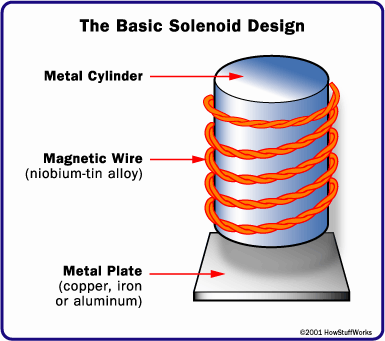
The model for the electromagnetic propulsion is seen here, called a solenoid. It is estimated that it will be about 3 feet high, 1 foot wide, and weigh about 55 pounds. All it basically is is a superconducting magnetic wire twisted around a metal cylinder. The wire is made from niobium-tin alloy and is cooled using liquid hydrogen. "Now, the catch here is, can we use this non-steady state condition in such a way that it only moves in one direction?" -Goodwin-
The answer, although hypothetical of course, is yes. The answer is the metal plate indicated in the picture. The metal will be charged then isolated from the contingent system to form asymmetry. Right at the point when it vibrates, the charge will be turned off and the because of the charge the magnetic will cause oscillation in the opposite direction.
BACK