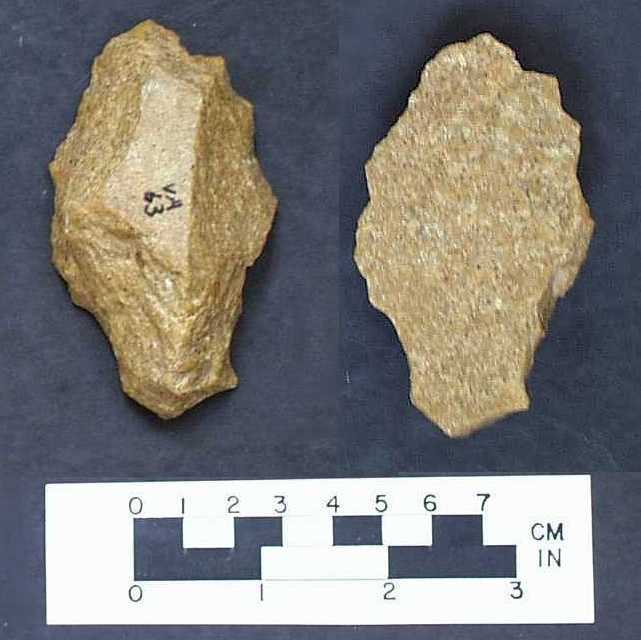
Defining Characteristics: This type is provisional due to only five examples being found. It is distinct in that it is usually made on a large flake, and is unifacially flaked with a ridge or high center running down it longitudely, thus being backed. In all three specimens, most of the use was concentrated onto one end which functionally worked like a gigantic end scraper.
|
Total Number |
5 |
|
Weight(oz) |
9.4 |
|
Circumference(cm) |
28.2 |
|
Thickness(cm) |
31.0 |
|
Min. Angle(average) |
64.4 |
|
Max. Angle(average) |
84.2 |
Notes: This type was found on sites that would make it most likely associated with Late Archaic or Early Woodland cultures. One other possible similar type was described by Dragoo (1973: 37) as Elongated Flake End-Scrapers (Large). They were made on large thick curved elongated flakes derived from large cores. The end was convex like a typical end scraper, and the sides were side scrapers and spokeshaves. The five found generally fit this description, but I think calling them end scrapers will only cause confusion and people to associate them with Paleo-Indian cultures.
Description of Figures:
a1: A
smaller example of a Ridge-Backed Scraper-Plane.
Both the dorsal (left) and ventral (right) surface are shown.
As with all five specimens cortex is still showing.
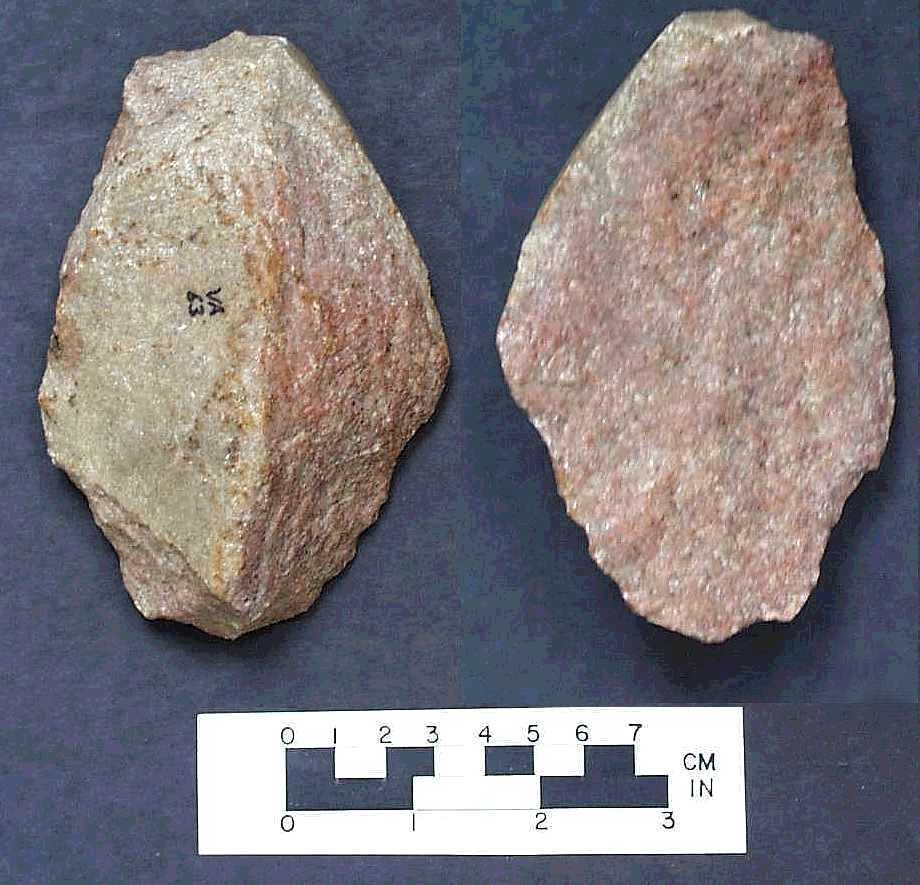
a2: Example
of a larger Ridge-Backed Scraper-Plane recovered from the same site as a1.
Both the dorsal (left) and ventral (right) surface are shown.
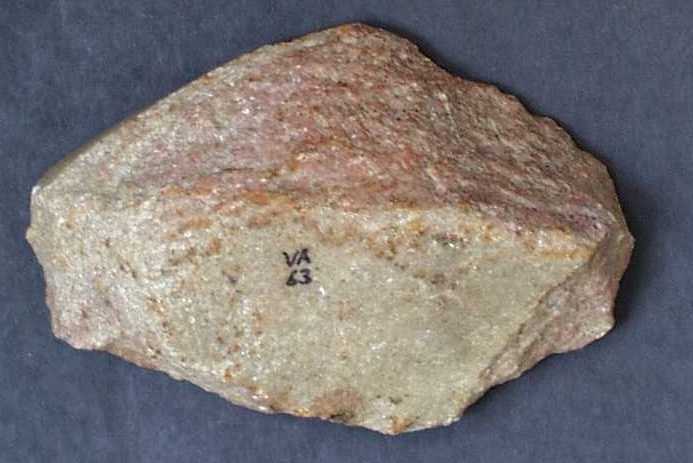
a3: Close-up
of Ridge-Backed Scraper-Plane, showing retouched edges. Average number of edges
used per plane: 3
|
Total |
Percent |
|
|
Convex |
6 |
40% |
|
Concave |
4 |
27% |
|
Straight |
5 |
33% |
Number of working surfaces totaled for type and percentages
.