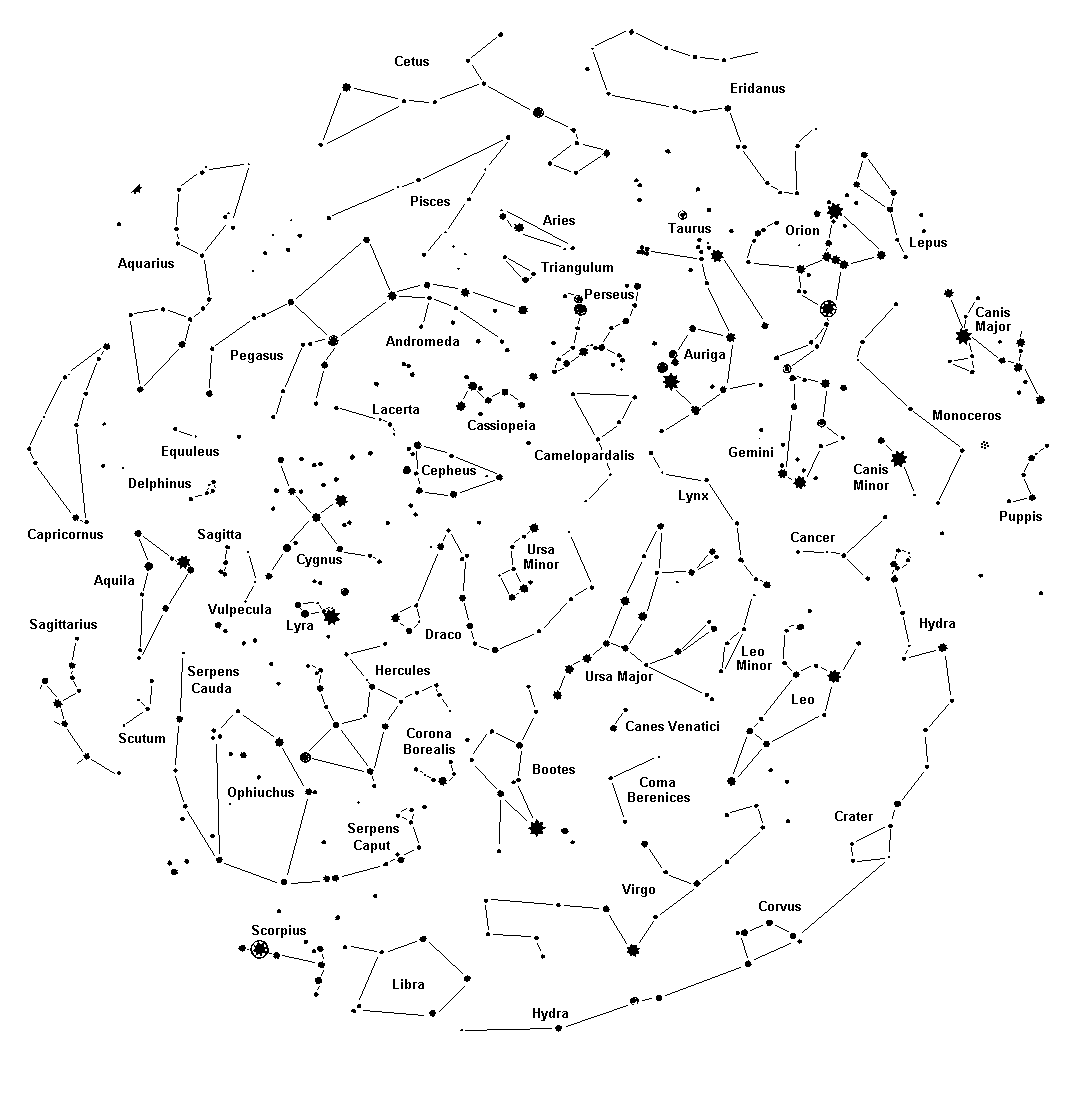
As an introduction to the most popular and brightest objects and pictures in the sky, I will include here a brief, constellation-orientated tour around the sky, with some snippets of information that may or may not inspire you to find out more. It would be a good idea to print out the constellation map found here to help you find your bearings: if you know which direction North is, and you have read why zodiac signs are associated with parts of the year, then this would also be quite a help. Also, it may be wise to remember that not all constellations will be visible at all times of the year, especially those closer to the celestial equator (especially Leo, Ophiuchus and Serpens, Aquila, Pisces, Taurus, Orion and Gemini). Now all you must do is wait patiently for a clear night...
Start by finding "The Plough"/"The Big Dipper".
This famous constellation is part of Ursa Major, "The Great Bear", and I thought it would be a good place to start as it is the one constellation most people can recognise. Seven bright stars form a saucepan-like shape, and the side of the saucepan opposite the handle points upwards (following a straight line) to the North Star, Polaris. Underneath Ursa Major's neck are Canes Venatici, the two hunting dogs of Bootes. Under the bear's body you may be able to make out Leo and Leo Minor.
Looking left, follow the plough handle/bear's neck to a bright, rust-coloured star low down.
This is Arcturus, the bottom star of the constellation Bootes. It is the fourth brightest star in the sky, and the brightest in the northern hemisphere, though may not give that impression due to its colouring. Arcturus (also known as Alpha Bootis) is a red giant, hence its orange glow, and lies 36 light years away.
From the top of Bootes, look leftwards to see an arc of stars.
This is Corona Borealis, The Northern Crown; its brightest star is known as Gemma, the jewel.
Follow from the bottom of Bootes up its left-hand side to an L-shape: Hercules' right leg.
Hercules is kneeling in the sky. He has a tight belt holding in his toga, two bright and broad shoulders, and a large, triangular head. Near to the head is another, brighter star forming part of the faint pentagon of Ophiuchus. If you are lucky enough to be able to make out Ophiuchus, try to see the serpent he is holding: Serpens Caput, its three-cornered head, curls round underneath Hercules' shoulder, close to Corona Borealis.
Follow Hercules' very long arm upwards to a very bright star.
This is Vega, the brightest star in the constellation of Lyra, and the fifth brightest star in the sky. It also forms part of another star pattern, known as the Summer Triangle, with two stars we are about to find in Cygnus and Aquila. Lyra is shaped like a fish, with its head pointing towards another bright star.
Follow the direction in which Lyra points to find another bright star.
This is Altair, brightest star in Aquila. Aquila is shaped like a boomerang, pointing back upwards at Lyra. Altair also forms part of the Summer Triangle with Vega. Near to the right of Aquila is a little kite-shaped constellation, known as Delphinus, and you may also be able to see Capricornus and Aquarius below them.
Find the brightest star between Aquila and Lyra, forming part of a noticeable cross.
This cross represents Cygnus the swan, who appears to be flying in between the Eagle and the Lyre we have just seen. Its tail is the bright star Deneb, the third star of the Summer Triangle, with a light output about 60000 times that of our Sun. Look again at Vega and Altair and see how bright these stars are in comparison to all around them.
Now re-find Hercules, and follow along his left leg, which bends and stands on a four-cornered object: Draco's head.
The dragon Hercules slayed lies here, twisted around the northernmost part of the sky. Draco's body is an S-shape, and contains another constellation, known as The Little Bear or the Little Dipper: Ursa Minor. The head of Ursa Minor, or the handle of this little saucepan-shape, is Polaris, the current Pole Star. Polaris is actually a double star, and it also varies in magnitude, but this change in brightness is imperceptiable to the naked eye. It has not always been the Pole Star, and will not always be, due to Earth 'wobbling' in space. Nearly 5000 years ago, the Pole Star was Thuban or Alpha Draconis in Draco, and in about 12000 years, the North Pole will have moved so much that Vega (in Lyra) will become its nearest star.
From Polaris, look leftwards towards a W-shape.
This is Cassiopeia, the Egyptian Queen, sitting in her throne (with very long toes). Following up from her head, a large pentagon nearby represents her husband, King Cepheus. He is less easy to find, but closer to the North Star.
Follow down towards the horizon from Cassiopeia.
With some imagination, you should be able to see the tall, pointy helmet of Perseus, the left-hand side of his body (or his right-hand side) and his arms stretched out to his sides. In his left hand he holds the head of Medusa, a variable star, and in his right hand he holds a spear (a faint few stars running up and down from the end of his arm!). Between Perseus and Cassiopeia is Andromeda, two curving lines of stars joining at Alpha Andromeda, a bright star which also forms part of the Square of Pegasus. Looking carefully, pointing upwards from the constellation is a spiral galaxy, very similar to our own: this is M31, the Andromeda Galaxy. Lying about 2.2 million light years away, it is the furthest object in the Night Sky visible to the naked eye. That should also give you a clue as to just how big it is. Look around Alpha Andromeda, and find the four bright stars forming the Square of Pegasus. This square is almost devoid of stars visible to the naked eye, a highly curious feature for the seventh largest constellation in the sky. Beneath Andromeda are two triangles of stars: the larger one is Triangulum, and the one beneath it, closer to the celestial equator, is Aries the ram. Pisces can sometimes be seen (dependent on the time of year) as a V-shape pointing downwards to the immediate right of Aries.
Look for a brilliant cluster of stars underneath Perseus.
These are the Pleiades, popularly known as the Seven Sisters, yet at least nine can be seen with the naked eye, and about 200 stars in all are known to belong to the cluster. It is part of Taurus, which also includes the star cluster known as the Hyades as the bull's head. Taurus is a recognisable V-shape, sharing the star at the tip of one of his horns with Auriga (also below Perseus). Aldebaran, Taurus' brightest star, is an orange giant lying 65 light years away from us, and is the bull's evil eye.
At the right time of year, look below Taurus for a bright belt of three stars.
This is Orion's belt, and from it hangs Orion's sword. This is not a star, but the Orion Nebula, or M42, which is about 1300 light years away from us. His shoulders are the stars Betelgeuse (his left) and Bellatrix (his right). Betelgeuse is a supergiant red star, so large it could contain the orbit of Mars, and too large to be of stable brightness. His right leg, the star Rigel, is a blue-white supergiant, the sixth brightest star in the sky. The large constellation immediately to the left of Orion's club is Gemini, and the two uppermost, bright stars are Castor and Pollux, the twins. Below this is Canis Minor, including a very radiant star, and to its left is Cancer, the faint crab.
| Start Page | The Northern Sky |