
Page 7
using a chain of ports and friendly cities in the eastern Mediterranean. Goods arrived (sometimes by camel caravan) and the Venetians shipped them westward where European land traders picked them up.
The Rialto Bridge area became the world’s busiest trading center and the commercial center of Venice. It is a major landmark of Venice and lined with shops. The third bridge on this spot, it was built in 1592. Earlier Rialto Bridges could open to let in big ships. But, the Grand Canal was closed to shipping and became a canal of places. With a span of 140 feet and foundations stretching 660 feet on either side, the Rialto was an impressive engineering feat in its day. Locals call the summit of this bridge the “icebox of Venice” for its cool breeze. Rialto means “high river bank”.
The wooden Accademia Bridge was built in 1932 as a temporary one, but locals liked it so much it has stayed.
The gondola is certainly the most photographed craft in the world and its image has become, for millions of tourists, the symbol of Venice. The unique boat of as much as 11 meters length and 600 kilos weight can be driven with lightness and easiness by a single man and with a single oar! But it is unique even for its building characteristics: it is asymmetric, as its left side is larger than the right one by 24 cm and so it always navigates inclined on one side. It has a flat bottom; this allows it to cross shallow depths. For its construction, they used 8 different kinds of wood composing 280 pieces. The only metal elements are the characteristic "iron" of the head and the " risso" of the stern. The iron head was originally an element of longitudinal stability, which had to balance the weight of the gondolier. Popular tradition states the front "pettini" represent the sestieri (six quarters) in which the city is divided and the back one is Giudecca island; the double "S" bending should simulate the "Grand Canal " and the lunette, situated under a stylized dogal horn, Rialto bridge. It takes approximately one year to build a gondola at a cost of $250,000 to $300,000. We did not get a gondola ride as the 400 gondoliers were on strike. But, that is even all the more reason to revisit the world famous city!
Venice with 150,000 citizens, was the most populous city in Europe in 1500. The gross “national” product of this city was 50% greater than that of the entire country of France. She even built warships and could crank out one a day. Besides expanding its commercial empire, Venice hired generals to conquer many of the cities in northern Italy. And Venice profited greatly from the Crusades.
All this wealth did not go to waste. The 15th century was a time of massive building and rebuilding. The earliest structures of this century show a Byzantine influence. The most distinctive, however, are “Venetian Gothic” in style, such as the Doge’s Palace. They have Gothic pointed arches, but they’re much lighter and more fanciful than the Gothic churches of Northern Europe. Later structures are Renaissance style, with rounded Roman arches.
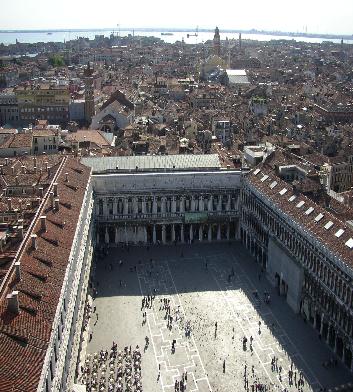
Piazza San Marco (St. Mark’s Square) is one of Europe’s great urban spaces, and the only square in Venice to merit the title piazza. It is nearly two football fields long surrounded by the offices of the republic. On the right are the older offices (16th century Renaissance) while the newer ones are 17th century Baroque. Napoleon, after enclosing the square with the more simple and austere neoclassical wing across the far end, called this “the most beautiful drawing room in Europe”. (It is taken for granted that there is always a church in the square. Of course, in this case it is St. Mark’s!) And, on opposite sides of the square you have elegant cafés with dueling orchestras playing classical music (The men were dressed in tuxedoes regardless of the time!). It was so very beautiful! But, of course, pigeons were like the locust of Salt Lake! And, St. Mark’s Square is about the first place in Venice to flood. Yes, I had the opportunity to witness the water bubbling into the square during high tide! When the tide is really high (10-12 days/year) you will see stacked wooden benches put end to end creating an elevated sidewalk.
The clock tower within the square is of the Renaissance period built in 1496. I did not have to climb this tower (It had an elevator!) to view the city and canals with the bronze men (Moors) swinging their huge clappers at the top of each hour. Try to avoid this experience if possible! It is extremely loud to say the least!
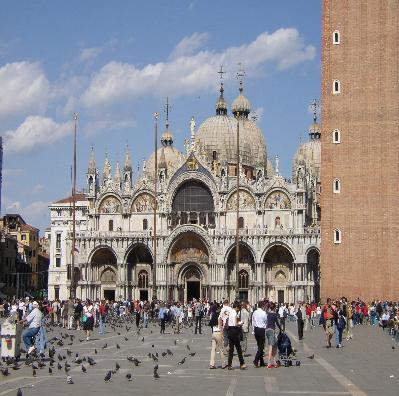
St. Mark’s, one of the world’s most famous cathedrals, is the best example of “Venetian Byzantine” (thus protecting it from the ambition of Charlemagne and his Holy Roman Empire) architecture with it onion-shaped Eastern domes telling the story of Adam and Eve plus the story of Noah, the ark, and the flood, Greek-cross 43,000 sq. ft floor plan, and interior mosaics. But the style might better be called “Early Ransack”. Beneath the high altar lies the body of St. Mark and the Pala d’Oro, a golden altarpiece made with 80 Byzantine enamels (1000-1300 A.D.). Each shows a religious scene set in gold and precious stones. Now, remember why the Venetians settled in the lagoon! Unfortunately, the church is in a very sad state of repair with a rolling floor!
San Marco’s treasury (within the bascilia) gives one the best chance outside of Istanbul or Ravenna to see the glories of Bysantium. Venetian crusaders looted the Christian city of Constantinople and brought home piles of lavish loot which is seen in the treasury. It is important to remember that most of this loot was made in 500 A. D. while western Europe was still rutting in the mud.
Even the bones of Venice’s patron saint, Mark, which rest under the altar, were booty. Middle Age Europe was into relic worship. In 829, the young, but powerful city-state of Venice was really nothing on the religious map. So, it needed some relics to give it clout. A band of merchants trading in Alexandria, Egypt, stole the bones of the Evangelist from Alexandria’s Moslem rulers, put them in their church, and presto! Venice became an important religious destination. St. Mark’s symbol, the winged lion, replaced Theodore and his dragon as the symbol of the Venetian Republic. But, the Catholic Church was often at odds with Venice, partly because of the city’s close ties with the rival Greek Orthodox Christians. The proud Venetians thought of themselves as Catholics, but not Roman Catholics!
With its newfound sanctity, Venice grew rapidly. The Venetian empire was controlled by an oligarchy of wealthy families. This top 5% of the population elected a council of rulers led by a duke, known as the Doge who served for life. But, rest assured, they always voted for the most elder duke! This was the most powerful ½ acre in Europe for 400 years. The rest of the population had no political rights, but they were treated well and did prosper.
The Doge’s Palace was built to show off the power and wealth of the republic! And, believe me it fulfilled this goal to the extreme! In typical Venetian Gothic style, the bottom has pointy arches, and the top has an Eastern or Islamic flavor. The grand staircase simply can’t be compared to anything I have seen with all the gold and intricate workmanship. Even the most powerful visitors climbed this to meet the doge. The doge of this “dictatorship of the aristocracy” lived with his family on the first floor near the halls of power which were on the top floor.
This was the beginning of an architectural power trip. This place is wallpapered with masterpieces by Veronese and Tintoretto. In the Senate Room, the 200 senators met, debated, and passed laws. This is where Tintoretto’s Triumph of Venice shows the city in all her glory. Lady Venice, in heaven with the Greek gods, stands high above the lesser nations, who swirl respectfully at her feet with gifts.
The Armory, a dazzling display originally assembled to intimidate potential adversaries, show remnants of the military might the empire employed to keep the East-West trade lines open and the local economy booming.
The giant Hall of the Grand Council (180 feet long, capacity 2,000) is where the entire nobility met to elect the senate and doge. Ringing the room are portraits of 76 doges. One doge is blacked out as he opposed the will of the Grand Council. Behind the doge’s throne, is the Tintoretto’s monsterpiece, Paradise. At 1,700 square feet, this is the world’s largest oil painting. Christ and Mary are surrounded by a heavenly host of 500 saints. Its message to electors who met here: Make wise decisions and you’ll ultimately join that holy crowd.
At the opposite end of the square and St. Mark’s is the Correr Museum. It is the city history museum displaying fine neoclassical works by Canova, armor, banners, and paintings recreating festive days of the Venetian republic.
Venetian society, while rigidly structured, was quite tolerant. It was a cosmopolitan city where traders from all over the world rubbed elbows. Some foreigners were even allowed to settle there. There was a Jewish community, giving us our work “ghetto” to identify a neighborhood set aside for minorities.
Venice peaked economically in 1450. Then, a series of world events set in motion three centuries of slow decline. Venice’s economic decline went hand in hand with political corruption and repression. Local rule grew more and more autocratic. But, as Venice fell, her appetite for decadence grew. Through the 17th and 18th centuries, Venice partied on the wealth accumulated through earlier centuries as a trading power.
In addition, Venice had some of Europe’s most convincing torture chambers. The famous Bridge of Sighs connected the lawyers’ offices in the Doge’s Place with the prisons. Prisoners could be brought from the prisons, tried in closed court, and sentenced without the public knowing about it. As they passed over the bridge to their deaths, they got one last look at their beloved city-hence the name, “Bridge of Sighs”.
Venice is Europe’s best preserved big city. It is the toast of the High Middle Ages and Renaissance in an elegant state of decay. I was only able to scratch the artist surface of this city, but did enjoy a classical evening concert in a small church. It should be noted that the acoustics were fantastic and it seemed very nice that churches are utilized for other things! But, here again, space is a concern so they have to use what is available! Seems pretty smart and practical to me! I also enjoyed a demonstration of the popular Murano glass blowing. Yes, I bought some Venetian glass beads, earrings, and bracelet! Yippee!! I also saw some of the most beautiful lingerie I have ever seen in my entire life! My goodness, it was gorgeous!!!! Not to be outdone are the Italian knits. The sweaters are extremely soft with an ever so fine gauge knit! On my next trip to Italia, I would also like to visit the islands of Murano which is famous for its glass factories and Burano which is know for its beautiful lace. Talk about the lap of luxury! So, as you can see, the city is fantastic from various perspectives!
Venice
St. Mark's Basilica
St. Mark's Square
(like a football field)