

Beginning the game
(Don't worry about this part too much, I'll set it up
for you in the beginning)
Step 1: Mix tiles up, then stack them upside down in
double-layered rows of 17.
Step 2: Roll 2 dice to determine which stack tiles are
going to be drawn from.
Step 3: Place the leftmost 7 double-layered tiles into
the center and flip over the 3rd tile from the left.
Step 4: Each player draws 4 tiles from the selected stack
going counter-clockwise until each player has 12 tiles. Then each player
draws 1 tile for a total of 13 tiles.
Step 5: The game is ready to go! Begin drawing tiles.
===============
III. RULES
===============
---------------------
A. Stealing tiles
---------------------
1. Verbally announce your steal: When another
player discards a tile you'd like to add your collection of tiles, verbally
announce to all players that you are going to steal the discarded piece
before the next player draws his/her tile.
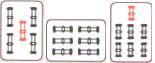
2. Reveal the set you've created: Reveal what pieces of yours you are combining the stolen piece with, set them aside to the right of your hand, and put the stolen piece next to them. Then throw away a piece.
To show what I mean by the above, here are examples when stealing for a straight and 3-of-a-kind.
-------------------
B. Straights:
-------------------
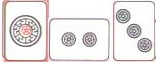
Straights can be created with any of the numbered tiles
of the same suit. Character tiles CANNOT be used as a straight -
they can only be collected as a 3-of-a-kind or a 4-of-a-kind.
Here are some examples of a steal for a straight:
Example 1
|
|
|
|
|
|
|
|
Example 2
|
|
|
|
 |
 |
 |
-------------------------------
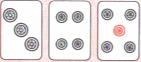
Steals that are illegal:
-------------------------------
Example 1
|
|
|
 |
 |
Example 2 :
|
|
|
 |
 |
----------------------
4. 3-of-a-kinds:
----------------------
Must be of the same suit, and stealing player must throw
a tile away.
Example:
|
|
|
|
 |
 |
 |
----------------------
5. 4-of-a-kinds:
----------------------
The rules for 3-of-a-kind also apply to 4-of-a-kinds
・the new set must be of the same suit, but before throwing a tile away,
the stealing player must draw a tile from the left side of the center stack.
-------------
6. Pairs:
-------------
You CANNOT steal to create a pair except when it is the
last piece you need.
=================================
C. 4-of-a-kinds (non-stolen)
=================================
If a player plans to go out using 4 identical tiles as
a 4-of-a-kind instead of as a 3-of-a-kind, the player must announce this
during one of his/her turns after he has drawn a tile. The 4-of-a-kind
must be revealed and put off the to the right of the player's tiles. For
example, suppose a player has the following:
If the player goes out without revealing the 4-of-a-kind for the 5, the hand will automatically be divided into (2,3,4) (5,5,5) (5,6,7). However, if the player announces his/her 4-of-a-kind, when s/he goes out, the hand will instead become (2,3,4) (5,5,5,5); and 6,7. It all depends on what you want to do.
D. What if 2 players want to steal the same stolen piece?
When a player throws away a tile that 2 other players want to steal, priority goes to the steal with the highest value. Here is the value of all the steals (from highest to last).
1) Going out (last piece to complete all sets)
2) 4-of-a-kind
3) 3-of-a-kind
4) Straight
If 2 players want to do the same type of steal, the player
closest turn-wise has higher priority.
For players who are trying to going out, the priorities
are as follows:
1) More combo points (i.e. similar to how a royal flush
beats a full house in poker)
2) Non-stolen
3) Closest turn-wise
If you've understood what I've explained so far, you're now ready to begin playing. The next sections are for those beginners who have mastered everything so far, so if you don't understand what I'm going to discuss in the next sections, don't worry about it for now because I'll explain it to you a little at a time while we play.