 Theme Unit
  CINDERELLA
Grade Level: First Grade
Developmental stage: Preoperational and Concrete operational
Overview or rationale for the unit: Cinderella is a familiar story for
most children. Many have seen video versions also. There are many versions
of the Cinderella story from many lands. (click here for a list of Cinderella stories you might want to use)
According to Denise Matulka (www.family.disney.com...) almost every culture
has a variant of the Cinderella tale and there are over 1,500 recorded
versions of Cinderella from almost every country in the world. Within the
Cinderella stories children can relate to aspects of family life like doing
chores, being left out or disappointed, having a nice surprise. The goals
of this unit are to use meaningful activities to develop cognitive, social-emotional,
and physical development. This unit uses some Cinderella related topics
to investigate time and measurement, size and ordering, art, socialization,
language arts, family concepts, music and movement.
(click here for a list of Cinderella stories you might want to use)
According to Denise Matulka (www.family.disney.com...) almost every culture
has a variant of the Cinderella tale and there are over 1,500 recorded
versions of Cinderella from almost every country in the world. Within the
Cinderella stories children can relate to aspects of family life like doing
chores, being left out or disappointed, having a nice surprise. The goals
of this unit are to use meaningful activities to develop cognitive, social-emotional,
and physical development. This unit uses some Cinderella related topics
to investigate time and measurement, size and ordering, art, socialization,
language arts, family concepts, music and movement.
Cinderella did not live in a traditional family. Family compositions
can be explored as well as the interaction of family members. Interactions
within the classroom community can also be related to the story by looking
at sharing chores, being part of group, or being left out. Family cultures
and interests will be explored as the children design and make a family
crest similar to those of the royal families in some Cinderella stories.
Time was important to Cinderella in the traditional story. The children
will explore the use of standard and non standard measurements of time.
Another type of measurement will be explored as children investigate the
size of different people's feet and using that information in measuring,
sorting and ordering activities. Shoe size and the corresponding standard
measure will also be examined through a field trip and learning center.
The children can experience the feeling of trying on shoes that don't fit
as depicted in the story. Language arts activities include selected vocabulary,
sequencing, illustrating, and retelling the story as well as listening
and reading. Recreating the King's Ball is a movement and music activity
as well as a drama exercise.
Many of the activities can be scaled up or down to accommodate a wide
variety of learning styles and developmental stages. Challenge activities
are also available as appropriate. Assessment is frequently by observation
or interaction with the child during the activity. An overall goal for
the classroom is to promote high self-esteem, a sense of competence, and
positive feelings about learning.
Also see Instructor Magazine, Nov/Dec 1997 
Activities include (click on the  for additional information on these activities)
Read at least two versions of Cinderella stories, discuss the story as
you go along. Some topics for discussion include family makeup, doing chores
at home and at school, team work, magic and make believe, good and evil,
new and interesting vocabulary, take some cues from the students and discuss
what intrigues or interests them.
References
for internet resources just click on underlined link to go there
The Cinderella story
http://www.inform.umd.edu/EdRes/ReadingRoom/Fiction/FairyTales/cinderella
The Princess And The Golden Shoes
(A Scottish Tale)
http://darsie.ucdavis.edu/tales/ptgs.html
The Flying Turnips (Expanded and much changed from a Russian
tale) http://www.sonic.net:80/~mary/kb/fft696/turnips.html
Rindercella
A mixed up tale of unknown origin
PICTURE-BOOK VERSIONS OF CINDERELLA
BILLY BEG AND HIS BULL (Holiday House, 1994) by
Ellin Greene, illustrations by Kimberly Bulcken Root.
BOOTS AND THE GLASS MOUNTAIN (Dial Books, 1992)
by Claire Martin, illustrations by Gennady Spirin.
CHINYE: A WEST AFRICAN FOLK TALE (Viking, 1994)
by Obi Onyefulu, illustrations by Evie Safarewicz.
CINDERELLA (Greenwillow, 1981) by the Brothers
Grimm, illustrations by Nonny Hogrogian.
CINDERELLA, OR THE LITTLE GLASS SLIPPER (Scribner,
1954) by Charles Perrault, illustrations by Marcia Brown.
THE EGYPTIAN CINDERELLA (Harper Trophy, 1989)
by Shirley Climo, illustrations by Ruth Heller.
JOUANAH: A HMONG CINDERELLA (Shen's Books, 1996)
by Jewell Reinhart Coburn, illustrations by Anne Sibley O'Brien.
KONGI & POTGI: A CINDERELLA STORY FROM KOREA
(Dial, 1996) by Oki S. Han, illustrations by the author.
THE KOREAN CINDERELLA (HarperCollins, 1993) by
Shirley Climo, illustrations by Ruth Heller.
MARUSHKA AND THE MONTH BROTHERS (North-South,
1996) by Philemon Sturges, illustrations by Anna Vojtech.
MOSS COAT (Clarion, 1987) by William H Hooks,
illustrations by Donald Carrick.
MUFARO'S BEAUTIFUL DAUGHTERS: AN AFRICAN TALE
(Lee, Lothrop and Shepard, 1987) by John Steptoe, illustrations by the
author.
PRINCESS FURBALL (Greenwillow, 1989) by Charlotte
Huck, illustrations by Anita Lobel.
THE ROUGH-FACE GIRL (Putnam, 1992) by Rafe Martin,
illustrations by David Shannon. (Algonquin Indian)
SARAH AND THE PEOPLE OF SAND RIVER (Douglas &
McIntyre, 1996) by W. D. Valgardson, illustrations by Ian Wallace.
SMOKY MOUNTAIN ROSE: AN APPALACHIAN CINDERELLA
(Dial, 1997) by Alan Schroeder, illustrations by Brad Sneed.
SUKEY AND THE MERMAID (Four Winds Press, 1992)
by Robert D. San Souci, illustrations by Brian Pinkney.
THE TALKING EGGS (Dial Books, 1989) by Robert
D. San Souci, illustrations by Jerry Pinkney.
TATTERCOATS (Putnam, 1989) by Joseph Jacobs, illustrations
by Margot Tomes.
VASILISSA THE BEAUTIFUL (Harper Collins, 1991)
by Elizabeth Winthrop, illustrations by Alexander Koshkin.
WISHBONES: A FOLK TALE FROM CHINA (Bradbury, 1993)
by Barbara Ker, illustrations by Meilo So.
YEH-SHEN: A CINDERELLA TALE FROM CHINA (Philomel,
1982) by Ai-Ling Louie, illustrations by Ed Young.
THE TURKEY GIRL: A ZUNI CINDERELLA (Little, Brown,
c1996) by Penny Pollock, illustrations by Ed Young.
INTERNET RESOURCES USED
Exploring
the Tale of Cinderella, Denise L. Matulka
http://www.ucalgary.ca/~dkbrown/cinderella.html
http://oleysd.k12.pa.us/oves/ec.html
Compare the stories using ven diagrams.
Ref.: Walther, M., "Expectations, experiences, and excitement: creating
a classroom environment that cultivates writers" presentation at NIU October
2, 1998.
Make a timeline of a story and discuss the beginning, middle, and end of
a story.
Ref: Walther, M., "Expectations, experiences, and excitement: creating
a classroom environment that cultivates writers" presentation at NIU October
2, 1998.
Reenacting the king's ball is a social activity as well as music and movement.
Have the children trace their feet and their family's feet and compare
sizes. Put them in order from smallest to largest around the room. Measure
them with a ruler and compare numbers.
Ref.: Http://www.eduplace.com/rdg/gen_act/large/home.html
Take a trip to a shoe store to learn about merchandise there and how shoe
size is measured.
Make a shoe store center in the class for children to investigate themselves
Set up an activity center with clocks, timers, and stopwatches.
Let the children make hour glass type timers from plastic bottles and a
variety of fillers.
Ref.: Wasserman, S. ( 1990) Serious players in the classroom.
A play-debrief-replay activity.
Instructor magazine October 1998, "Time in a Bottle"
Children can learn about their own families by designing a family crest
similar to the crests of royalty in Cinderella.
Ref.: http://www.eduplace.com/rdg/gen_act/family/f_crest.html
A card game, odd card, (similar to old maid) uses Cinderella's lost slipper
as the odd card provides social interaction as well as an exercise in memory
and logic.
Ref.: Kamii & Devries (1980) Group Games.
additional/ optional activities
| Cognitive |
Social |
Emotional |
Physical |
| reading the stories |
gather info of feet size |
dancing "at the ball" |
making family crest |
| discussing vocabulary |
put all feet in order by size |
discussion of emotions in the story |
dancing, bowing, curtseying |
| playing the card game |
dancing with a partner |
cooperating during activities |
drawing and cutting out feet |
| learning about time |
gathering family info for crest |
|
|
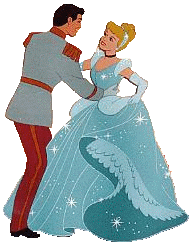 The King's Ball
After watching the dance portion of the Roger's and Hammerstein's Cinderella
video (or any other appropriate version), the children will listen to classical
music and dance with each other. They can practice bowing and curtseying
to each other, also.
A related activity can be making crowns, hats and/or costumes for the
ball depending on how much time can be allotted for the activity and the
children's interest level.
Goals
Increased kinesthetic awareness.
Dancing, bowing, and curtseying provide practice in balance, coordination
and agility.
Positive self concept and socialization skills can be addressed, also.
Listening to an appreciating music.
Show the children the dance portion of the Cinderella video. Point out
the curtsey, bow, and dance movements. Discuss the kind of music used in
the video. Suggest that the class put on a King's ball. (If crowns, hats,
and costumes are going to be used do that next)
Invite the children to practice curtseying and bowing as they would
if they were preparing to attend the king's ball. (Some may need to start
out by holding on to a chair or table with one hand to maintain balance,
let them figure it out) Next, invite them to practice dancing with each
other. You might try it without music first and see how they do. (I think
it will be harder to do) Add the music and ask the children if they think
it is easier to dance with music rather than without. (Probably, yes) "Why
is that so?" Encourage them to change partners and extend invitations to
dance with each other. Modeling this behavior is recommended.
Children's evaluation:
How did the children interact with each other?
How did they react to the music?
Can they bow and curtsey without falling?
What kind of motions in the dance are easy for the children? Difficult?
Teacher evaluation:
Could the children imitate you successfully?
Was the music appropriate and acceptable to the children?
Were unacceptable social interactions remedied?
What other kinds of activities can be used to work on balance, etc
(if a need is identified)?
Suggested music: (should have a strong simple beat, easy to count)
record the music from the video and play it
Tchaikovsky: Serenade for Strings
Grieg: "Peer Gynt" Suite-- Morning Song
Motzart: Piano concerto No.21
Ven Diagram of Cinderella
Stories
(Adapted from presentation by Dr. M. Walther)
Goals:
-
To increase appreciation for and pleasure in stories
-
To increase skills in listening to meaning in stories
-
To identify similarities and differences in the stories and classify items
from the story
-
To make intelligent comparisons
-
To help children feel comfortable in expressing their ideas with a group
Choose two of the Cinderella stories to compare and contrast. As an opening
activity compare what the children already know of Cinderella to
what is presented in one of the other stories such as The Princess and
the Golden Shoes.
As the children tell you what they already know of Cinderella write
key words on 3" X 5" cards. Read another version to the children. Make
cards with key words from the second story. Do not duplicate any words
such as shoes, prince, etc.
Place two hula hoops on the floor. Label one for the common version
of Cinderella and one for The Princess and the
Golden Shoes (or other second version) and ask the children
to place the cards in the appropriate hoop. Let them figure out the overlap
of words requires an overlap of the hoops. Provide guidance only as necessary.
(Dr. Walther says they always figure it out and it is exciting to watch
them )
Evaluation of students:
Observe students actions during the activity. Throughout the activity
discuss what the children are doing and why they think it is so. Provide
encouragement for any student who does not actively participate (they may
know and understand but be too shy to interact with the other students).
Evaluation for the teacher:
Evaluate the interest and skills demonstrated by the students throughout
all parts of the activity. Should you do the activity again with another
story? Would the children continue this activity on their own if left in
a learning center? Evaluate the appropriateness of the questions during
the discussions; should there be more? Less? Differently worded? Should
the hula hoop activity be extended to a ven diagram on paper? If this activity
is repeated with another Cinderella story can the ven diagrams be compared
to each other?
Timeline Activity
(Adapted from presentation by Dr. M. Walther and
C. Hurst at http://www.ucalgary.ca/~dkbrown/cinderella.html)
Goals:
to understand the sequence of the story over time
to begin to relate to the beginning, middle, and end of a story
to begin to recognize key vocalbulary words in the story
to reassemble the timeline and retell the story using the timeline
cues
to illustrate key points in the story
The class will be making a large time line using sentence strips.
Use the story The Flying Turnips (other stories can be used as
well but this one has a good number of events to plot on the time line
and events lend themselves to creative illustrations).
Let the students decide which dates are important enough to be placed
on the line. Ask the children to defend their choices. As you write the
event on the sentence strip hang it up in chronological order. Have the
children decide the order of the sentence strips. Refer back to the story
as needed.
When all the events have been placed in order invite the children to
return to their seats to illustrate the event segment. Reassemble the children
with their sentence strips and have them "get in order" around the room.
The can retell the story by taking turns talking about their sentence strip
illustration.
Student evaluation:
Watch for signals that the children are beginning to understand the
sequence of the story. Can they find their place in the story line up activity?
Do they understand what you mean when you ask them "What happened first?
Next? Last? Do the illustrations show an understanding of what happened
in the story sequence?
Teacher evaluation:
How much help do the children need to illustrate and reassemble the
story? What can be done to increase their understanding of this activity?
Did the children enjoy as well as comprehend the activity? What other stories
would work well for this activity? Should it be repeated? What worked well,
and how can those things be used in other activities?
Field
Trip to the Shoe Store
Goals:
To introduce the children to a merchant in the community and see "behind
the scenes" at the shoe store.
To investigate the use of a standard measurement to find shoes that
fit
To see the variety of shoes and other merchandise available at a shoe
store
Set up a trip to the local shoe store through a parent or local merchant.
Coach the merchant on the involvement with the Cinderella theme, measurement
lesson, and relevance of the field trip experience to the children. Arrange
to have shoe size measuring devices available for the children and a variety
of shoes to explore. Ask that the merchant allow the children to see "behind
the scenes" in the storeroom, etc.
Before the trip review the "rules" and safety issues surrounding all
field trips.
Discuss what the children think they will see at the shoe store and
what they want to learn or find out. Have the children ever been to a shoe
store? Where else can you get shoes? Have they ever had their foot measured
for shoes? How else can you find the shoes that fit you? What might they
find at a shoe store besides shoes? A "K.W.L." chart (or variation of)
could be used for this.
Follow the field trip with a discussion of what they saw and learned.
How was that the same or different from what they thought they would see?
A follow up activity could be a trip to a shoe repair shop. (Read The
Shoemaker and the Elves)
Student Evaluation:
Review the results of the K. W. L. chart with the children. Did the
children get their questions answered? Do they have a better concept of
how a shoe store is operated and the importance of such stores in the community?
Teacher Evaluation:
Were instructions and safety issues followed on the field trip? Evaluate
the use of parent helpers and the mode of transportation? Did the merchant
get enough information from the teacher to fulfill the teacher's expectations?
Shoe
Store Learning Center
Goals:
The children can see what it feels like to try on a shoe that is too
small or to walk in shoes that are too big. They will better understand
the importance of correctly fitting shoes.
To explore the importance and convenience of standard measurements
and shoe sizes
The children can experiment with various roles in the community.
Materials:
Collect a variety of shoes. Different sizes and styles. (Be sure to
have some too small for the children and some that fit) In boxes labeled
by size
chairs and stools
measuring device from shoe store
bags
cash register and play money
Encourage the children to reenact the visit to the shoe store. The importance
and convenience of standard measurements can be explored here.
Questions to ask children: If you don't measure your foot first, how
would you find the right size shoes? What if you didn't have time to try
on all the shoes? Can you find the right size by holding it up to your
foot? What if you measured with a ruler instead of the shoe size measuring
tool?
The children will gain experience in cooperating, taking turns, assuming
various roles, and comparing with other children. Children may discuss
differences between boy and girl shoes and gender differences.
Student evaluation:
By observation of the play in the center. Use the questions above to
provide insight into the child's thinking and understanding.
Teacher evaluation:
Were the materials adequate (enough items and enough variety)? How much
intervention was required by the teacher? Did the activity carry over to
other areas of the room (was housekeeping involved?, were language arts
activities brought into the center?)?
The
Passage of Time
a play-debrief-replay activity center
adapted from Wasserman (1990)
Cinderella had to leave the ball by midnight, 12:00 or she would be
seen in her ragged clothes, her carriage would turn to a pumpkin, and her
horses to mice. How did she know how much time she had to dance with the
prince? How did she know when to leave? Did she have time to stop for a
cup of punch?
Concepts: The passage of time can be measured; there are standard
unit of measure for time; non-standard measures of time can be used for
some things.
Learning Goals: To provide opportunities for experiences with
standard and non- standard units for measuring time. To increase appreciation
for the usefulness of standard units of measure in communicating our thoughts
to others; to demonstrate and create an awareness of what can be done in
different periods of time.
Thinking operations: Observing, comparing, interpreting data;
designing projects and investigations; creating and inventing; suggesting
by hypothesis; examining assumptions
Materials: Standard timers, stop watches, clocks (digital, analog
with second hand, alarm clock), home made hourglasses,* toy or cardboard
clocks with moveable hands.
Activity card:
-
How is time measured?
-
What kind of instruments measure time?
-
How do clocks measure time?
-
How are clocks and timers alike?
-
How are they different?
-
How are the homemade timers different from the others?
Sample Debriefing Questions:
-
What observations did you make about how clocks measure time?
-
What observations did you make about how timers measure time?
-
What are some differences between clocks and timers?
-
How are the homemade timers different?
-
How are they similar?
-
What is a minute? A second? An hour? How are they measured? What are your
ideas?
Challenging children beyond their observations:
-
How long does it takes the items in the homemade timers to flow from one
bottle to the other when you turn it over using standard measures of time?
-
How can we use the materials in the center to find out? Make predictions?.
-
Can we use our homemade timers to time things in the classroom?
Replay activities:
Use the predictions from #2 above and materials in the center to find
the answer to #1.
Make a chart of the times reflected by the homemade timers.
Use both homemade and standard timers to time events in the classroom.
For example: How long does it take to drink a glass of water, tie your
shoe, read a book, how long until lunch time? Start with an estimate and
then time it.
Another challenge: If Cinderella gets to the ball at nine o'clock and
a each song is 5 minutes long, how many dances will she and the prince
have before the clock strikes midnight? What if they take a half hour out
for a drink of punch and conversation?
Student evaluation:
Observe the children during the Play.
What kind of discussion was initiated by the debriefing session?
Were the children ready to move on to the Re-play?
Where children interested in the challenge activities?
What kind of results did they achieve?
Teacher evaluation:
What kind of debriefing questions could be added? Do any need to be
changed or discarded?
Did the children use all of the materials? Were some materials preferred
over others? Why do you think so?
Can materials be added or changed? How were the home made timers used?
Effectively?
Time in a Bottle
adapted from Instructor magazine Oct 1998
The students can make these as a separate activity or you can make them
at the same time as the Passage of time activity. These timers can
be made ahead of time or reused from a previous class if time, etc. prevents
them from being made by the children. However, children may be more likely
and more interested in experimenting with them if they made them themselves.
After having the students collect a variety of empty plastic bottles
match the bottles up in pairs. Fill one of each pair with sand, salt, rice,
beans - anything that will flow from one bottle to the other. Supply the
children with funnels, scoops, and boxes or tubs to but the bottle in to
catch the overflow. Fasten the empty bottle on top of the filled bottle
at their necks with heavy tape to make the shape of an hourglass or egg
timer.
Measuring
Family Feet
Adapted from Http://www.eduplace.com/rdg/gen_act/large/home.html
Goals:
Children will gain an appreciation for the concepts of big and little
and improve their measurement skills as they compare the measurements of
feet among family members.
They will become more familiar with the terms; small, smaller, smallest,
big, bigger, bigest, larger
To organize and display results of their data, draw conclusions and
communicate the results
Supply the children with a piece of paper for each member of their family.
Explain to the children that they will be drawing an outline of one
foot from each family member, cutting it out, and labeling each foot with
the name of the person. Have the children practice by drawing an outline
of their own or a partner's foot, cutting out their own and putting their
own name on the foot.
When the children return with their family feet have them place them
in order from smallest to largest. Use terms like small, smaller, smallest,
large, larger, largest, big, etc. Which one is the largest and how can
you tell. There will probably be references to older and younger, too.
Ask the question, What can we tell by the size of a person's foot? (Bigger
is usually older) Is that always right? Use the feet to find the answer
to the assumptions.
Have the children form groups and place their feet from smallest to
largest. You could even have the entire class order all the feet and put
them up around the room or across the floor.
Feet cutouts can be measured with a ruler and the results written on
each foot. Point out that the numbers are bigger on the bigger feet.
Extension activity: Record the results on a graph.
Student evaluation:
How did the children order small groups of data (their own family)?
How did they order larger groups of data?
What were their observations during the activity? How did they use
the vocabulary involved in sorting and ordering? What kind of conclusions
did they draw?
Teacher evaluation:
Was there enough information communicated to the parents?
What happened when the children had to combine footprints? Was the
whole class activity successful? Orderly?
Were the children's discussions encouraged? Did they help each other
and figure out problems cooperatively?
Family Crest
adapted from http://www.eduplace.com/rdg/gen_act/family/f_crest.html
Goals:
In this social studies activity the children can begin to think about
their family histories and aspects of their own lives by making a family
crest.
Children can learn about each other's families and cultures including
similarities and differences
Children can use pictures and drawings to represent important family
characteristics as well as talk about them orally.
Start with the pictures from the Cinderella story that show the King's
crest. Show the children other pictures of crests and talk about what they
could represent. Have the children ask their parents about family history,
stories, items that would be good representations of their family to use
for the family crest. They can have one to four items on their shield.
Discuss ideas for their own family crests. Brainstorm with the children
to get ideas that could represent their family histories or lives. A few
possibilities include:
-
flags that represent the countries their families came from
-
pictures of foods that are common to their ethnicity
-
pictures that represent first or last names
-
drawings that depict favorite family events
-
photos that show family celebrations
materials:
-
book from the library containing pictures of crests
-
the outline of a shield cut from oak tag
-
large pieces of paper
-
pictures from magazines or photos, etc that the children have brought
-
crayons, markers, pencils
-
glue
On the large pieces of paper trace the oak tag shield
divide the paper shield into sections ( in ½ diagonally, vertically,
horizontally or in fourths)
In each section have the child draw or glue one idea about your family.
Have the children share and compare their crests. Have them explain
why they chose the pictures or drawings they did.
Student evaluation:
What was represented on the child's crest? How did he/she explain it
verbally?
Did the children show interest in each other's projects? Families?
Were there indications of family involvement in the project?
Teacher evaluation:
Was there adequate input from home? Was there adequate information communicated
to parents about this project?
Were there enough examples and ideas presented to the children to stimulate
interest? Was there ample materials in the classroom for the children to
express ideas creatively? Should there be more or less materials? Different
kinds of materials? What?
Odd Card
(Group game - played like Old Maid)
Make a deck of cards with pictures from the story Cinderella. Each object
appears on 2 identical cards (pairs). There is one odd card (with no match)--
Cinderella's lost slipper.
The dealer deals out all the cards to the players. Each player looks
at his hand and takes out any matches he has and lays them face up. The
player on the dealer's left then starts by offering all his cards to the
person on his left to draw one of them at random, without looking at them.
If the person who drew the card can make a pair, he puts it down for everyone
else to see. If he is unable to make a match, he simply keeps the card,
and lets the player on his left draw one. Play continues around the circle
until one person is left holding the odd slipper card. (Adapted from Kamii
& DeVries, 1980, p. 50)
The following rationale for using this game is provided by Kamii &
DeVries(1980):
"Making sets of two, three, or four that are the same requires perceptual
discrimination." This game also requires memory and logic. Children begin
to choose cards at random. Soon they begin to choose from the person who
is more likely to have a match they need. In these kinds of games "children
learn to coordinate different actions, spatial relationships, and temporal
order. They learn that after B takes a card from A, the turn goes clockwise,
and B has to offer his cards to C to let him draw one. Each player does
one thing first and its complement next. The coordination of drawing a
card and letting someone else draw one with the right-left relationship
is not easy for young children."
Additional
activities
Technology: Cinderella Sites
Visit the Cinderella Disney Character Image Site
( http://www.disneyclipart.com/
) Great clipart images that students can print or download. The students
are given the web address, and at home they can choose to print out something
from the site (For the students who don't have Internet access at home,
give them time during the day to do it.) Some students may just print out
the pictures; others may download them and write stories to go with the
pictures. This is an awesome activity! Let them be creative.
Cinderella Around the World/ Comparing Cultures
(adapted from M. Willon Eric lesson plan # AELP-GGR0003 titled
Comparing Cultures at http://ericir.syr.edu/Virtual/Lessons/Social_St/Geography/
and M. Brown at http://www.eduplace.com/tview/tviews/hagen31.html
)
Description: Most elementary students have heard
the traditional story of Cinderella. Review this
story with them, asking them to elaborate on the parts
they remember, such as the main characters
and the setting.
Goals:
-
encourage students to use the higher level thinking skills
and will help them learn to better cooperate with their peers. It will
also help students develop a respect for cultures different from their
own.
-
Work with a partner to answer questions in a cooperative
manner.
-
Compare two stories/cultures and point out how they are alike
and how they are different.
-
Share their own version of a well-known story and adapt it
to another culture, elaborating on why they made certain adaptations.
Materials: For this particular lesson, the teacher
would need Cinderella stories from the resource list to read, (if possible
use stories that reflect the cultures and heritage represented in the classroom)
compare the story or stories read to the version that the students are
familiar with.
Procedure:
After reviewing the story of Cinderella with the students,
the teacher will then explain the cooperative learning strategy of think-pair-share
(TPS). The teacher will ask the students to find a partner and hold up
her/his hand, so that each student has only one partner. If there is an
off number of students, the teacher may want to assign one group of three,
or be a partner to the extra student. (If the teacher feels more comfortable
assigning pairs, that strategy would also be appropriate.)
The teacher would then explain that the students are to
watch her/him for visual cues for questioning during the remainder of the
lesson. The teacher may use any hand signals for cueing, such as putting
her/his finger to her/his head indicating "think time", when everyone should
be silently thinking about the best answer to the question that the teacher
has asked. The students will be told that for the next cue - two fingers
being held up they will, in whisper voices, share their answers with their
partners.
Finally, when the teacher raises her/his hand, the students
will again be silent, while the teacher calls on one students at a time
to share some answers.
Once the teacher has explained the strategy for TPS, s/he
will read the story, The Egyptian Cinderella, or other
version, to the class. As the teacher reads the story, s/he will pause
to ask questions throughout, that compare and contrast this story to the
version of the story that the students have read or seen as a movie.
Some examples of questions that the teacher could ask
would be:
1.How is the dress of Rhodopis (The Egyptian Cinderella)
different from the Cinderella you
have previously read about? Why do you think they dress
differently? Can anyone tell us how
the climate of Egypt compares with the climate of the
United States? (The teacher may want
to show the student Egypt and the United States on the
globe and on a map, to integrate
geography into the lesson.) Investigate and identify
the different cultures and customs of that location. Complete Venn diagrams
to compare the different places.
2.How are Kipa and the other two servant girls like Cinderella's
step- sisters? Do they treat
Rhodopis fair? Tell why you think they do or don't.
3.Does this story have a happy ending? Compare the way
this story ends with the ending of
Cinderella .
The questions that the teacher asks would be varied and
geared toward the age level, interests, and abilities of the class.
Extension activities
Have the students either orally, or on paper, write their
own version of a well-known story, adapting it to another culture.
Math: Graphing-- Complete a graph of the students' favorite
version of Cinderella.
back to home page