URL: http://www.geocities.com/algheeli
|
|
URL: http://www.geocities.com/algheeli |
From a geological perspective, our planet is a very
unique and awe-inspiring place, and this world is
filled with wonders from the mountaintops to the
depths of the seas. Some of the greatest marvels the
earth lie somewhere between mountains
are hot springs which are
fascinating features, so tourists come from different countries to see these springs. In the United States (U.S), there are at least five United States national parks feature hot springs including Big Bend National Park in Texas, Death Valley National Park and Lassen Volcanic National Park in California, Hot Springs National Park in Arkansas, and Yellowstone National Park in Wyoming (and Idaho/Montana). (Wikipedia, 2004, ¶ 5). I have been Yellowstone National Park with group from the English Language Institute ( ELI) on September 9,2004, and I saw several geothermal features there, but I like hot springs because this feature bring up many questions when people see them, so in this research, I will examine hot springs in Yellowstone National Park.
.
�Yellowstone National Park covers 2,221,766 acres, which is roughly the size of the state of Connecticut. Most of the park is located in the northwestern corner of Wyoming, but a small portion overlaps that state's boundaries with Montana and Idaho. The park is comprised primarily of high, forested, volcanic plateaus that have been eroded over � the millennia by glaciations and stream flow and that are flanked on the north, east, and south by mountains. The Continental Divide traverses the park from its southeastern corner to its �-western boundary. The elevation of the park averages 8,000 feet, ranging from 5,282 feet in the north, where the Gardner River drains from the park, to 11,358 feet in the east, at the summit of Eagle Peak in the Absaroka Range" (Yellowstone National Park.com. 2003, ¶ 1).
 |
URL: http://www.geocities.com/algheeli |
(Wikipedia, 2004, ¶ 1) defines a hot spring as follows:
There are many factors that help create and develop hot springs like faults in the rocks, deep source of magma, water location, and the kind of minerals in the rocks, but some of the writers consider one or two factors more important than others.
Alien and Day (1935, P. 32) state that �half of writers see an important factor in the development of hot springs are fault and fissures, also they consider volcanic gases as playing an important role.�
Hot springs are amazing creations because these springs are created by many factors, and each factor works with other factors to start creating hot springs (e.g., temperatures, pressure from the underground, and several kinds of minerals make earth layers to create faults); therefore, these faults, in the layers and rocks, temperatures, and pressure work together to produce hot springs on the surface.
"A warm spring or hot spring is a place where warm or hot groundwater issues from the ground on a regular basis for at least a predictable part of the year, and is significantly above the ambient ground temperature (which is usually around 55~57 degree F or 13~14 degree C in the eastern United States). The water is heated by geothermal heat, or heat generated from the interior of the Earth"
In additional, these springs are form in the mountains area in the Rockies. According to Mountain Nature.com (2003, ¶ 3), �there are many springs in the Rockies. Springs are defined as places where groundwater is discharged at a specific location. They vary dramatically as to the amount of water they discharge. Some of the water may have traveled great distances underground before resurfacing as a spring. Many of the larger springs in the Rockies are the result of long cracks, or joints, in sedimentary rock.�
The website, Yellowstone National Park, (2004, ¶ 1 ) states how hot springs are created and work, and it explains several factors that affect them:
�In the high mountains surrounding the Yellowstone Plateau, water falls as snow or rain and slowly percolates through layers of porous rock, finding its way through cracks and fissures in the earth�s crust created by the ring fracturing and collapse of the caldera.
Sinking to a depth of nearly 10,000 feet, this cold water comes into contact with the hot rocks associated with the shallow magma chamber beneath the surface. As the water is heated, its temperatures rise well above the boiling point to become superheated. This superheated water, however, remains in a liquid state due to the great pressure and weight pushing down on it from overlying rock and water. The result is something akin to a giant pressure cooker, with water temperatures in excess of 400 degree F.
The highly energized water is less dense than the colder, heavier water sinking around it. This creates convection currents that allow the lighter, more buoyant, superheated water to begin its slow, arduous journey back toward the surface through rhyolitic lava flows, following the cracks, fissures, and weak areas of the earth�s crust. Rhyolite is essential to geysers because it contains an abundance of silica, the mineral from which glass is made. As the hot water travels through this natural plumbing system, the high temperatures dissolve some of the silica in the rhyolite, yielding a solution of silica within the water.
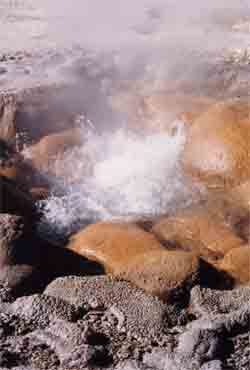
At the surface, these silica-laden waters form a rock called geyserites, or sinter, creating the massive geyser cones; the scalloped edges of hot springs; and the expansive, light- colored, barren landscape characteristic of geyser basins. While in solution underground, some of this silica deposits as geyserites on the walls of the plumbing system forming a pressure-tight seal, locking in the hot water and creating a system that can withstand the great pressure needed to produce a geyser."
 |
URL: http://www.geocities.com/algheeli |
As we know, hot springs are formed in the Rockies under high temperature underground. Uhler. (2003, ¶ 2) explains that geologists believe �that just the right combination of rock types and old faults exists here to permit water to percolate deep, where it is heated by surrounding rock.� In addition, water of a hot spring becomes hot depending on the depth Uhler. (2003, ¶ 6) also states �that great depth the heated water comes into contact with cracks and faults within the Hot Springs Sandstone. These cracks bring the water quickly, in about a year, back up to emerge as hot springs on the slope of Hot Springs Mountain. The water retains most of its heat during this relatively upward journey and arrives at the surface at an average temperature of 143 degrees Fahrenheit.�
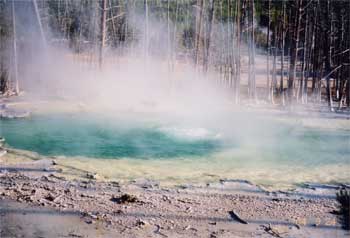
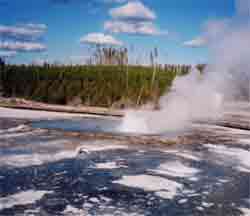
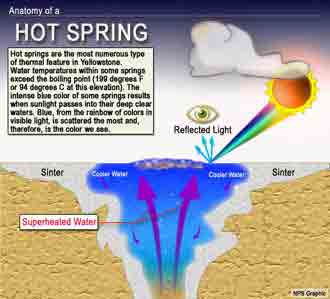
One of the most wonderful features of geothermal areas in the Yellowstone National Park is the beautiful colors of the hot springs waters. Alien and Day (1935, P. 78) state �that the distinctive characteristics of these blue springs are clear water, considerable depth, and light-colored walls and bottom.�
URL:http://www.nps.gov/yell/nature/geothermal/hotspring_works.htm
Explain for Why people can see colors in hot springs.
The website, Yellowstone National Park (2004, ¶ 1) states "that a hot spring�s color often attests the presence of minerals. In addition, the water in a clear blue pool is absorbing all color of sunlight barring blue color, which is reflected to our eyes, also kind of minerals in the hot springs playing role to give them different colors, for example, Emerald spring�s pool with light refraction, and the yellow color from the sulfur combines with the reflected blue light, so minerals and sunlight are the main factor to give hot springs these colors.�
Hot springs colors are magnificent when people see these springs and different colors between springs depending to what kind of minerals the spring has in its rocks. In addition, refraction by the sun light on the surface of springs also makes different colors.
Hot springs, whose water issues from underground and the water at a temperature above that of the human body, are wonderful thermal features in the Yellowstone National Park. These springs attract people by their unique geologic formation and magic colors, so the areas that include springs become special places in any country. According to a recent survey of 37 people on hot springs in Yellowstone National Park (Al-Thaibani, 2004), 60% of who answer state the geothermal features are the most part of Yellowstone National Park they like it, and 100% of them would like to visit Yellowstone National Park in the future. This suggests that people world like to see and visit natural areas. Furthermore, to the question � Do you agree or disagree with this statement: Government should convert some of the hot springs areas into hot spring pools for visitors?�, most people disagree with any change in these springs, and 86.49% of them state that we should protect and keep these springs as they are. In my opinion, I think we might to protect and keep these springs from destruction because these areas not only have one kind of environment, but also several environments that change the environmental balance otherwise.
During this video you will watch magnificent features in the Yellowstone National Park, one of them being hot springs .
Click Video [7.59 MB]
Alien, E. T., & Day, Arthur A. L. (1935). Hot springs of the Yellowstone National Park. Washington D.C: Carnegie Institution of Washington.
Al-Thaibani, Najat. (2004). Hot Springs in Yellowstone National Park. Retrieved December 1, 2004, from World Wide Web: http://www.createsurvey.com/c/21705-1TN9yX/.
Mountain Nature.com. (2003). Hot Springs. Retrieved November 16, 2004, from World Wide Web: http://www.mountainnature.com/Geology/HotSprings.htm#An%20Introduction%20to%20Hot%20Springs.
Uhler,J. W. (2003). Geology - What makes the water hot. Hot Springs National Park. Retrieved November 16, 2004, from World Wide Web: http://www.hot.springs.national-park.com/info.htm#hot.
Wikipedia. (2004). Hot spring. Retrieved November 16, 2004, from World Wide Web: http://en.wikipedia.org/wiki/Hot_spring.
Yellowstone National Park. (2004). Emerald Spring. Retrieved November 16, 2004, from World Wide Web: http://www.nps.gov/yell/tours/norris/emerald.htm.
Yellowstone National Park.com. (2003). Geology. Retrieved November 19, 2004, from World Wide Web: http://www.yellowstonenationalpark.com/geology.htm.
Yellowstone National Park. (2004). Hot springs and how they work. Retrieved November 16, 2004, from World Wide Web: http://www.nps.gov/yell/nature/geothermal/hotsprng.htm.

I have written it this way to avoid spam.