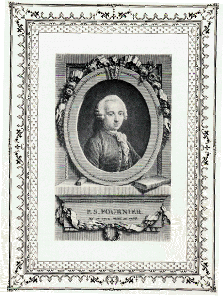
Pierre Simon Fournier
y la Tipografía
He set up his own type foundry in Paris in 1736. He designed many new characters, and the fame of his foundry spread beyond his native France. His Table des proportions qu'il faut observer entre le caractères (1737) was followed by several other technical treatises, including Modèles de caractères (1742), which presented his entire range of typefaces.
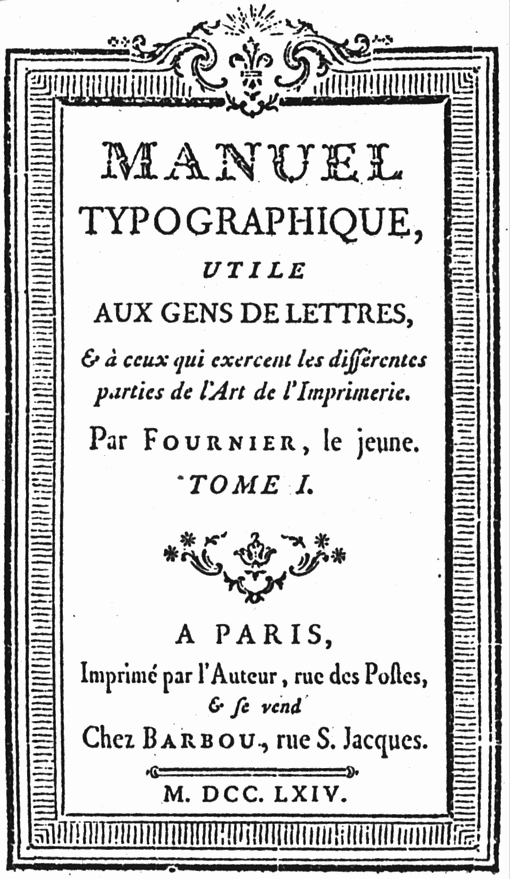
His principal work is Manuel typographique (2 vol. 1764-66), the first volume of which deals with punch cutting and type founding; the second is devoted largely to type specimens, with many pages of ornaments.
The Didot typographical measurement system
So named after the French book printer François Ambroise Didot (b.1730 - d.1804) who is remembered for his work of fine tuning the "Fournier point based" typographical measurement system that now bears his name.
The Fournier family by Monotype was based on the types cut by Pierre Simon Fournier circa 1742 and called St Augustin Ordinaire in Fournier's Manuel Typographique.
James Mosley, Librarian at the St Bride Printing Library (London) will discuss the value of typefounding archives, his Dictionary of punchcutters, and his recent work on a facsimile of Fournier's Manuel Typographique.
Fournier, Pierre-Simon, dit le jeune (1712-1768)
Rééditions :
Monographies
Pierre Simon Fournier: 1712-1768
Born in Paris. Pierre's father, Jean Claude Fournier, came from a family, which carried on a printing business for many generations. He learned a lot of his typography knowledge from a man named Jean Cot, in Paris.
Things to know about Fournier:
Books written by Fournier:
Modeles des Caracters de le Limprimerie1 and 2
Fournier, Pierre-Simon
b. Sept. 15, 1712, Paris
d. Oct. 8, 1768, Paris
French engraver and typefounder particularly noted for decorative typographic ornaments reflecting the Rococo spirit of his day.
Trained as an artist, at 17 he went to work in a typefoundry, where he learned to cut punches and to engrave ornaments. He set up his own typefoundry in Paris in 1736. He designed many new characters, and the fame of his foundry spread beyond his native France. His Table des proportions qu'il faut observer entre le caractères (1737) was followed by several other technical treatises, including Modèles de caractères (1742), which presented his entire range of typefaces. His principal work is Manuel typographique (2 vol., 1764-66), the first volume of which deals with punch cutting and typefounding; the second is devoted largely to type specimens, with many pages of ornaments.
Though intended for the exclusive use of the Imprimerie Royale, the new roman was immediately copied by other designers, one of the most active of whom was the founder Pierre-Simon Fournier, who is also remembered for his creation of a wide range of printers' devices that could be combined into festoons, borders, and headpieces and tailpieces for the heavily ornamented éditions de luxe that were popular in France then and that were to remain so until the Revolution.
www.adobe.com/type/browser/D/D_FOUR.html
http://www.myfonts.com/Person152.html
The history of the American POINT SYSTEM
by Nicholas Fabian
The European connection
In 1737, Pierre Simon Fournier, a typefounder in Paris, France, published a booklet entitled, "Tables des Proportions qu'il faut observer entre les caractères", announcing his adoption of a typographic point system. The following year he published a type specimen book, in which all the types shown were cast on the point system he invented. Fournier based his point system on the French type size called "cicero", which was 0.1648 of an inch, and he divided his cicero into 12 typographical points.

The upper portion of Pierre Simon Fournier's second booklet from 1742,
"Table des Proportions des differens caracteres de l'imprimerie".
Fournier was one of the great typefounders in the history of type making. He was a type designer, punch-cutter, typefounder, printer, publisher, and a gifted historian. His monumental work, "Manuel Typographique" was published in two volumes between 1764-1766 in Paris. The work is so exceptional both in quality and contents that it probably never be equalled by anyone, now or in the future.
 Ambroise Didot
After the death of Pierre Simon Fournier, Ambroise Didot, who was an influential
typefounder and printer of the period, decided to improve on Fournier's point system by
harmonizing it with the existing legal French foot measurement of the day, which was
12.7892 American inches. And so he did. Didot's new thicker point measured 0.0148"
compared to Fournier's 0.0137" point. From 1770 on, the Didot typographical point
measurement became the accepted European standard¹, and it remains so to this day.
Unfortunately for Didot, in 1795 the French government adopted the metric system, thereby
divorcing the Didot point system from any legal authority of measurement. C'est la vie!
From Paris to Philadelphia
The type making equipment purchased by Benjamin Franklin in 1785 included many matrices
supplied to him by the son of Pierre Simon Fournier, the inventor of the point system. The
Franklin type foundry was sold in 1806 to Binny & Ronaldson, which company continued
to function commercially under various names until 1892, when it became one of the
principal mergers of the newly created American Type Founders Company. Through this
acquisition, ATF also became the owner of a curious set of historical documents. They were
the well worn copies of Fournier's "Manuel Typographique", volumes 1 and 2.
The American Connection
Nelson C. Hawks of Alameda, California (1841-1929) -- a man of great character and personal integrity -- most likely honestly believed that he "invented" the point system. Now, the quality of his historical research, obviously was either very poor or non-existent. On the other hand, it is not unusual in science and technology for different people to independently discover very similar concepts and produce nearly identical results. Fournier's typographic point was 0.0137", Didot's was 0.0148", and the Hawks's American point was set at 0.0138".
During the late 1860s and early 1870s Hawks was personally involved in the printing
business and time after time he unsuccessfully tried to convince several companies to
change to his point system. It was during his employment with Marder, Luse & Company,
as Partner/Manager of the Pacific Type Foundry in San Francisco, that Hawks was finally
able to convince A.P. Luse & John Marder to accept and back his point system. The
"American System of Interchangeable Type Bodies" was announced in the winter of
1879, and it became an unqualified success. The American printing trade, almost
universally, accepted the new point system with astonishing speed. Finally, there was an
American standard and typography would never be the same again. Non-pareil, pica, great
primer, double pica, three-line pica, and all other unique non-standard sizes, in a very
short time, were nothing but history.
The Standard
In 1886, at the Association of Typefounders of the United States convention in Saratoga, the Hawks's point system was officially adopted as a national standard. By 1892, when the American Type Founders Company was formed, the manufacturing of all non-standard old body types had almost completely ceased. All this change happened predominantly because of the efforts of one individual, Nelson C. Hawks, the man who should be an American legend.
The invention of the point based system came out of a need for standards as more and more print shops was founded, and the first successful attempt to standardize typographical sizes was made by P.S.Fournier who brought his system into its final form in his book "Manuel Typographique" published 1764.
Mr Fournier was of French origin and he based his point size on the "French Royal Inch" that was different in size as compared to the "Imperial Inch" (FRI = 27.07 mm -- II = 25.40 mm) and that seems to form the background of why the Anglo saxon and the European typesetting systems have different sized points.
Later in around 1775 another French man, Mr Didot, took over and fine tuned the Fournier system and the result has since been known by the name The Didot System. Any way, the "magic" divisor of "72" was used in the Di system in the same way as it later would appear in the As system, as in "1 point Di = 0.376 mm = 1/72 of a French Royal Inch" (27.07 mm)
Today the basic point of the As system is defined as 1/72 of an "Imperial Inch" (0.353 millimeters).