 |
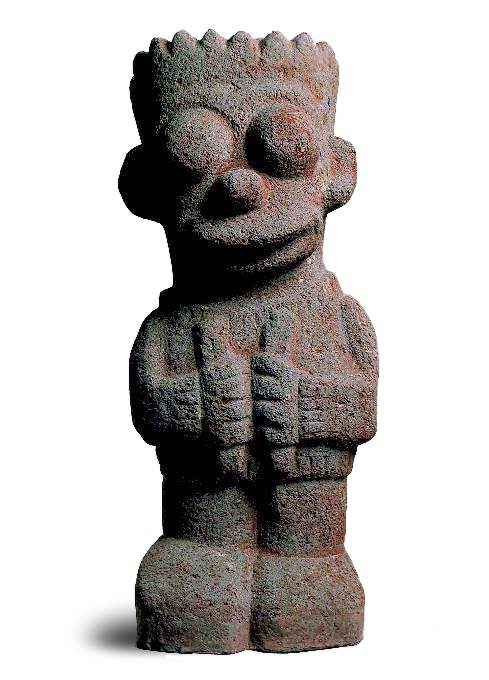
| Bogot� is a city of few museums. There are three main museums which attempt to consolidate Colombia�s past culture into an image of identity. The most prestigious museum of the three is the Museo del Oro (Museum of Gold), a collection of pre-Columbian artifacts and silversmith objects displayed as luxuriously as in an elegant jewelry store. In the low-lit rooms of a late 1950s building, small spotlights set the stage and dramatize a glorious spiritual past. After walking through the dilapidated streets around the museum, full of potholes, beggars, street vendors, and flea-bitten mutts �a sign not only of poverty, but also of corruption and spiritual bankruptcy- it is not hard to imagine how all cultural ties to Colombia�s mythical and mystified past have been completely Arcaic Critic. 1993 lost in the political farce that has destroyed the country�s cultural artificial stone unity. Nonetheless, the intention of this museum �the most popular one among tourists and schoolchildren- is to become a contemporary ceremonial space that seeks to reconstruct, or at least appropriate, a past that offers at least a modicum of spiritual dignity. In 1992, Nad�n Ospina won the first prize in the National Contest of Visual Arts, the most important art competition in Colombia. The work he presented was called In Partibus Infidelium (In the country of the Infidels), a museum installation of imaginary �pre-Columbian� objects with new �ancient� forms, manufactured by contemporary Indians, set within walls painted as a jungle and with ambient sounds of crickets. This work was a parody of the reconstruction of the past in the decontextualizing environment of the museum which imposes a sterile, aestheticized and denaturalizing gaze on religious objects: The museum as a sacred setting for a stylization of the pre-Columbian past, idealizing historical unity that obliterates any trace of the bloody Spanish conquest. The museum creates a new grammar for the objects, articulating them according to a set of values that bears less relation to their original meaning than to the need to satisfy the demands of simulation as the only possible reality. The medium serves to consolidate truisms of identity of a happy past and a future based on these fictions. This work of Nad�n Ospina plays a mirror game with originality and appropriation, with contemporary reality and El Dorado (invented only to be eternally lost), with history and fiction, with representation and simulation. Art becomes the postmodern means of reshaping religion (from the Latin, religare, to join again). In the following years, appropriation became the main axis of Nad�n Ospina �s work. In late 1993, Nad�n Ospina presented an installation called Faust an a private gallery in Bogot�. Baudrillard has said that it is more human �to hand over our luck, our desire, our will to someone else�, that it is better �to be controlled by others than by oneself. It is better to be oppressed, exploited, persecuted, manipulated by the others than by oneself.� This is the aim of Nad�n Ospina when he assumes the role of Mephistopheles, getting the Colombian artist Carlos Salas to sell him one of his major works, a �soul� titled The Amphibian Ambiguity of Feeling (1989), designated by a Colombian critic as the master work of the 80s in Colombia. Nad�n Ospina then proceeded to dismember the work. That is, the paintin (a 1.50 x 10 meter canvas) was cut up into household shapes and reinscribed within the terms of its own formal codes. Eight vases filled with white roses, the flowers of salvation in Goethe�s text, in the center of the installation. Heavenly choruses and the reverberating echo of clapping hands put the final touches on the work�s complicity and irony. When the clapping started an imaginary curtain was lowered, the representation came to an end, and the lights in the room were turned off. Museum and art galleries become theatrical spaces in Nad�n Ospina�s work, though ones with ambiguous settings. Representation and simulation become part of the scene as the artost is displaced from his starring role and become a behind-the-scene director-voyeur. Barthes (the death of the author), Duchamp (the appropriation of objects manufactured by others), and Baudrillard (simulation) are the spiritual fathers of this work. In the 1994 Havana Biennial, Nad�n Ospina presented a wor in wich the �pre-Columbianization� of identity takes on more literal qualities of humor and perversity. Among the ceramic objects that adopt �pre-Columbian� shapes, Nad�n Ospina included a series of characters from The Simpsons cartoon, represented with the traditional shape, frontality and material of the works of the pre-Coloumbian Agustinian culture . The characters are called Bizarre & Critics and refer playfully �as in a �petit historire�- to contemporary Colombian critics who never go beyond their petty vanity and their mediocre power, at the expense of complicity and communicative power. However, beyond the local context, the pieces appear to be a parody of the �center and periphery� discourse that has fueled so much contemporary debate. The mass media characters are set into the �pre-Columbian� mold to become a sort of Borgian Aleph in wich different times, situations, visions of cultural servility wich debased dignity and identity, and it is part of the transculturation inherent in our contemporary hybridization, though also of the displacement of El Dorado to Northern countries that have become the only possible paradise. This work, like In Partibus Infidelium, deconstructs all attempts at establishing the coordinates of present through a past whose link to the contemporary world is only hypothetical. In the context of a critical debate on multiculturalism that is trying to maintain at all costs a more complex concept of the Americas, the work of Nad�n Ospina attacks all exoticisms that surround this discourse. The invented pre-Columbian pieces represent hippopotamuses, crocodiles and african turtles, that is, everything except American creatures, and thus become mythical inventions of Americas. The lack of spirituality was a factor behind the need for multiculturalism as a space within contemporary culture �the need to return to ones �roots�, no longer represented by popular archaic cultures and their anonymous authors, as in the times of Cubism, but by sophisticated �peripheral� artists- and has led to the establishment of ritual as the ideal cultural fetish for the defense and legitimation of cultural differences. However, the work of Nad�n Ospina plays with these new prototypes of cultural exoticism. He laughs at the fifteen minutes of neoexoticism granted to the artists by a misunderstood multiculturalism and situates what has been the aim of the strategies of postmodern peripheral arts in a medium that shows how elusive identity is a political project still submerged in bipolar dialectics (north/south; center/periphery). A further deconstruction is needed an order to explore different options within the artistic program that multiculturalism has oponed for contemporary Latin American art. Nad�n�s pre-Columbian Faust game aims at appropriating the souls of others (Indian ceramicists, contemporary artists), and at turning tha act of appropriation into an artistic survival strategy which turns plunder into a legitimate cultural practice. But it is also aimed at displacing the notions of cultural, identity and subordinated culture towards a path that remains to be explored. In his work, humor becomes an instrument that turns contemporary definitions on their head. Article at: Poliester magazine. Vol. 4 num. 11. winter 1995. Mexico D.F. |
|
 |
 |
| Nadin Ospina Postmodern Pre-Columbian Carolina Ponce de Le�n |
 |