
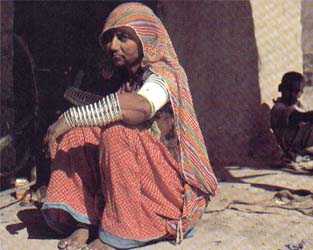
indh is noteworthy for being the area of Pakistan with the largest number of Hindus. The whole province was Hindu before its rulers were overthrown by Muslims. Today, despite the majority of its inhabitants being Muslims, certain Hindu customs, like the putting of palms togethel in greeting, still persist. It is only recently that Sindh has developed its agricultural potential, due to the extensive network of canals that has been laid down. There is still a tradition of hunting for food, and many of the poorer Hindus still maintain a precarious existence in this way by living off the riverine jungle land. In many of the small towns that have grown up along the rivers, there are families who trace their origins to Turkey and Afghanistan. Many place names are simply called "Shah," betraying their common Arab ancestry.
Elsewhere, wealthy landlords hold enormous social and political power and peasants live a semi-feudal existence. It is not uncommon to find peasants suffering under a medieval type of servitude being obliged to give as much as 80% of their harvest to landlords. Ironically, modern agricultural innovations, mechanization and irrigation schemes, are worsening peasants' plight. The new methods force many small farmers off the plots of land their families worked for generations. Landlords make more profit by cultivating larger areas of land, obtained by buying off numerous all landholders.
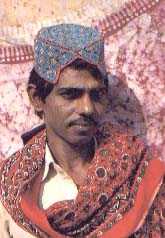 The
distinctive feature of male dress in Sindh is the ajrak, a red cloth,
about six and a half feet long and 24-36 inches wide, which is worn over the
shoulder of the kurta bizar, the long shirt and baggy pants
worn by men. Individual tribes weave their unique pattern into the ajrak, which
is hand-dyed using vegetable dyes and cow dung. Another highly colorful item
of dress is the embroidered cloth cap with tiny mirrors stitched into it. Women,
who do not wear the colorful caps, make up for it by embroidering their shirt-fronts
with bright color schemes of their own.
The
distinctive feature of male dress in Sindh is the ajrak, a red cloth,
about six and a half feet long and 24-36 inches wide, which is worn over the
shoulder of the kurta bizar, the long shirt and baggy pants
worn by men. Individual tribes weave their unique pattern into the ajrak, which
is hand-dyed using vegetable dyes and cow dung. Another highly colorful item
of dress is the embroidered cloth cap with tiny mirrors stitched into it. Women,
who do not wear the colorful caps, make up for it by embroidering their shirt-fronts
with bright color schemes of their own.