
 |
The major festivals in Pakistan are all religious, although there are many rural festivals that are more secular in nature. In the north of the country, the coming of spring is often be celebrated by locally organized competitions. At harvest time, local festivals are held to mark the successful conclusion of summer's work. In Punjab, this is the time when singers aandytellers bring traaditional myths and legends to life. A popular folk dance is Bhangra, and it is usually featured at Punjabi harvest festivals.
Many festivals vary from one region toanother. In a northern area called Hunza, te autumn festival celebrates the return of the herdsmen from the higher pastures andasword dance is performed.
The two major religious festivals aare the two Eids. The "Small Eid" celebrates the end of Ramadan, the fasting month, and 10 weeks later the "Big Eid" commemorates Hazrat Ibrahim's willingness to slaughter his own son in obedience to God.
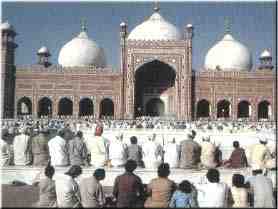 |
Young people always look forward to the small Eid, the Eid-ul-Fitr , because it is the time of year when they receive a new set of clothes and gifts of money.
Eid-ul-fitr is celebrated throughout the muslim world, is the most festive day on the Islamic calender.
On the first day of the festival , all the male members of a household visit a mosque for special morning prayers. Immediately after, they visit friends and relatives. Children dressed in their best new clothes looking forward to receive gifts of money also go visiting.
Since it marks the end of Ramadan, the small Eid is always aan occasion for a celebratory meal and families come together.
 |
Eid ul azha , also known as the "Big Eid", is the celebration of Hazrat Ibraahim's willingness to sacrifice his son in obedience to Allah . It is marked by the slaughtering of a male goat,sheep or a calf.
The day itself begins like the Small Eid , with the men and boys going to the mosque for special prayers. They return homes with a butcher to slaughter the animals, if they are not doing it themselves.
The sacrificial meat is cut into three main portions: for the family, for the relatives and for underpreviliged.
During both Eids , theusual greeting is "EID MUBARAK" meaning "An Auspicious Eid for you".
 |
On the 10th of Moharram, the first month of the muslim calender, the death of Hazrat Imam Hussain is marked.
The mourning begins on the first first day of the month for shiite muslims, but the culmination of the festivalis on the 10 day, knawn as "ASHURA". On this day there are large public processions held in all parts of country where Shiites are found.
The most dramatic feature ofthe day is the self-flagellation that some devotees suffer as an act ofpious identification with the sufferings of Hussain. Each procession has a section where believers volunteer to have their backs beatenwith special whips and chains that contain five short, sharp blades at the end. Some members of the procession collapse from shock after the loss of blood, but they are quickly replaced by others, all crying "Ya Hussain".
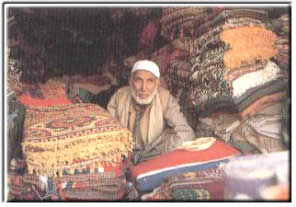 |
Mela is the general word for fairs that takes place throughout the century at different times of the year. they are not national events and generally attract by the local population. To the visitor they often seem to represent a mix of the religious and secular. Traders setup more stalls in the market than usual and a traveling circus may erect its limits to display dancing bears and monkeys.
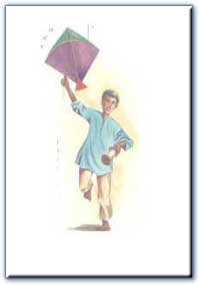 |
This colourful festival takes place at the begining of March in the cityof Lahore marks the coming of spring. It is not a relegious event and is celebrated by a great display of kite flying. Bigfields as well as roof tops became the locations for large scale kite-flying.competitions.
The festival lasts all day and in the evening food stands are crowded with competitors and spectators.