N7DLV's Field Day 2006 Activities!
Numerous Ham radio clubs will also set up stations to participate. Many of these clubs use Field Day as a social event and set up in parks, campgrounds, shopping centers, etc. They will use Field Day to show the general public what it is to be a Ham Radio Operator and to show that Ham Radio is an important form of emergency communications, and why in some cases, it may be the only form of communications when disasters strike.
I take a different approach. During an actual emergency, it will be very unlikely that a large group of Hams will be able to get together and set up elaberate stations. More likely, it will be the individual Ham radio operator who will be providing emergency communications for his or her community at the local park, church, or shopping center. Everything for continuous operating will have to be provided and packed into the family vehicle for transportation to and from the communications site. This approach to Field Day most closely approximates it's intended purpose in my opinion.
Here is my story!
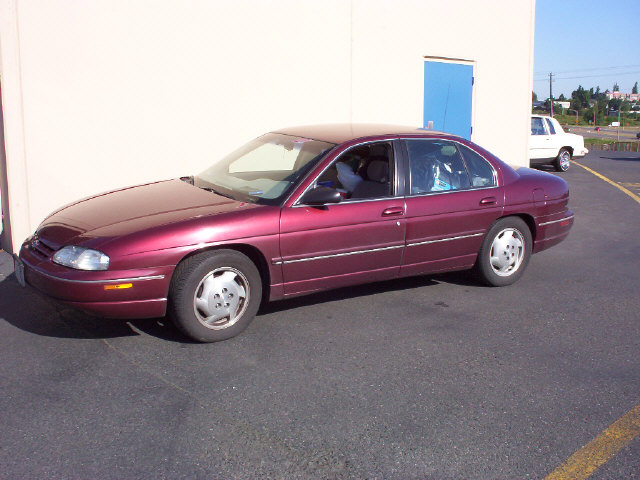
Everything I will be needing for this year's Field Day is packed up in the car and I'm ready to go. Everything I need for 3 days is there. The radios, antennas, coax cables, antenna masts, electrical power for the portable station, food, shelter, everything. This year I am doing things a little differently. In addition of taking 3 high frequency dipole antennas, I am taking the Cushcraft R5 HF Vertical antenna. This time, the 3 dipole antennas will be raised and lowered using a pully system. This should make things easier on my injured wrist and shoulders.
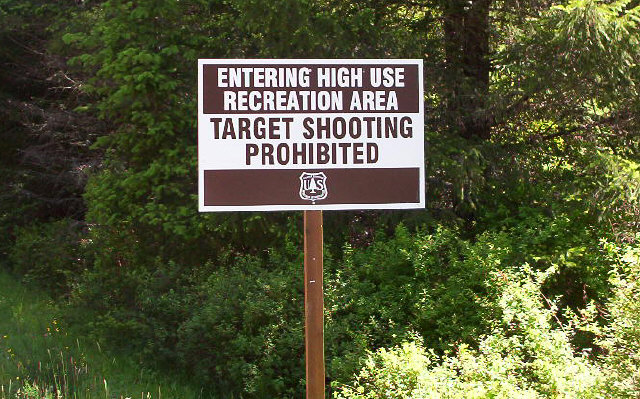
The area from which I operate Field Day is in the Mount Baker/Snoqualmie National Forest. It is open to the general public and this sign is to remind visitors that shooting is prohibited.
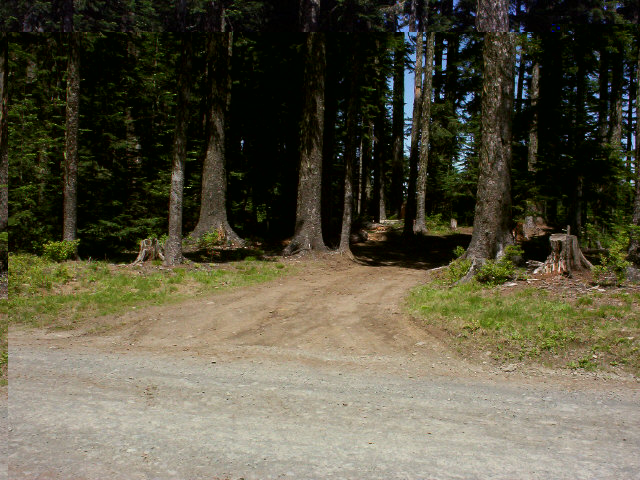
I have arrived at my Field Day site! It is located along Forest Service Road #70 off of Washington State Highway 410, just a bit south of Greenwater, WA. Just follow FS #70 and it will take you to my Field Day site. FS #70 initially is paved, but later becomes a gravel road. However, it is well maintained and easily traveled by standard vehicles. This year, I saw a motor home drive by the site, towing a small car. I have been coming to this location since 1993 with the exception of one year when I operated mobile in Eastern WA.
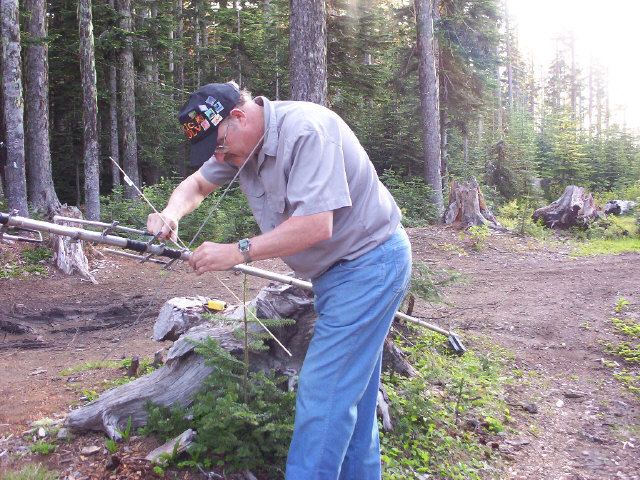
Here I am, putting together the R5 HF Vertical. One of the capacity hat rods had became broken while it was in storage. I fabricated a replacement out of brass rods and ring terminals. Far less expensive then the replacement Cushcraft wanted.
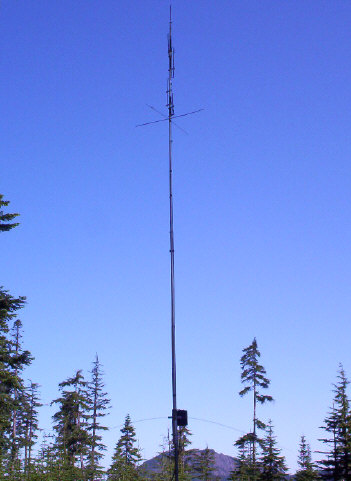
It's up and looking good! SWR checks out very low on 10 through 20 meters. EXCELLENT! During Field Day, it actually out performed the dipole to the Eastern US and to the Pacific on several occassions.
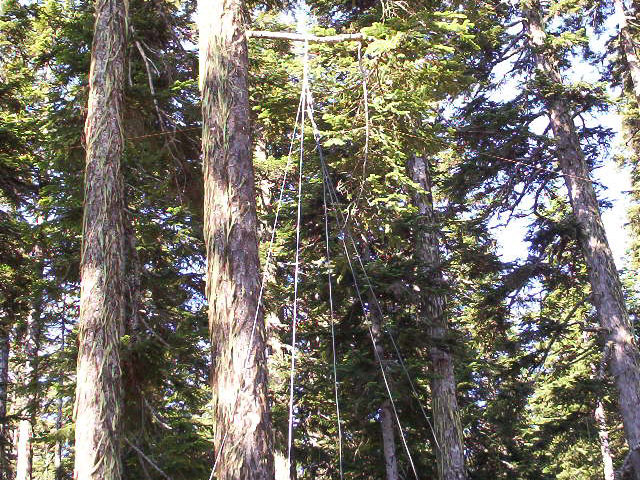
The dipoles are up as well. I have three dipoles hanging from this tree branch. I have a 40/80 meter and a 10/15/20 meter dipole bidirectional for East/West propagation and a 40/80 meter dipole for North/South propagaton. I am still having shoulder and wrist issues, so I couldn't get the antennas any higher. This is the same tree branch that I used during Field Day 2005. Band changing is real easy though. Just lower the antennas, disconnect or reconnect the spade connectors as required and raise the antennas to change bands. It takes less than 3 minutes. The SWR on the East/West antennas was excellent in the phone portion of the bands. The North/South dipole was cut for the CW portion of the bands. I had to use the internal tuner of the radio on this antenna for SSB operating.
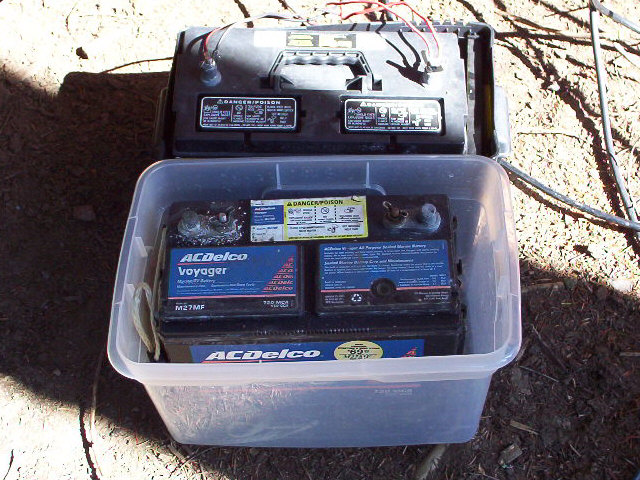
Two deep cycle marine batteries provide power for the entire station. The primary battery is the one with the power leads connected. The other battery was charged using solar power and will be used later for the natural power bonus points. Yea I know, There is corrosion on the post and terminal. I'll clean it up when I get home.
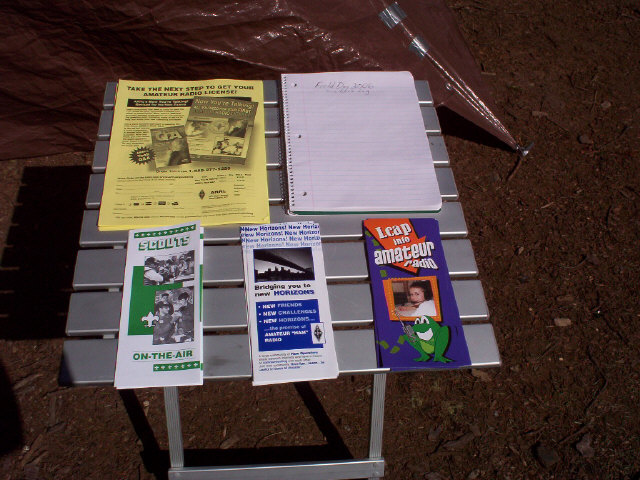
The information booth is set up with various handouts provided by the ARRL.
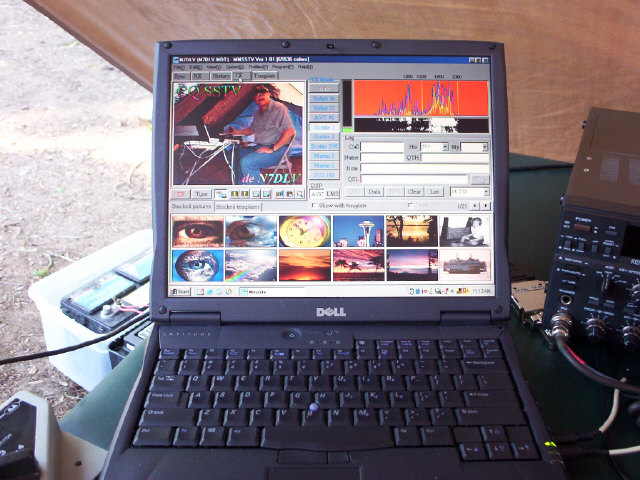
The Slow Scan TV demonstration for additional bonus points. This year I used a lap top I purchased used at the Mike and Key ARC flea market. I am using MMSSTV and a home built interface. You can just see the interface between the computer and the radio. It has full isolation and works great.
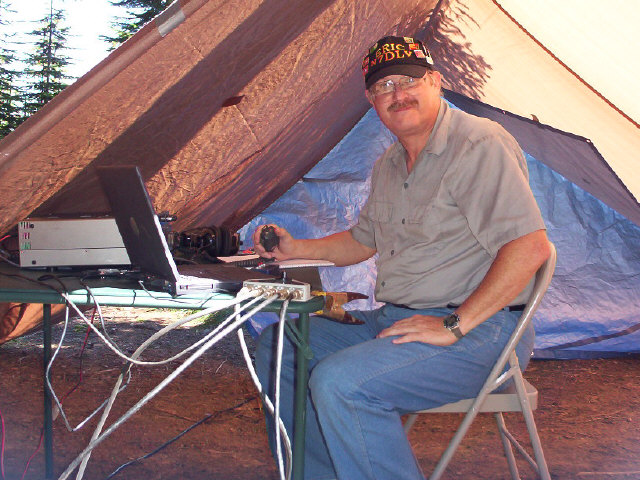
Here is N7DLV at the Field Day station just before Field Day is set to begin. Everything has been checked and is ready to go. The weather this year was much warmer than last year. My total claimed score for this year's Field Day will be 1320 Points. Next time, I'm going to bring a LOUDER alarm clock! What was supposed to be a three hour nap turned out to be seven hours long! LOL
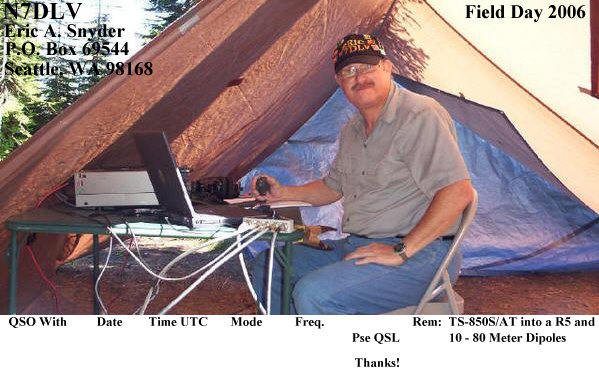
This special Field Day 2006 QSL card will be sent to those stations I need for Worked All States. If you worked N7DLV during Field Day and would like one, please send a SASE. I'll confirm the contact and send one to you.
If you want an interesting challenge, try going out on your own next Field Day. Like me, you might find that it is a lot of fun. Additionally, you will learn your individual limitations and your individual capabilities. Also you will get a better understanding how to set up and operate a portable station on your own. You will be able to make improvements to the Field Day station for better performance in following years. I'm already planning for Field Day 2007!
Questions? Comments? Send me an E-Mail
Back to the Main Page