Horsepower is a great thing, but to get any appreciable amount of horsepower, we need torque.
Torque is a rotary force. Twisting a bolt with a wrench to a torque of 14 ft.-lbs. means the head of the bolt experienced a twisting force of 14 ft.-lbs. Simple, eh?
A 125cc dual-purpose bike might make 14-hp peak, with a peak of 14 ft.-lbs. of torque. A 125cc Motocross bike might also make 14 ft.-lbs. of torque but some how it cranks out 28 hp. Why is that?
HP = Torque X RPM / 5252
Thus we can solve for our 125 dual-purpose machine:
14 = 14 ft.-lbs. x RPM / 5252
Therefore or engine makes it’s peak hp at 5252 RPM
The motocross bike is very peaky and hard to ride. No power on the bottom end but lots up top. We can see why with the math:
28 = 14 ft.-lbs. x RPM / 5252
Therefore our engine makes its peak hp at 10,500 RPM (10504 to be exact.)
For a more entertaining version of this plus more detail about the constant 5252 and where it is derived from, refer to my paper below.
A similar article entitled "Power in Numbers" was featured in the American Thunderbike Club’s monthly publication:
The Weather Report
POWER IN THE NUMBERS
By
CRAIG S. WALKER
It happens all the time during bench racing sessions, after a fast and furious ride or even
sometimes at the coffee machine. " That motor is fast, but all it's got is horsepower, this other machine's got lotsa torque." Or " My engine has great power, it's just not fast at the drag strip." I even once heard something like " My engine doesn't make much power on the dyno, it's got a kind of raw power that those dynos can't measure".
The truth is, if an engine makes power, it will show up on a dynamometer. Dynamometers (dynos) measure power output from engines. They do this by measuring the torque, or twisting force in foot / lbs. at a convenient output shaft (crank shaft or transmission output shaft / countershaft) or rear wheel. The torque is determined through the use of a hydraulic or water brake, eddy current power absorption unit or inertia drum. All of these units force the engine to perform work against a known load. The term brake horsepower comes from premise that a brake affixed to the shaft of an engine could be gradually applied until the rpm is held constant. The brake, if attached to a fixed and floating rod system like old style torque wrenches, will deflect slightly (this was called the prony brake). Through the deflection of the brake arm, torque in foot lbs. can now be read. New brake style dynos use a much higher tech method of measuring the deflection with electro- mechanical sensors. The software compares the engine rpm to torque and calculates the horsepower from these figures. The formula is rather simple but it's roots complex.
Horsepower = Torque x RPM
5252
Where torque is measured in foot / lbs. Rpm is the rpm where the particular torque figure is obtained. 5252 is a constant. This is a standard.
If you notice, when the rpm is equal to 5252 the torque will equal the horsepower. This is always the case, it never changes. Every dyno chart will show the torque and horsepower as being equal at 5252 rpm. If you see a chart that does not look like this, it's a fraud. Don't buy an engine from this person. In fact, I wouldn't recommend buying a used car, motorcycle or cup of coffee from this guy. The numbers are based on simple physics and physics never breaks.
The constant 5252 goes back all the way to the 17
th century. A man named James Watt developed a steam engine to pump water out of coalmines. There was no convenient measurement standard so Watt had to equate his engine to the power of the previous standard, the draft horse. The typical arrangement was a draft horse pulling on a 12-ft. lever affixed to a turnstile (the pump was driven by the turnstile). The pulling force of the horse was estimated to be 180 pounds. The circumference of the twenty four-foot turnstile circle is 75.4 feet. (2 x pi x 12 ft. = 75.398 ft.) A good horse could make 144 revolutions per hour which equals 2.4 revolutions per minute. 2.4 x 75.4 ft. = 180.96 ft. which was rounded up to 181 ft. / min.Watt took the 180 lbs. of force and multiplied it by the 181 feet to get 32,580 lbs.- feet of force per minute. If 32,580 lb.-ft. of force is rounded up to 33,000 and divided by 60 sec. we get 550 lbs.-feet per sec. Thus 550 lbs.-feet per sec was determined to be the average power output of the draft horse.
How does this relate to the modern engine? James Watt had to equate this to his steam engine, which had a crankshaft like a modern engine, to the horse. His engine turned the center of the aforementioned turnstile, not the 12-foot lever. To finish the equation he "affixed " a lever off the crankshaft. For ease of calculation he used one foot as the length. The length of travel of the one-foot lever is:
2 x pi x one ft = 6.283 ft
To relate this to the average horse calculation, the total distance the end of the lever travels in one minute would be 6.283 ft. x rpm. When this figure is multiplied by the torque output of the engine we get the total lbs.-feet of torque per minute. If we divide this by 33,000 (Watt’s figure for lbs.-feet per minute for one horsepower) we will get the horsepower for the given engine. To recap:
Horsepower = 6.283 x RPM x torque
33,000
Simplified we get:
Horsepower = RPM x torque
5252.268
The numbers are still a little too cumbersome so we round 5252.268 to 5252. Hence the simple equation referred to at the opening.
HP = Torque x RPM / 5252
Stuska Model 90 Limits
By
Craig S. Walker
Using this math one can determine an awful lot about an engine. I used this math to determine the theoretical limits of a Stuska Model 90 absorption brake dynamometer. Since the unit was advertised as being capable of sustaining a 200-hp load and requiring 10 gallons of supply water per minute for every 100 hp, one would figure with enough water flow this machine might be able to handle more. Seeing I have a 31-GPM gas powered water pump, I did the math to see what the biggest motor my absorption brake could handle.
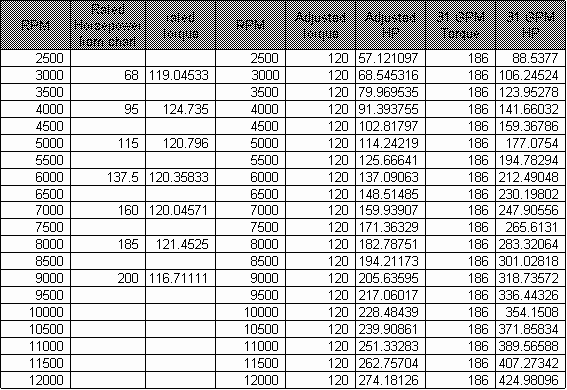
The 31-gpm would seem to equate to 310 hp (10-gpm required per 100-hp). But noting the published curves I saw 200 hp occurred at 9,000 rpm. The unit is good for 12,000+. I extrapolated the torque required for the published absorption curve and derived the following:
The chart below shows the hp capacity in an easy to comprehend format.
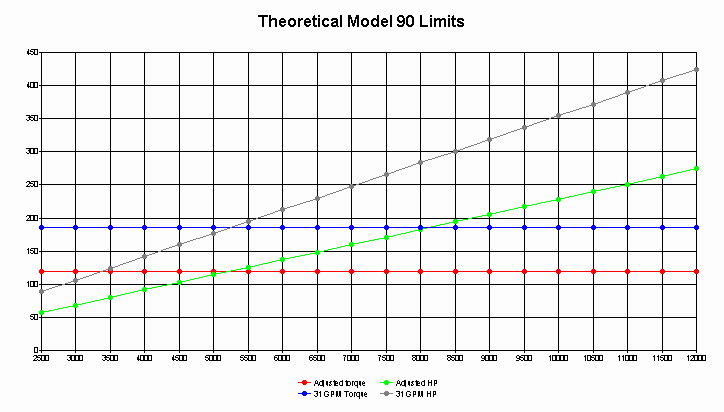
Knowing the math helped determine the capabilities of this machine long before trying to put an engine on the dyno that was too powerful. It also showed me that the unit was severely under estimated.